澳洲不僅在提供國際教育方面卓越出色,更為學生創造建立全球人脈的絕佳機會。多年來,澳洲教育機構始終以注重實務學習與全面理解各學科為核心理念,持續滿足學生的發展需求。
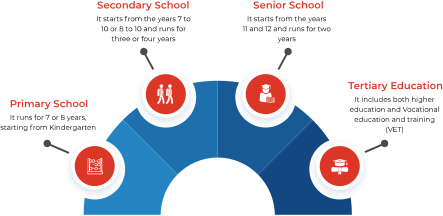
與其他國家相似,澳洲教育體系主要分為三大階段—小學、中學/高中,以及高等教育。
澳洲職業教育與培訓(VET)受澳洲資格架構(AQF)規範,提供以實務及產業為導向的教育。VET院校通常稱為技術與繼續教育(TAFE)機構,提供從證書到高級文憑等一系列受全國認可的課程。這些課程旨在讓畢業生具備就業競爭力,符合國內外產業標準。
澳洲在職業教育培訓領域以其最佳實踐而享譽國際,因其注重個人能力養成的評估,並專注於培養與技術專業領域相關的技能發展。
對於希望進入澳洲大學的學生而言,大學預科課程是絕佳選擇之一。這類課程專為國際學生設計,讓學生在完全認可的專業課程中完成大學預科學習,通常最多為期一年。
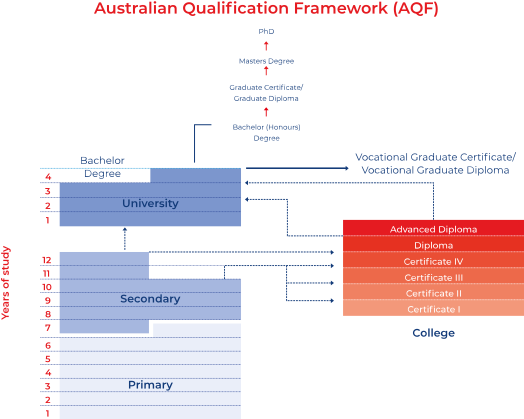
澳洲學歷資格框架由澳洲政府於1995年設立,旨在確保全國資格名稱的一致性,並代表相同的優質教育標準。
該架構涵蓋所有澳洲學歷資格,對每項學歷資格所代表的教育級別訂有明確規範。這為國際學生帶來諸多益處,使他們能根據需求尋找最適合的課程與機構,無需耗費時間理解不同的學歷資格名稱。
攻讀AQF認證資格的國際學生可完全放心,其就讀機構均受政府認可並通過國家認證,所獲學位皆為正規有效。
身為國際學生,必須選擇在CRICOS(海外學生院校及課程註冊系統)註冊的教育機構就讀。該註冊系統由澳洲政府教育部管理,授權教育機構向持有學生簽證在澳就讀或計劃留學的海外學生提供課程。
澳洲教育體系分為四個主要層級:小學教育、中學教育、職業教育與培訓(VET),以及高等教育。
小學教育通常包含學前班至六年級,而中學教育則從七年級延伸至十二年級。
在中學教育階段,學生需接受考試、作業及課程作業等評量,這些成績將計入最終評分,並作為申請高等教育資格的依據。
ATAR是澳洲多數省份採用的排名系統,用於評估學生在高中最後一年的學業表現,並作為大學入學申請的審核依據。
澳洲高等教育包含學士學位、研究生文憑、碩士學位及博士學位。
學士學位通常需修業三至四年,具體時間取決於所選修的學科領域以及是否能獲得先前學習經驗的學分抵免。
主要入學時間通常為二月/三月及七月,部分機構另於十一月提供較小規模的入學梯次。
高等教育的評量通常包含考試、論文、研究專題、小組報告及實務評估等,具體形式依課程要求而有所不同。
澳洲大學為國際學生提供多元支援服務,包含新生導航課程、課業輔導與諮詢服務等。
可以,若課程期間超過原簽證有效期,您可以申請學生簽證延長。請務必於現行簽證到期前提出申請。
VET refers to post-secondary education and training that focuses on providing practical skills and knowledge for specific industries or occupations. It includes courses and qualifications that are designed to prepare students for the workforce.
VET courses are offered by a wide range of institutions, including Technical and Further Education (TAFE) institutes, private training providers, and some universities. TAFE institutes are government-run institutions that specialise in vocational training.
The VET system offers a variety of qualifications, including Certificates (I to IV), Diplomas, Advanced Diplomas, and Vocational Graduate Certificates/Diplomas. These qualifications are nationally recognised and can lead to specific job outcomes.
The duration of VET courses can vary depending on the level of qualification and the field of study. Certificate courses may range from a few months to a year, while higher-level qualifications like Diplomas and Advanced Diplomas can take one to two years.
Yes, international students can study VET courses in Australia. There are many VET providers registered to offer courses to international students, and they must apply for a student visa to study in Australia.
Entry requirements can vary depending on the course and the institution. Generally, applicants need to meet the minimum age requirement and demonstrate the required level of English language proficiency. Some courses may have additional prerequisites.
VET qualifications issued by registered Australian training providers are highly regarded and recognised both nationally and internationally. They are designed to meet industry standards and often lead to job opportunities in Australia and overseas.
Yes, many VET qualifications can be used as a pathway to university. Students who complete a VET diploma or advanced diploma may be eligible for credit transfer towards a related higher education degree.
The cost of VET courses for international students can vary depending on the course and the institution. International students are required to pay full tuition fees, and the cost will depend on the duration and level of the course.
Australian citizens and permanent residents may be eligible for government-funded VET courses, which can reduce the cost of tuition. However, international students generally do not have access to such funding.
VET graduates may be eligible to work in Australia after completing their courses. Depending on the occupation and the qualifications obtained, they may be able to apply for skilled migration or other work visas.
VET institutions in Australia typically offer support services to students, including academic support, career guidance, counselling, and assistance with job placements.
In some cases, students may be able to transfer between VET institutions or change courses. However, this is subject to the policies of the respective institutions and the recognition of prior learning (RPL).
The Australian Skills Quality Authority (ASQA) is the national regulator for the VET sector. It is responsible for ensuring the quality and standards of VET courses and providers.
Yes, VET courses are eligible for the Australian Government’s JobTrainer program, which provides subsidies for selected courses to help individuals gain new skills and improve their employability.
Foundation Studies are preparatory courses designed to provide international students with the necessary academic and English language skills to succeed in higher education in Australia.
Foundation Studies are suitable for students who do not meet the entry requirements for direct entry into an undergraduate degree program in Australia or need to improve their English language proficiency.
Foundation Studies programs generally cover core subjects such as English language, mathematics, science, and social sciences. They may also include subject-specific modules related to the student’s intended field of study.
Foundation Studies programs typically run for one year (two semesters) full-time. However, some institutions may offer shorter or longer duration programs based on individual student needs.
Foundation Studies are offered by many universities and private colleges across Australia. Students should research and choose an institution that best aligns with their academic goals and location preferences.
Some universities may offer credit recognition for completing Foundation Studies, but this depends on the institution and the specific course you plan to pursue afterwards. It’s best to enquire directly with the university.
While Foundation Studies are designed to improve English language skills, students are generally expected to have a basic level of English proficiency to start the program. Language requirements may vary by institution.
Assessment methods may include exams, essays, projects, presentations, and practical assessments. The assessment structure varies depending on the program and institution.
International students enrolled in full-time Foundation Studies programs may be eligible to work up to 48 hours per fortnight during the academic year and unlimited hours during scheduled breaks.
Scholarships for Foundation Studies may be available at some institutions, but they are less common compared to undergraduate or postgraduate scholarships. Students should check with their chosen institution for any available financial assistance.
The application process for Foundation Studies is similar to applying for other courses in Australia. Students should submit an application directly to their prefered institution along with the required documents.
Yes, international students enrolling in full-time Foundation Studies programs are eligible to apply for a student visa (subclass 500) to study in Australia.
Yes, all international students in Australia, including Foundation Studies students, are required to have Overseas Student Health Cover (OSHC) for the duration of their visa.
Yes, upon successful completion of Foundation Studies, students can apply for entry into undergraduate or diploma programs at their chosen university, provided they meet the necessary entry requirements.
There are generally no specific age restrictions for Foundation Studies. However, some institutions may have their own age criteria for admission.
The Australian Qualifications Framework (AQF) is a national framework that ensures the quality and consistency of qualifications across the Australian education and training system. It covers qualifications from primary school through higher education and vocational education and training (VET).
The key features of the AQF include a set of 10 qualification levels, which are based on learning outcomes, and a system of credit points that allows for recognition of prior learning and credit transfer between qualifications.
The AQF comprises 10 qualification levels, ranging from Level 1 (Certificate I) to Level 10 (Doctoral Degree).
The AQF aims to provide a nationally consistent and easily understood framework that supports lifelong learning and facilitates pathways between different education and training sectors.
The Australian Qualifications Framework is overseen by the Australian Government’s Department of Education, Skills, and Employment.
The AQF sets standards for qualifications, and each qualification level specifies the learning outcomes that students should achieve. Providers must meet these standards to offer AQF qualifications.
In some cases, international qualifications can be recognised and mapped to the appropriate AQF level. This process is known as recognition of overseas qualifications.
Recognition of Prior Learning (RPL) allows individuals to receive credit for their skills and knowledge gained through work experience, previous study, or other learning experiences. RPL can be used to gain credit towards a formal qualification.
The AQF qualification specifications, which outline the learning outcomes and requirements for each qualification level, are available on the AQF website.
Yes, the AQF is designed to facilitate pathways between different qualification levels, allowing individuals to progress from one level to another based on their learning achievements and career aspirations.
Yes, to issue AQF qualifications, education and training providers must meet specific requirements set out in the AQF.
Yes, AQF qualifications are widely recognised by employers in Australia and internationally as a measure of a person’s skills and knowledge.
The AQF plays a crucial role in the VET sector by setting standards and learning outcomes for VET qualifications. It ensures that VET qualifications are nationally consistent and meet industry needs.
Yes, the AQF covers higher education qualifications, including undergraduate and postgraduate degrees, and ensures that they are aligned with the same set of qualification levels and learning outcomes.
Yes, the AQF can be used to compare Australian qualifications with those from other countries’ education systems through the use of tools like the Australian Qualifications Framework (AQF) Recognition Database (AEI-NOOSR).
CRICOS registration is a process through which educational institutions in Australia are registered to offer courses to international students.
CRICOS registration is essential because it ensures that international students are studying at approved institutions that meet certain quality standards set by the Australian Government.
All educational institutions in Australia that wish to enrol international students on a student visa need to obtain CRICOS registration.
Institutions can apply for CRICOS registration through the Australian Skills Quality Authority (ASQA) or the Tertiary Education Quality and Standards Agency (TEQSA), depending on their level of education.
Eligibility criteria for CRICOS registration include meeting specific quality standards, having appropriate facilities, and demonstrating financial viability.
The CRICOS registration process can take several months, depending on the completeness of the application and other factors.
No, institutions can only offer courses that have been approved and registered on CRICOS. Each course must have a CRICOS code.
A CRICOS code is a unique identification code assigned to each registered course. It helps identify the course for international students during the visa application process.
Students can verify an institution’s CRICOS registration status by visiting the official CRICOS website and searching for the institution or course using its name or CRICOS code.
CRICOS registration ensures that international students have access to certain protections, including the Tuition Protection Service (TPS) and access to government services.
The TPS is a government initiative that provides safeguards for international students in the event that their education provider ceases to operate.
Yes, institutions can lose their CRICOS registration if they fail to meet the required quality standards or violate the rules and regulations set by the Australian Government.
No, CRICOS registration and accreditation are different processes. CRICOS registration is specific to enrolling international students, while accreditation relates to the quality and standards of education.
Yes, institutions can offer online courses under CRICOS registration, but they must meet specific requirements and quality standards for online delivery.
Institutions need to follow the renewal process outlined by the relevant regulatory authority to extend their CRICOS registration.
Yes, institutions can update their CRICOS registration to include new courses, but they must ensure that the courses meet the required standards and receive approval.
Yes, in some cases, institutions may be granted provisional CRICOS registration, allowing them to offer courses to international students temporarily.
Yes, institutions are required to pay fees for CRICOS registration and renewal. The fee structure may vary depending on the type and size of the institution.
Yes, institutions that are CRICOS registered are allowed to advertise this status to inform potential international students. Note: Get latest updates from official website: https://cricos.education.gov.au/
AQF Levels help students make informed decisions about their education pathways and career choices. They also make it easier for students to move between different levels of education and transition into the workforce.
Here is a breakdown of what each AQF Level generally represents:
Level 1 7-9 Elizabeth Street, Melbourne, Victoria, Australia
282 B, Clayton Road, Clayton, Victoria - 3168, Australia
244, Lonsdale street, Dandenong, Melbourne - 3175
Level 2, 203 Palmers Road, Truganina, Victoria 3029
Level 1, Suit 1, 27 Ringwood Street, Ringwood, Victoria - 3134.
Suite 1 & 2/12 Bankstown City Plaza, Bankstown, NSW 2200
120 A, Herring Road, Macquarie Park, NSW 2113
Unit 1, 556 Princess Highway, Rockdale, NSW, 2216
Suite 4/179-181 Keira Street, Wollongong NSW 2500
Suite 1, Level 14, 116 Adelaide Street, Brisbane, QLD - 4000, Australia
2 / 1957, Logan Road, Upper Mount Gravatt QLD 4122
Level 3/86 Gawler Place, Adelaide 5000, Australia
15B, Level 1/1 Main Street, Mawson Lakes, Adelaide 5095
Unit 2, 1069 South Road, Melrose Park SA 5039
Level 1, 355 Newcastle Street, northbridge, WA 6003
Level 1, 53-55 Northbourne Avenue, Canberra City - 2601
1st Floor, Central Business Space, Opp Sukhsagar Complex, Nr. Fortune Landmark Hotel, Ashram Road, Usmanpura, Ahmedabad, Gujarat - 380013, India
2nd Floor, Bahuchar Complex Opp Surya Complex, ST Workshop Road, Mehsana, Gujarat - 384002 India
1st floor, 105 Atlantis, Near, Genda Cir, Vadodara - 390002
No.4, Vijaya Towers, 5th Floor, Kodambakkam High Rd, Opp to Gemini Parson Complex, Tirumurthy Nagar, Nungambakkam, Chennai, Tamil Nadu 600034
Office 2904 HDS Tower, Cluster F , Jumeirah Lake Towers, Dubai, UAE
Unit 1508, Star House, 3 Salisbury Rd, Tsim Sha Tsui, Hong Kong
UNIT #449, 2 County Court Blvd, Brampton, ON L6W 3W8