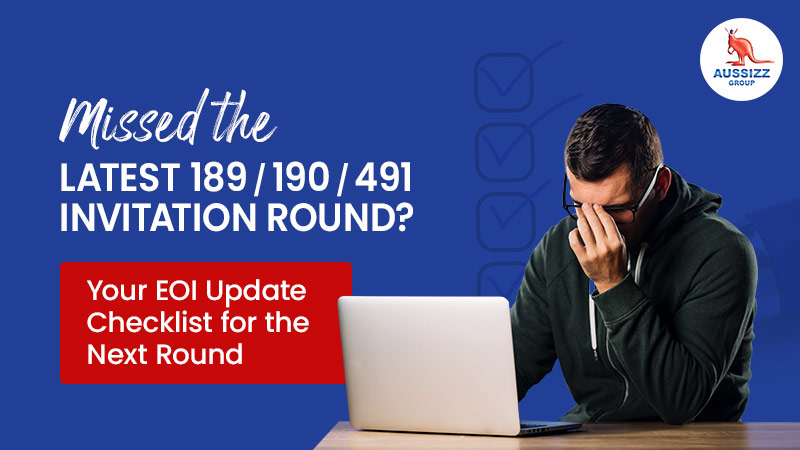
Missed the Latest 189/190/491 Invitation Round? Your EOI Update Checklist for the Next Round
When an invitation round is published, most applicants do one thing first: they check the results.
The more important step comes next.
For applicants who were not invited in the latest SkillSelect round, the smartest move is usually not to wait and hope. It is to review and update the Expression of Interest (EOI) so the profile is accurate, competitive and ready before the next round.
This matters because Australia’s Subclass 189, 190 and 491pathways are points-tested, and an applicant must submit an EOI before they can be invited to apply. Home Affairs also states that meeting the minimum points threshold does not guarantee an invitation.
Important distinction: This blog is written for applicants who missed a round and are still waiting in the pool. Home Affairs states an EOI can be updated before an invitation is received, but it cannot be updated after an invitation is issued.
Aussizz Group has helped 200,000+ applicants move closer to their Australian Dreams, and this checklist is designed to help applicants take the right action immediately after a round rather than losing time between rounds.
Why Missing a Round Should Trigger an EOI Review, Not Just More Waiting
A missed invitation round can feel like a result. In practice, it should be treated as a strategy checkpoint.
After each round, an applicant usually has better visibility on:
whether the current points score is likely competitive,
whether the nominated occupation appears active,
whether an alternative pathway (190 or 491) should be prioritised,
Home Affairs specifically advises applicants to keep their EOI up to date and update it when circumstances change, because those changes may affect the points score.
That makes a post-round EOI review a practical optimisation step, not just admin work.
EOI Updates Are Allowed Before Invitation, Not After Invitation
This is the most important rule to get right.
Many applicants confuse:
“after an invitation round” (the round result is published), with
“after receiving an invitation” (the applicant personally got invited).
Home Affairs is clear that applicants can access and update the EOI before receiving an invitation, and cannot update it after receiving one.
Home Affairs also states that if invited, applicants generally have 60 days from the invitation date to complete and submit the visa application online through ImmiAccount.
What this means in practice
Not invited in the latest round: update and optimise the EOI now.
Already invited: stop EOI editing and move to visa lodgement preparation within the deadline.
This distinction is exactly why a “post-invitation round checklist” is most useful for applicants still waiting in the pool.
Start With a Clean EOI Audit Before Making Any Changes
Before changing anything, the best approach is to do a quick audit of the existing EOI and compare it against the applicant’s current situation.
The goal is simple: confirm whether the EOI still reflects the applicant’s current, provable profile.
Home Affairs notes that SkillSelect gives an indicative points score based on the information entered in the EOI. That is why accuracy matters just as much as ambition.
English Test Updates Should Be Reviewed First After a Missed Round
Home Affairs includes improved English language proficiency as a valid reason to update an EOI.
This is one of the biggest missed opportunities after a round.
What applicants should check
Has a new English result been received since the EOI was last updated?
Does the EOI claim match the latest valid result exactly?
Is a re-test likely to improve points in the near term?
Is the current claim under-stated or over-stated?
Even when the improvement looks small, English can influence competitiveness significantly because English language proficiency is part of the points-tested framework for 189/190/491.
For many applicants who missed a round, English is the fastest realistic lever to review.
Work Experience Date Milestones Can Change Competitiveness
Home Affairs also specifically lists new work experience as an update trigger.
This is important because many EOIs sit unchanged while applicants continue gaining experience.
Post-round work experience checks should include
whether another eligible experience period has been completed,
whether employment dates were entered correctly,
whether there is a new employer or promotion to add,
whether the role still aligns with the nominated occupation,
and whether evidence is ready to support the claim.
A missed round does not always mean the occupation is the problem. Sometimes the profile is simply one update behind.
Completed Qualifications and Study Outcomes Should Be Reflected Promptly
Home Affairs states that applicants should update the EOI if they have received a higher education qualification.
That means a missed round is the right time to ask a strategic question:
Is the applicant relying on one pathway when a broader EOI strategy is needed?
Common examples:
Waiting only for 189 when 190 or 491 may be more practical
Not reviewing state/territory nomination readiness
Not adjusting strategy after repeated rounds without movement
A post-round EOI checklist should not only focus on data fields. It should also review pathway positioning.
This is where a strong migration strategy moves from passive waiting to active optimisation.
Contact Details and Identity Details Are Small Fields With Big Consequences
Some applicants focus heavily on points but ignore basic EOI details.
After a missed round, it is worth checking:
email address access,
phone number accuracy,
passport details,
spelling consistency of names,
and date of birth consistency across records.
These details may seem simple, but they affect communication readiness and can create avoidable stress when an invitation does come.
Build an Evidence Checklist for Every Claimed Point Before the Next Round
An EOI should not be treated as a best-case estimate. It should be a profile the applicant can support.
Because SkillSelect provides an indicative points score based on what is entered, applicants should make sure every point claimed is backed by evidence.
A practical post-round evidence checklist should cover
This step improves both accuracy and confidence. It also reduces the risk of scrambling after an invitation.
Why EOI Timing Matters Even If the Score Stays the Same
After missing a round, many applicants focus only on increasing points. That helps, but timing also matters.
Home Affairs’ invitation rounds framework applies a tie-break for EOIs with equal points based on the time and date the EOI reached its score (commonly referred to as the date of effect). This is reflected in Home Affairs invitation round information and tie-break reporting.
Practical implication for applicants who were not invited
If a valid points increase is available, delaying the EOI update can delay competitiveness at the new score.
If no points increase is available yet, keeping the EOI accurate and ready still protects the profile for future rounds.
In a tie-break environment, waiting without action can become a silent disadvantage.
A Practical Post-Round EOI Checklist for Applicants Who Were Not Invited
The best post-round strategy is simple and repeatable.
Same-Day EOI Review Checklist
Confirm the applicant was not invited and is still in the pool
Check whether the EOI is still active and relevant
Review current claimed points honestly
Verify occupation and visa subclass selections
Check English, work experience, qualifications and skills assessment entries
Confirm family and contact details are current
Home Affairs states an EOI remains active in SkillSelect for 2 years from submission, which makes regular review important over a long waiting period.
Next-Step Optimisation Checklist
Plan English retest (if realistic and strategic)
Update new experience/qualification milestones
Review 190/491 pathway suitability alongside 189
Organise evidence for each claimed point
Get a professional EOI review if the profile is borderline, complex or repeatedly missing rounds
This is how applicants turn a missed round into progress.
The Most Common Mistakes After Missing an Invitation Round
Treating the round as information only
Many applicants analyse results but do not update their own EOI.
Keeping outdated details in the EOI
An old English score, missing qualification, incorrect experience date or unchanged family details can weaken the profile or create later complications.
Waiting for a “perfect score” before updating anything
This often delays competitiveness and can work against applicants in tie-break situations.
Assuming the minimum points threshold means an invitation is likely
Home Affairs is clear that meeting the minimum threshold does not guarantee an invitation.
Staying locked into one subclass strategy
Applicants sometimes keep waiting on one pathway while stronger opportunities may exist under another points-tested route.
What to do after a Missed 189/190/491 Round
A missed round should not be treated as a dead end.
It is a prompt to:
clean up the EOI,
improve what can be improved,
and position the profile better for the next round.
For applicants in the SkillSelect pool, the strongest progress often happens between rounds, not on the day results are published.
That is the real purpose of a post-round EOI checklist.
FAQs
Q1. Can an applicant update the EOI after missing an invitation round?
Yes. Home Affairs states applicants can access and update the EOI any time before they receive an invitation.
Q2. Can an applicant update the EOI after receiving a personal invitation?
No. Home Affairs states the EOI cannot be updated after an invitation has been received.
Q3. What should be updated first in a SkillSelect EOI after a missed round?
The highest-priority areas are usually English results, work experience, qualifications, skills assessment details and family changes, all of which Home Affairs recognises as valid update triggers.
Q4. Does improving English help after missing a round?
It can, because English language proficiency contributes to points in points-tested skilled visas.
Q5. Is 65 points enough to get invited for 189/190/491?
Not necessarily. Home Affairs states applicants need to meet or exceed the threshold of 65 for these visas, but meeting the minimum does not guarantee an invitation.
Q6. How long does an EOI stay active in SkillSelect?
Home Affairs states an EOI remains active for 2 years from submission.
Q7. Why does EOI timing matter at the same points score?
Because Home Affairs applies a tie-break for equal-point EOIs based on when the EOI reached that score/date of effect.
Q8. How long does an invited applicant get to lodge the visa application?
Home Affairs states invited applicants generally have 60 days from the invitation date to submit the visa application online.
Book a Consultation with Aussizz Group
Aussizz Group has helped 200,000+ applicants move closer to their Australian Dreams.
Book a consultation with Aussizz Group to get a personalised EOI review and build a stronger migration strategy based on accuracy, timing and optimisation.

 AUS
Australia
AUS
Australia
 IND
India
IND
India
 UAE
UAE
UAE
UAE
 CA
Canada
CA
Canada
 SL
Srilanka
SL
Srilanka
 HK
Hong Kong
HK
Hong Kong