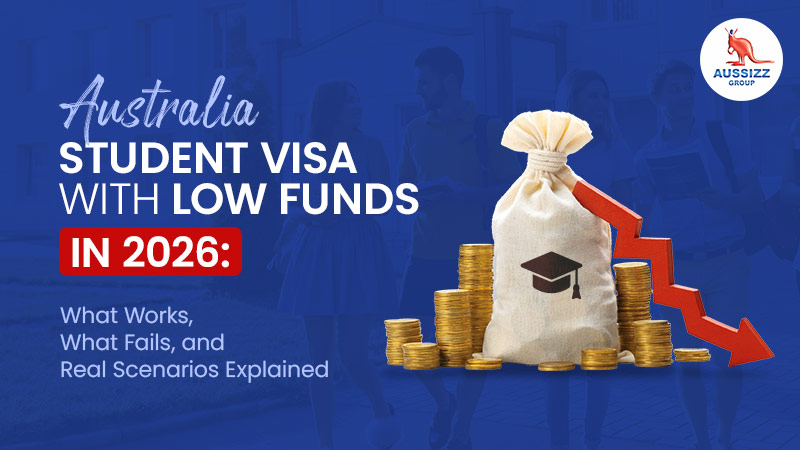
Australia Student Visa with Low Funds in 2026: What Works, What Fails, and Real Scenarios Explained
A lot of students ask the same question before applying: can I get an Australian student visa with low funds?
The honest answer is: sometimes, but not if the financial story looks weak, unclear, or unrealistic. In 2026, the issue is not only whether your bank balance looks small. The real issue is whether you can prove that enough money is genuinely available for your tuition, living costs, travel, and any dependants, and whether the rest of your application still looks like a genuine student case. Home Affairs says student visa applicants must have sufficient funds available for their stay in Australia, and some other sources says international student visa applicants must provide proof of at least AUD 29,710 for living costs, with more needed for accompanying family members and course-related expenses.
That means “low funds” does not always mean automatic refusal. But it also does not mean you can lodge with a weak account balance and hope the case officer ignores it. A student visa file becomes stronger when the funds are traceable, the sponsor is credible, the course choice makes sense, and the application is lodged as a decision-ready file with the right supporting documents. Home Affairs explicitly tells applicants to check the document checklist, upload a current CoE, include English evidence if required, and submit a complete application the first time.
What “low funds” really means in a student visa case
Many applicants use the term “low funds” very loosely. Sometimes they mean they do not personally have large savings. Sometimes they mean their parents are sponsoring them. Sometimes they mean they can show money, but only recently. And sometimes they mean they can cover tuition, but not clearly show the full living-cost requirement.
That distinction matters because Home Affairs is not simply asking whether you personally are rich. It is assessing whether sufficient funds are genuinely available for your stay and whether the financial evidence supports the story you are telling in the application. Under the Genuine Student requirement, case officers also look at your current circumstances, why you chose the course and provider, and how the course will benefit you. So weak funds combined with weak course logic or weak GS responses can make the whole file riskier.
The current 2026 financial benchmark students should understand
Before looking at real scenarios, it helps to understand the baseline numbers applicants are commonly working with.
Student visa financial capacity guide
Cost area
Amount commonly referenced for current applications
Main student living costs
AUD 29,710
Partner / spouse or de facto partner
AUD 10,394
Dependent child
AUD 4,449
Annual school costs for a school-aged child
AUD 13,502
These figures reflect the updated financial capacity requirement introduced from 10 May 2024, and they continue to be referenced in current official guidance for student visa applications. Study Australia also repeats the AUD 29,710 minimum proof figure for student applicants.
This is exactly why “low funds” is not a simple yes-or-no issue. If a student says, “I only have AUD 8,000 in my account,” that is not enough information by itself. The case officer would still want to know:
Who is paying tuition?
Who is paying living costs?
Are there parents or sponsors?
Are the funds recent or stable?
Does the file explain the source clearly?
Is the course and GS story otherwise strong?
A small personal balance is not always fatal if the sponsor story is strong
This is one of the most common real-life scenarios.
A student may not personally hold a large amount of money, but their parents or a close family sponsor may be funding the studies. That can still work if the sponsor relationship is clear, the sponsor’s financial capacity is believable, and the documents actually support the claim. Home Affairs’ guidance focuses on whether sufficient funds are available, not only whether they sit in the student’s own account.
Scenario 1: Low funds in the student’s account, but strong parental support
Profile
Risk level
Why it may still work
Student has limited personal savings
Medium
Not fatal by itself
Parents are sponsoring
Lower if well documented
Sponsor relationship can support the file
Stable income / savings evidence from sponsor
Lower
Supports genuine financial capacity
Course and GS logic are strong
Lower
Helps the whole file look credible
In plain language, this type of case is not refused just because the student’s own account looks small. It becomes workable when the sponsor documents are clear, the relationship is proven, and the financial position looks stable rather than artificial.
Recently deposited funds are much riskier than genuinely held funds
One of the biggest problems in student visa finance cases is the “sudden money” issue. A file may show the required amount on paper, but if the balance appears only shortly before visa lodgement and the source is unclear, it can still look weak. This is where many applicants misunderstand the process. They think showing the number is enough. It often is not.
Home Affairs says more weight is given to statements supported by evidence, and the department encourages decision-ready applications with proper supporting documents. A weakly explained bank balance does not automatically look genuine just because it hits the minimum figure.
Scenario 2: Full funds shown, but only just before lodgement
Profile
Risk level
Main issue
Bank balance looks sufficient
Medium to High
Number alone is not enough
Large recent deposit
High
Source may look unclear
No clear supporting explanation
High
Can damage credibility
Weak GS and course logic too
Very High
Multiple concerns combine
This is why some “technically funded” cases still fail. The application may meet the number on the surface, but the story behind the number is not convincing.
Tuition covered but living costs not properly supported is still a weak case
Another very common misunderstanding is this: “I have paid tuition, so the rest should be okay.”
That is not how the student visa test works. Home Affairs and Study Australia both make it clear that financial capacity is broader than tuition. The applicant needs to show enough money for the stay in Australia, including living expenses, and where relevant, travel and dependant costs as well.
Scenario 3: First-semester fee paid, but no strong living-cost evidence
This type of profile often looks better than it really is. Paying the tuition deposit can help show seriousness, but it does not replace the need to show broader financial capacity. If the rest of the funds position is weak or unclear, the case can still become risky.
The best way to think about this is simple: tuition shows commitment to the course, but living-cost evidence shows you can realistically stay and study in Australia. Both matter.
Low funds become more dangerous when the rest of the profile is already weak
A borderline finance case can sometimes still be manageable. But when low funds are combined with a weak course choice, a generic GS response, missing English evidence, or poor documentation, the refusal risk rises sharply.
Under the Genuine Student requirement, applicants must show they are genuine students and that studying in Australia is the primary reason for applying. The application form asks about current circumstances, why the course and provider were chosen, and how the course will benefit the applicant. Home Affairs also prefers responses in the form itself, supported by evidence.
When “low funds” becomes a major red flag
Combined issue
Why it is risky
Low or unclear funds + weak course progression
Looks less like a genuine study plan
Low or unclear funds + generic GS responses
Reduces overall credibility
Low or unclear funds + incomplete documents
Makes the file look rushed or unprepared
Low or unclear funds + work-heavy narrative
Can make study look secondary
Low or unclear funds + unexplained study gaps
Raises more questions than answers
This is why there is no safe one-line answer to the question “Can I apply with low funds?” A weaker funds profile can sometimes survive in a strong case. In a weak case, it often becomes the deciding problem.
Can an education loan or sponsor help if personal funds are low?
In many practical cases, yes. The key question is not whether the student alone has cash sitting in a savings account. The key question is whether the overall financial arrangement is real, available, explainable, and properly documented.
That can include parental support, close-family support, or other acceptable financial evidence that fits the applicant’s circumstances. Study Australia explicitly notes that there are a range of options to prove financial capacity. But whichever option is used, it still needs to be credible and consistent with the rest of the application.
The strongest low-funds cases usually share the same features
Some lower-funds or borderline-funds profiles do get approved. Usually, they are not approved because the finances were ignored. They are approved because the case as a whole was well structured.
What makes a lower-funds profile more workable?
Stronger factor
Why it helps
Clear sponsor relationship
Makes the financial story believable
Traceable source of funds
Reduces doubt around money movements
Sensible course progression
Supports Genuine Student credibility
Specific GS responses
Shows this is a genuine study plan
Complete document pack
Helps the case look decision-ready
Current CoE and required evidence
Avoids avoidable refusal issues
Home Affairs says applicants should lodge a current CoE, use the Document Checklist Tool, include English evidence where required, and respond quickly to information requests. These basics matter even more when the finance side of the file needs careful handling.
Real scenarios: when low funds may work and when they usually do not
Quick comparison of common low-funds situations
Scenario
Can it work?
Practical view
Student has low own savings, but parents have stable and well-documented funds
Often yes
Usually workable if the file is clean
Student shows required amount only through a last-minute deposit
Sometimes, but risky
Needs very strong source explanation
Tuition is paid, but living-cost evidence is weak
Risky
Tuition alone is not enough
Student has low funds and a weak GS/course story
Usually difficult
Multiple refusal risks combine
Student has modest funds but a strong sponsor, clear career logic and complete documents
Often more workable
Whole-file strength matters
This is the most useful way to understand the topic. Low funds do not automatically mean no visa. Weakly explained funds often do.
What applicants should do before lodging if funds are tight
The safest move is not to rush the application. If funds are borderline, the rest of the file needs to be especially clean. That means checking whether your course choice is logical, your GS answers are personal and specific, your sponsor documents are complete, and your financial evidence is properly traceable.
Home Affairs also requires applicants to upload a current CoE and says complete applications are more likely to get faster outcomes. It warns students to check twice before submitting because missing or poor-quality information can delay the case or lead to refusal.
Aussizz Group has helped 200,000+ applicants to their Australian Dreams, and this is exactly where proper guidance matters. A low-funds case should never be prepared casually. If you want to know whether your Australia student visa profile is financially strong enough for 2026, book a consultation with Aussizz Group and get your case assessed before you apply.
FAQs
Q1. Can I get an Australian student visa with low funds?
Sometimes, yes. But the application still needs to show that sufficient funds are genuinely available for tuition, living costs, travel, and dependants if applicable. A weak or unclear financial story can increase refusal risk.
Q2. How much money do I need to show for an Australian student visa in 2026?
Current official guidance commonly refers to AUD 29,710 for the main student’s living costs, with extra amounts for a partner, dependent children, and school costs where relevant.
Q3. Can my parents sponsor my student visa application?
Yes, parental sponsorship can support a student visa case if the relationship and financial capacity are properly documented and the money is genuinely available.
Q4. Is paying tuition enough for student visa approval?
No. Tuition helps, but applicants also need to show broader financial capacity for living expenses and related costs.
Q5. Are sudden deposits risky in a student visa application?
They can be. A recent large deposit without a clear source explanation can make the financial evidence look weak or artificial, especially if the rest of the file is also weak. This is an inference based on Home Affairs’ emphasis on evidence-backed claims and decision-ready applications.
Q6. What is the Genuine Student requirement?
The Genuine Student requirement applies to student visa applications lodged on or after 23 March 2024. Applicants must show they are genuine students and that studying in Australia is the primary reason for applying.
Q7. What documents help prove financial capacity for a student visa?
Home Affairs and Study Australia indicate that applicants need evidence showing sufficient funds are available, and that there are different ways to prove financial capacity depending on the case. Applicants should follow the official document checklist for their circumstances.
Q8. Does a stronger GS statement help if funds are borderline?
It can help the whole case look more credible, but it does not replace the need to show sufficient funds. A strong student visa case usually needs both believable finances and believable study intent.
Q9. Is OSHC still compulsory for student visa approval?
Yes. Study Australia says students must have Overseas Student Health Cover for the duration of their stay, and if proof is not provided, the visa application will be refused.
Q10. What is the safest way to apply if my funds are not very strong?
The safest approach is to avoid rushing. Build a clear sponsor and finance story, make sure the course choice and GS responses are logical, and lodge a complete, decision-ready file with the correct supporting documents.

 AUS
Australia
AUS
Australia
 IND
India
IND
India
 UAE
UAE
UAE
UAE
 CA
Canada
CA
Canada
 SL
Srilanka
SL
Srilanka
 HK
Hong Kong
HK
Hong Kong