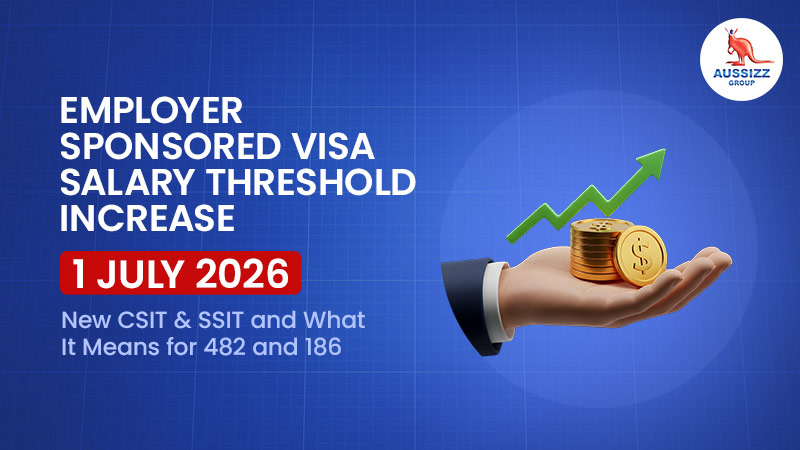
Employer Sponsored Visa Salary Threshold Increase (1 July 2026): New CSIT & SSIT and What It Means for 482 and 186
From 1 July 2026, Australia’s employer sponsored visa salary thresholds are set to rise again. This matters if you’re planning an employer-sponsored nomination (or negotiating a job offer) for visas like Skills in Demand (subclass 482) or Employer Nomination Scheme (subclass 186)-because if the salary doesn’t meet the minimum threshold (and the market salary rate), the nomination usually can’t proceed.
In plain language: even if you have the right job and the right occupation, the salary has to meet the new minimum from July 2026.
Aussizz Group has helped 200,000+ applicants move closer to their Australian dreams. This guide explains the change clearly-what’s increasing, who it affects, and what to do if your salary offer is close to the line.
What is the salary threshold and why does it keep increasing?
For employer-sponsored skilled visas, Australia uses minimum income thresholds as a safety and integrity measure-so sponsored workers aren’t underpaid and the system targets genuinely skilled roles.
These thresholds are indexed each year in line with wage movement data (AWOTE-Average Weekly Ordinary Time Earnings). The Australian Bureau of Statistics (ABS) published the November 2025 AWOTE release on 26 February 2026, which shows annual growth around the high-3% range, and this is what the indexation is based on.
The key point: July updates are normal. The big mistake is assuming “my salary is fine” without checking which financial year threshold applies to your nomination lodgement date.
Current threshold vs 1 July 2026 threshold (the headline numbers)
Australia currently uses two main thresholds for the 482 program:
Multiple professional migration updates note that the 186 salary floor is aligned with the “core” threshold settings used for employer sponsored pathways, meaning the July 2026 increase matters for many 186 nominations as well.
What about subclass 494 (regional employer sponsored)?
Regional employer sponsorship rules can involve different threshold settings (often discussed using “TSMIT” terminology). Because the exact mechanics can vary and may require separate updating, the safest planning approach is: assume salary compliance will be checked tightly from 1 July 2026 and confirm the threshold that applies to your exact stream before lodging.
How the rule works in real life: you must meet the threshold AND the market salary rate
This is where many people get confused.
Think of it like a “two-step salary test”:
Minimum threshold test (CSIT or SSIT, depending on stream)
Market salary test (you must be paid at least what an Australian worker would be paid for the same role in the same location)
So even if your salary meets the threshold, you still need it to make sense for the role. And if the market salary is higher than the threshold, the market salary is what matters.
What this means for employers (and why July 2026 changes your planning)
If you’re an employer (or you’re working with one), July 2026 affects three practical things:
1) Budgeting for new nominations and renewals
If your nomination is lodged on or after 1 July 2026, the proposed annual earnings may need to be lifted to meet the new floor.
2) Contract and offer letter wording
Employers should ensure offer letters and contracts clearly show:
base salary and guaranteed earnings
role title and duties
location
full-time hours
This reduces back-and-forth and avoids nomination delays when the case officer checks salary compliance.
3) Timing decisions if the salary is “close”
If a role is currently sitting near AUD 76,515 (or a specialist role near AUD 141,210), lodging timing can matter. Many advisory notes recommend reviewing pipelines early and lodging before 1 July where possible-because after 1 July the minimum floor rises.
What this means for visa applicants (how to protect your nomination)
If you’re on a job offer: confirm the salary in writing early
Many candidates only discover the salary issue right before lodgement. The simple habit that avoids this:
Ask the employer: “Will my nomination be lodged before or after 1 July 2026?”
Then match the offer to the correct year’s threshold.
If your salary is under the new threshold: don’t panic, pivot
There are only a few realistic pathways:
Negotiate salary to meet the threshold
If eligible, consider a different stream/pathway that matches your pay level
Consider regional or state-nominated options if employer sponsorship becomes unrealistic
What usually doesn’t work: “lodge anyway and explain later.”
If you’re a graduate or early-career candidate: plan earlier than you think
Employer sponsorship is a long game. If your pay is likely to rise over the next 6–12 months, it may be smarter to plan nomination timing around:
salary progression
role stability
evidence readiness
“Should I lodge before 1 July 2026?” – the practical answer
If your employer is ready and the salary is close to the current threshold, earlier lodgement can reduce salary pressure.
But don’t rush blindly. A failed or weak nomination costs more time than waiting a few weeks to lodge properly.
A good rule:
Lodge early only if the file is complete and the role is clearly compliant.
If not, focus on strengthening the nomination (duties, market salary, documents) so you don’t create delays or refusal risk.
Common mistakes people make with salary thresholds
Mistake 1: Assuming “salary threshold” means your take-home pay
These thresholds are about guaranteed annual earnings for nomination purposes. If your package relies heavily on variable bonuses, commissions, or non-guaranteed extras, that can create issues.
Mistake 2: Using the wrong stream threshold
482 has different streams with different thresholds (CSIT vs SSIT), and employers need to use the right one for the stream they are nominating under.
Mistake 3: Ignoring the market salary requirement
Even if you clear CSIT/SSIT, market salary still matters. If the salary looks unrealistic for the occupation/location, it can raise questions.
Mistake 4: Leaving it too late
Once July 2026 hits, nominations lodged after that date are assessed against the new thresholds.
What to do now (simple checklist)
Confirm whether your nomination will be lodged before or after 1 July 2026
Match the offer to the correct threshold: CSIT/SSIT
Check market salary alignment (role + location)
If salary is close, plan the timeline now (don’t wait until June)
Keep documents ready so the nomination is “decision-ready”
FAQs
Q1. What is CSIT and what will it be from 1 July 2026?
CSIT is the Core Skills Income Threshold. It is AUD 76,515 for the 2025–26 period (after the July 2025 indexation), and is widely reported to rise to AUD 79,499 from 1 July 2026 for relevant nominations.
Q2. What is SSIT and what will it be from 1 July 2026?
SSIT is the Specialist Skills Income Threshold. It is AUD 141,210 for 2025–26 and is widely reported to rise to AUD 146,717 from 1 July 2026 for specialist stream nominations.
Q3. Which visas does the July 2026 threshold increase affect?
It directly impacts employer sponsored nominations using CSIT/SSIT-most notably Skills in Demand (subclass 482) and commonly discussed alignment impacts for ENS 186 nomination pathways.
Q4. If my nomination is lodged before 1 July 2026, will the new threshold apply?
Commonly, the threshold that applies is based on the lodgement date of the nomination (pre-1 July vs post-1 July). If you’re close to the threshold, timing can matter.
Q5. Does this affect existing visa holders already in Australia?
In most cases, the immediate impact is on new nomination applications lodged on or after 1 July 2026. If you are extending/changing employer, the new nomination may need to meet the new threshold-so it’s still important for planning.
Q6. Why does Australia increase these thresholds every year?
The thresholds are indexed in line with wage growth signals such as AWOTE. The ABS November 2025 release (Feb 2026) shows the wage movement used for annual indexation planning.
Q7. What if my salary is below the new threshold?
Usually, the options are:
negotiate the salary to meet the threshold,
consider a different eligible pathway,
or restructure timing and strategy (sometimes including state nomination or regional options).
Book a consultation with Aussizz Group
If your employer-sponsored plan is sitting near the threshold, the biggest risk is wasting months due to salary misalignment or lodgement timing mistakes.
Aussizz Group has helped 200,000+ applicants move closer to their Australian dreams.

 AUS
Australia
AUS
Australia
 IND
India
IND
India
 UAE
UAE
UAE
UAE
 CA
Canada
CA
Canada
 SL
Srilanka
SL
Srilanka