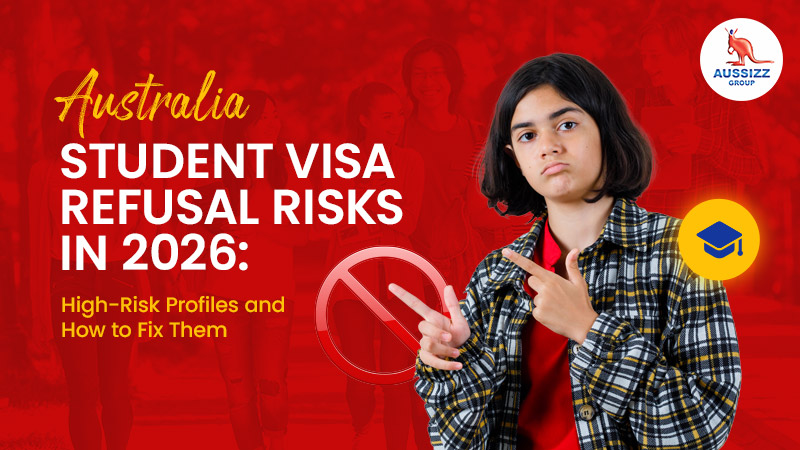
Australia Student Visa Refusal Risks in 2026: High-Risk Profiles and How to Fix Them
Applying for an Australian student visa in 2026 is not only about getting admission. It is about showing that your full profile makes sense: your course choice, your finances, your documents, your English, and your reasons for studying in Australia all need to line up clearly. The Department of Home Affairs now assesses Student visa applicants under the Genuine Student (GS) requirement for applications lodged on or after 23 March 2024, and it says applicants must show that studying is their primary reason for applying.
That is why a “high-risk profile” does not always mean a bad profile. In many cases, it simply means the application raises unanswered questions. A weak course progression, generic GS answers, poor financial evidence, missing documents, or a study plan that feels more work-driven than study-driven can all increase refusal risk. Home Affairs is also urging applicants to lodge decision-ready applications with the right supporting documents from the start.
What a high-risk student visa profile usually looks like in 2026
A high-risk student visa profile is usually a profile with inconsistencies, not just one with low marks or limited funds. Home Affairs looks at your current circumstances, ties to your home country, why you chose your course and provider, and how the course will benefit you. So if the story in your documents does not match the story in your statement, the file can become risky very quickly.
Quick snapshot of the biggest risk areas
Risk area
Why it becomes a problem
What usually fixes it
Weak course progression
The chosen course doesn’t align with previous studies or work experience
Provide a clear academic or career progression with logical justification
Generic GS answers
Responses sound copied, vague, or not personalized
Write specific, personal answers supported by real examples and evidence
Poor financial evidence
Funding sources appear unclear, inconsistent, or unsupported
Show a transparent, traceable source of funds with proper sponsor documentation
Missing documents
Application appears incomplete or hastily prepared
Submit a complete, decision-ready application with all required documents
Weak English evidence
Raises doubts about academic ability or eligibility
Provide valid test results and strengthen explanations if needed
Work-driven narrative
Application appears to be focused on work rather than study
Clearly position study as the primary purpose of travel
Timing/provider issues
Late or rushed submission can negatively affect outcomes
Apply early with a well-prepared, complete application
This table is useful because it shows the core issue clearly: most high-risk files are not refused because of one dramatic problem. They are refused because several small weaknesses combine into one unconvincing application.
When your course choice does not make sense, the whole visa story becomes weaker
One of the most common refusal risks is poor course logic. Home Affairs specifically asks why you want to study that course in Australia with that education provider, and how the course will benefit you. So your course choice is not only an admission issue. It is a visa credibility issue as well.
This becomes risky when an applicant chooses a course with no clear link to past academics or work experience, or when there is a major study gap with no proper explanation. It can also become a problem when the chosen course is at a lower level than the applicant’s previous qualification, but the application does not explain why that still makes sense. A file like that can look random, or worse, like the course was chosen only because it seemed easy or migration-friendly.
How to fix weak course progression
The best fix is not to over-explain. It is to explain properly. Show how the course connects to your background, current situation and future career. If you are changing fields, explain the reason with a real career logic. If you had a study gap, account for it with truthful detail and supporting evidence. If the course level looks unusual, explain why it still adds practical value. The stronger the logic, the safer the profile.
Generic GS answers are still one of the biggest avoidable mistakes
A lot of applicants still submit GS responses that sound almost identical: “Australia has a world-class education system,” “I want global exposure,” or “This course will help my future.” Those lines are not enough on their own. The Department asks for much more than that. It wants to understand your actual circumstances, why the course and provider make sense for you, and what benefit the course will bring after completion.
This is where many high-risk files fail in 2026. The GS statement may not be legally separate from the rest of the application, but it often acts like the glue that holds the file together. If it feels copied, migration-heavy, or disconnected from your documents, the whole application can lose credibility. Home Affairs also makes it clear that future plans, including possible permanent residence later, do not automatically count against you. But studying must still be the primary purpose of the visa application now.
What stronger GS answers usually do better
Weak approach
Stronger approach
Talks generally about Australia
Explains why this course and this provider fit the applicant
Uses copied wording
Uses personal, specific details
Focuses too much on PR or work
Keeps study as the main reason
Gives no context about current life
Explains present circumstances clearly
Sounds emotional but vague
Sounds practical and evidence-based
A stronger GS answer does not need fancy language. It needs clarity, consistency and honesty. That is usually what reduces risk.
Weak financial evidence still causes major student visa problems
Financial capacity remains one of the most important parts of a Student visa application. Under the simplified student visa framework, applicants must have sufficient funds available for their stay in Australia, and Home Affairs has updated financial settings in recent years to align more closely with the real cost of living.
A high-risk finance profile is not always a profile with no money. Sometimes the issue is poor evidence. For example, large recent deposits with no explanation, unclear sponsor documents, mismatched income evidence, or a funding story that does not line up with the rest of the file can all make the case look weak. If parents or another family member are sponsoring you, the relationship and their funding ability should be easy to understand from the documents.
How to fix finance-related risk
Make the financial story simple and traceable. Show where the money comes from, who is funding you, and how that person can realistically support your studies. Do not rely on unexplained balances. Do not assume a bank statement alone tells the whole story. A financially strong application is one where the documents and explanation support each other clearly.
Incomplete documents can make a decent profile look risky
Home Affairs says applicants should use the Document Checklist Tool, upload a current Confirmation of Enrolment (CoE), include English evidence where required, and respond quickly to further document requests. It also says complete applications are more likely to be finalised faster.
This became even more important after the onshore rule change that took effect on 1 January 2025. Home Affairs says it no longer accepts Letters of Offer from people applying in Australia for a Student visa. Onshore applicants need a CoE, not just an offer letter. That means outdated advice can create avoidable refusals or delays if applicants lodge with the wrong document set.
Documents that applicants should be extra careful about
Document area
Why it matters in 2026
Current CoE
Mandatory for proper student visa lodgement
English evidence
Needed where the checklist asks for it
Identity documents
Must match across the file
Financial documents
Must support the sponsor or funding story
GS-related evidence
Should align with your written answers
OSHC
Must cover the required period
Translations and uploaded copies
Poor quality uploads can weaken a file
This is where many risky profiles can be improved very quickly. A better-prepared file often looks stronger even before the case officer reads the deeper details.
English ability can affect both eligibility and credibility
English is another area where some applicants underestimate the risk. Home Affairs announced in March 2024 that the minimum score required for a Student visa increased from IELTS 5.5 to 6.0, or the equivalent in another accepted test. It also updated the accepted English language tests for Australian visa purposes on 7 August 2025.
That means two things matter in 2026. First, the score itself must meet the current rule where required. Second, the test evidence must still be from an accepted test and within the accepted validity framework. In some cases, the real issue is not just the score. It is that the broader application does not show the applicant is genuinely ready for the course they chose.
How to fix English-related risk
Use valid English test evidence, check that your test is still accepted for visa purposes, and make sure the rest of your application supports your study readiness. English should strengthen your story, not sit there as a disconnected score report.
When the file looks work-driven instead of study-driven, risk increases
A Student visa is a study visa, not a work visa. Home Affairs says applicants must show that studying in Australia is the primary reason for applying. Student visa holders are generally subject to work restrictions, and Home Affairs’ conditions guidance notes the current general limit of 48 hours per fortnight, unless an exception applies.
This does not mean you cannot mention work at all. But if your course choice, GS statement and financial story all suggest that work opportunities in Australia matter more than your actual study plan, the application can start to look less genuine. That is especially risky if the chosen course itself already looks weak or poorly matched.
How to fix a work-driven-looking profile
Keep the file study-led. Explain academic value, skill development and realistic career outcomes. Do not build the application around part-time work rights or migration hopes. Those are not the centre of a Student visa case.
Provider choice and timing matter more than many students realise
Student visa processing for offshore Subclass 500 applications is being prioritised under Ministerial Direction 115, which applies to applications lodged on or after 14 November 2025. Home Affairs says prioritisation is linked to the education provider of the main CoE and that provider’s progress toward allocation thresholds. It also makes clear that processing priority affects order and speed, not whether the visa is granted or refused.
So a student may have a genuine file and still experience different timing depending on the provider and when the application is lodged. That is why late filing, incomplete filing, or poor provider planning can add pressure even if the case is otherwise workable.
The practical fix: build a stronger overall case, not just a longer file
The safest Student visa applications in 2026 usually share the same features: a sensible course progression, clear GS answers, well-supported finances, current CoE, valid English evidence where required, proper OSHC, and a complete, decision-ready document pack. Home Affairs’ own guidance points applicants back to exactly these basics.
Aussizz Group has helped 200,000+ applicants to their Australian Dreams, and this is where strong preparation matters most. A high-risk student visa profile is often still fixable before lodgement, but only if the risk points are identified properly and corrected early. If you want to know whether your 2026 Australia Student visa application has refusal risks, book a consultation with Aussizz Group and get your profile reviewed before you apply.
FAQs
Q1. What is considered a high-risk student visa profile in Australia in 2026?
A high-risk profile usually includes issues like weak course progression, generic GS answers, poor financial evidence, missing documents, weak English support, or an overall application that does not clearly show study as the main purpose.
Q2. What is the Genuine Student requirement?
The Genuine Student requirement applies to Student visa applications lodged on or after 23 March 2024. Applicants must show they are genuine applicants for entry and stay as students and that studying in Australia is their primary reason for applying.
Q3. Is a CoE compulsory for an Australian Student visa?
Yes. Home Affairs says applicants should upload a current Confirmation of Enrolment (CoE), and from 1 January 2025 onshore applicants can no longer rely on a Letter of Offer instead.
Q4. What is the minimum IELTS score for an Australian Student visa?
Home Affairs raised the minimum Student visa English requirement from IELTS 5.5 to 6.0 in 2024, or the equivalent in another accepted English test.
Q5. Did the accepted English tests change in 2025?
Yes. Home Affairs says the approved English language tests for Australian visa purposes changed on 7 August 2025.
Q6. Does weak financial evidence increase refusal risk?
Yes. Student visa applicants must have sufficient funds available, and unclear or poorly evidenced finances can weaken the application significantly.
Q7. How many hours can an international student work in Australia?
Student visa holders are generally subject to a work limit of 48 hours per fortnight, unless an exception applies.
Q8. Does processing priority guarantee visa approval?
No. Home Affairs says processing priority only affects how applications are ordered for processing, not whether they are granted or refused.
Q9. What is the best way to reduce student visa refusal risk in 2026?
The best way is to lodge a complete, decision-ready application with a logical course choice, strong GS responses, clear finances, correct English evidence, current CoE and proper OSHC coverage.

 AUS
Australia
AUS
Australia
 IND
India
IND
India
 UAE
UAE
UAE
UAE
 CA
Canada
CA
Canada
 SL
Srilanka
SL
Srilanka
 HK
Hong Kong
HK
Hong Kong