Queensland National Innovation Visa (Subclass 858) for Innovative Investors
A Serious Permanent Residency Pathway for Founders, Innovative Investors and Globally Recognised Talent
Australia has materially changed the way it approaches high-value migration.
The old assumption that a wealthy applicant could simply place capital into Australia and expect a straightforward investment-based migration outcome is no longer the real story. The current Queensland pathway is tied to the National Innovation visa (subclass 858), which is a permanent, invitation-only visa for exceptionally talented people who can make a meaningful contribution to Australia’s future prosperity. It is not a passive investor visa. It is a selective, evidence-heavy pathway designed for people with real influence, proven outcomes and strong national-interest value.
For Queensland, this pathway is particularly relevant to global researchers, entrepreneurs, innovative investors, athletes and creatives. For investors, the focus is not on passive wealth. It is on active, innovation-led capital deployment backed by a credible track record.
This pathway is linked to the National Innovation visa (subclass 858). That visa is a permanent visa, not a provisional one. It replaced the former Global Talent visa framework, and the Australian Government separately closed the Business Innovation and Investment Program to new applicants on 31 July 2024. In other words, applicants should stop thinking about this as a modern version of the old business-investor model. It is not.
A subclass 858 visa holder can live in Australia permanently and, according to Home Affairs, can travel to and from Australia for 5 years from the date of visa grant and may apply for Australian citizenship if eligible. The visa is also an invitation-only program, so no one can simply lodge it on demand without first being invited.
What is the National Innovation Visa Really for?
The National Innovation visa is aimed at exceptionally talented migrants from around the world who can help create jobs and drive productivity growth in sectors that matter to Australia’s future. Home Affairs describes it as a visa for established and emerging leaders with high-calibre talent and skills who can make significant contributions to Australia’s future prosperity.
That is the federal framework.
Queensland’s role is different. Queensland can support certain candidates through a state nomination process, and if Queensland nominates a candidate, that candidate is treated by Home Affairs as Priority 2 in the National Innovation visa system. That matters strategically because this visa is invitation-based and priority settings materially affect competitiveness.
Why Queensland?
Queensland is not selling lifestyle alone. It is selling scale, economic depth and long-term growth potential.
Queensland is Australia’s second-largest state by land area, covering more than 22% of the continent. It has the third-largest economy in Australia, after New South Wales and Victoria. Queensland also holds credit ratings of AA+/Negative/A-1+ by S&P Global and Aa1/Stable/P-1 by Moody’s. Its population reached 5.6 million at 31 December 2024, and the state has been supported by strong interstate migration.
Queensland is also globally recognisable. The Great Barrier Reef extends over roughly 2,000 km and covers more than a quarter of the state’s 7,400 km coastline. Trade and Investment Queensland positions the state as globally connected, research-capable and increasingly attractive for innovation, investment and commercial growth.
On top of that, Queensland is heavily leaning into the future. TIQ specifically highlights internationally ranked universities, research hubs, a strong innovation ecosystem, Asia-Pacific connectivity, supportive government initiatives and the momentum created by the Brisbane 2032 Olympic and Paralympic Games and associated infrastructure and partnership activity.
The Brutal Reality: This is not a Passive Investment Visa
This point needs to be said clearly because too many people still misunderstand it.
The Queensland innovative investor pathway under subclass 858 is not for passive rich applicants, not for property buyers, and not for people whose only strength is holding capital. Queensland’s published guidance for innovative investors is directed at applicants who are actively involved, have an established track record of supporting successful innovative ventures, and are read
y to deploy at least AUD 5 million into Queensland’s innovation ecosystem for two or more years.
If the applicant’s profile is basically:
money with no innovation background,
property investment only,
a traditional business with no real innovation exposure,
or vague claims without documented outcomes,
then the profile is weak. The policy settings are telling you that directly, even if they do not use that language.
Who does Queensland Say It wants Under the Investor Pathway?
For the innovative investor pathway, Queensland says it is looking for actively involved innovative investors with an established track record of leading groundbreaking ventures and who are ready to invest a minimum of $5 million for two or more years in Queensland’s innovation ecosystem. Queensland specifically points to investment structures such as private equity, venture capital, research and development, asset managers and co-investments, including examples such as Queensland Investment Corporation-linked ventures.
That means the state is looking for people who understand:
venture investing,
innovation ecosystems,
growth-stage capital,
commercialisation,
institutional co-investment,
and strategic deployment into sectors that have national-interest value.
Which Sectors are Relevant?
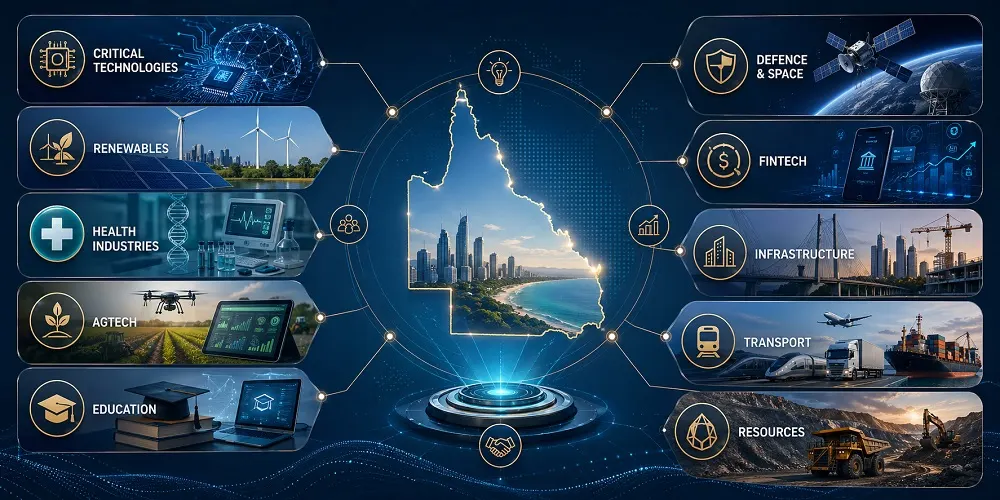
Queensland’s investor messaging aligns with the federal National Innovation visa sector priorities. For investment profiles, the strongest candidates are typically those operating in sectors that Home Affairs and Queensland both regard as future-focused and nationally important. Queensland’s public materials and Home Affairs invitation data point to sectors including:
Critical technologies
Renewables and low-emission technologies
Health industries
Agri-food and AgTech
Education
Defence capabilities and space
Financial services and FinTech
Infrastructure and transport
Resources
Sports and the arts in other talent categories.
Queensland also states that candidates in a Tier One or Tier Two sector will be highly regarded in the investor stream. Recent Home Affairs invitation-round data for January to March 2026 shows invitations issued across Tier One sectors such as critical technologies, renewables and low-emission technologies, and health industries, with additional invitations across Tier Two sectors including Agri-food and AgTech, Education, Defence Capabilities and Space, Financial Services and FinTech, Infrastructure and Transport, and Resources.
The Minimum Investment Threshold
For Queensland’s innovative investor pathway, the published requirement is severe and non-trivial:
A minimum of AUD $5 million, to be deployed upon visa grant, and maintained for two or more years in Queensland’s innovation ecosystem. Queensland also requires a well-developed investment deployment plan that is focused on both optimising returns and driving growth in Queensland’s innovation ecosystem.
What Investment Structures Look Credible?
Queensland expressly refers to investment avenues such as:
private equity
venture capital
research and development
asset managers
co-investments.
The examples of evidence it gives also refer to innovative investments linked to groundbreaking ventures in high-growth sectors, successful exits, IPOs, acquisitions, funding rounds, and active involvement in listed companies where that activity supports start-ups, scale-ups or other high-growth innovative ventures.
Property purchase is not the profile this pathway is trying to reward.
Passive listed shares alone are usually not persuasive.
Buying a conventional business with no innovation angle is weak.
A serious VC, PE, R&D or co-investment profile is far more aligned.
What Makes a Strong Investor Candidate?
Queensland’s evidence expectations make this fairly obvious.
A strong candidate should be able to show:
an established track record of actively supporting innovative ventures,
documented capital deployment into innovation-led businesses,
outcomes such as exits, IPOs, acquisitions, returns or funding rounds,
active involvement through board positions, leadership roles, strategic guidance or direct support to scale-ups,
and third-party endorsements from innovative investment firms, venture capitalists, government-backed funds or well-regarded co-investors.
In plain language, Queensland is not looking for someone who just wrote cheques. It is looking for someone who can prove they helped build value.
What does a Weak Profile Look Like?
A weak profile usually looks like one or more of the following:
cash-rich but no serious innovation investment history,
traditional business wealth without innovation-led ventures,
heavy real estate exposure but no venture or commercialisation profile,
no board roles, no strategic involvement, no recognised exits,
no institutional endorsements,
no clear Queensland deployment strategy.
That does not mean refusal is automatic in every case, but it does mean the case is not naturally aligned to the published framework.
What do Home Affairs Priorities Look Like?
Home Affairs runs the National Innovation visa through an invitation-priority system.
Recent federal guidance and invitation data show:
Priority 1: exceptional candidates from any sector who are global experts and recipients of international “top of field” awards
Priority 2: candidates from any sector nominated on the approved Form 1000 by an expert Australian Commonwealth, state or territory government agency
Priority 3: candidates with exceptional and outstanding achievements in a Tier One sector
Priority 4: candidates with exceptional and outstanding achievements in a Tier Two sector.
For January to March 2026, Home Affairs reported 1,815 EOIs received and 146 invitations issued. Only 15 of those invitations were issued in Priority 2 during that period. That does not mean Priority 2 is weak. It means the program is tight and selective.
Is There an Age Limit?
There is a real age issue here and people ignore it at their own risk.
Home Affairs’ Form 1000 specifically asks whether the applicant is below 18 or aged 55 years or above, and if so, requires the nominator to indicate how the applicant would be of exceptional benefit to the Australian community. That means age is not automatically fatal, but older applicants need a much stronger exceptional-benefit case.
What about English?
Home Affairs’ National Innovation visa listing indicates that there may be an extra fee for applicants aged 18 or older who have less than functional English. That is not the same as saying every applicant must hold a particular English test score before all else, but English still matters operationally and cost-wise.
Is This still an “Investment Visa” in the Traditional Sense?
No. Not in the way most people use that term.
If someone is asking for a classic investor migration route where money itself is the centrepiece, they are probably thinking in old BIIP logic. But the BIIP was closed to new applicants on 31 July 2024, and the current National Innovation visa is framed around exceptional talent and national interest, not passive investment migration.
For innovative investors, capital still matters, but it must be tied to:
innovation,
track record,
active involvement,
recognised outcomes,
and a convincing Queensland contribution case.
Who is the Ideal Client for This Pathway?
The strongest profiles are usually:
serial entrepreneurs with exits,
venture capital or angel investors with documented results,
family-office operators with an innovation portfolio,
founders who have built and scaled high-growth ventures,
investors with strong institutional networks and third-party validation,
and applicants who can put forward a credible Queensland deployment strategy at serious scale.
Who should Probably not be Pitched This Pathway?
Bluntly:
passive property investors,
applicants whose wealth sits mostly in conventional assets,
traditional business owners with no innovation ecosystem exposure,
investors without documented deals,
and applicants hoping money alone will carry the case.
Those profiles are not impossible in every scenario, but they are badly aligned to the published framework.
Why Strategic Preparation Matters
This visa is not paperwork-first. It is profile-first and evidence-first.
A strong case needs:
a properly framed narrative,
evidence of achievements and influence,
a defensible investment deployment plan,
third-party endorsements,
sector alignment,
and a nomination strategy that makes sense within Queensland’s priorities and Home Affairs’ invitation framework.
Weak preparation usually fails in one of two ways: either the applicant never becomes nomination-worthy, or the EOI is simply not competitive enough to attract an invitation.
How Aussizz Group Can Assist?
At Aussizz Group, we assist clients with strategic assessment and positioning for complex migration pathways, including innovative investor and high-calibre talent pathways. For clients considering the Queensland National Innovation visa route, the work is not just about forms. It is about:
assessing whether the profile is genuinely competitive,
identifying the strongest pathway angle,
structuring a commercially credible Queensland investment narrative,
preparing evidence for track record, achievements and endorsements,
and managing the nomination and visa strategy with realism rather than empty promises.
If the profile is weak, it needs to be said early. If the profile is strong, it needs to be structured properly.
The Queensland pathway under the National Innovation visa (subclass 858) is one of the most selective migration routes currently available in Australia. It is a permanent visa, not a provisional stepping-stone. It is built for people with exceptional achievement, serious credibility and national-interest value. For innovative investors, the benchmark is even harsher: active involvement, a proven innovation investment track record, and at least $5 million ready to be deployed into Queensland’s innovation ecosystem for two or more years.
Anyone treating it like an easy investment visa is reading the market badly.
Anyone who can genuinely meet the standard may have a very strong pathway.
Article written and authorised by – Tejas Patel MARN 1688211

 AUS
Australia
AUS
Australia
 IND
India
IND
India
 UAE
UAE
UAE
UAE
 CA
Canada
CA
Canada
 SL
Srilanka
SL
Srilanka
 HK
Hong Kong
HK
Hong Kong