
 AUS
Australia
AUS
Australia
 IND
India
IND
India
 UAE
UAE
UAE
UAE
 CA
Canada
CA
Canada
 SL
Srilanka
SL
Srilanka
Degrees, Pathways, Accreditation, Costs & Career Outcomes Explained
Introduction
If you’re planning to study psychology in Australia, you’re definitely not alone. It’s one of the most popular courses among international students due to its strong career prospects and global recognition.
However, there’s something important that many students don’t realise at the beginning — not every psychology degree leads to becoming a registered psychologist.
Australia follows a structured and regulated pathway for psychology and choosing the wrong course can result in limited career opportunities or additional years of study.
That’s why understanding the right pathway from the start is critical. At Aussizz Group, we guide students in selecting the right courses, aligning their academic plans with visa requirements, and ensuring long-term career success.
Table of Contents
- Understanding Psychology Accreditation in Australia
- The Psychology Pathway in Australia
- Entry Requirements for Psychology Courses
- Alternative Pathways: Foundation and Diploma Options
- Cost of Studying Psychology in Australia
- Scholarships for Psychology Students
- Career Outcomes After Studying Psychology
- How to Become a Registered Psychologist in Australia
- Student Visa and Genuine Student (GS) Considerations
- FAQs
Understanding Psychology Accreditation in Australia
In Australia, psychology is a regulated profession governed by the Australian Health Practitioner Regulation Agency (AHPRA) and the Psychology Board of Australia (PBA).
To become a registered psychologist, students must complete programs accredited by the Australian Psychology Accreditation Council (APAC).
Important:
A 3-year bachelor’s degree in psychology alone does NOT qualify you for registration.
To verify whether a course is approved, students should always check:
- Australian Government Department of Education approved course list: https://www.education.gov.au/professional-pathway-psychology-approved-course-list
- APAC accreditation database: https://apac.au/accredited-programs/search-a-program/
👉 This simple step can decide your entire career pathway.
The Psychology Pathway in Australia
Before choosing a psychology course in Australia, it’s important to understand that it is not a single-degree pathway. Instead, it is a structured journey that takes several years to complete.
Many students assume that a bachelor’s degree is enough to become a psychologist. However, in Australia, that is only the first step. To become a registered psychologist, you must complete a minimum of 5–6 years of approved study and training, followed by further qualification or supervised practice.
Psychology Pathway Overview
| Stage | Duration | What You Study | Outcome |
| Bachelor’s degree | 3 years | Core psychology subjects and research fundamentals | Foundation only (no registration) |
| Honours / 4th Year | 1 year | Advanced study and research | Eligible for postgraduate pathway |
| Postgraduate / Internship | 1–2 years | Specialisation or supervised training | Eligible for registration |
| Total Duration | 5–6 years | Full pathway | Registered Psychologist |
Each stage plays an important role, and students must complete all steps to move forward. The fourth year is especially critical, as it determines eligibility for postgraduate study, which is often competitive.
Most students choose a Master’s pathway, as it offers better career opportunities and a clearer route to registration.
At Aussizz Group, we help students plan their complete psychology pathway—from selecting the right course to preparing for visa requirements—so they can move forward with confidence.
Important Points to Remember
- A 3-year bachelor’s degree alone does NOT qualify you for registration.
- A 4th year (Honours or equivalent) is required
- Postgraduate study or supervised training is essential
- The full pathway typically takes 5–6 years
Entry Requirements for Psychology Courses in Australia
Before applying, it’s important to have a clear idea of whether your academic background matches the requirements for psychology in Australia.
For most students, the requirements are straightforward at the beginning but become more competitive as you move further along the pathway—especially for postgraduate programs.
Entry Requirements Overview
| Study Level | Academic Requirement | English Requirement |
| Bachelor’s Degree | Year 12 or equivalent | IELTS 6.0 – 6.5 |
| Honours / 4th Year | Relevant psychology background | IELTS 6.5 |
| Master’s Degree | 4-year psychology qualification (APAC-aligned) + strong GPA | IELTS 6.5 – 7.0 |
As you progress, universities place more emphasis on academic performance and overall profile. For master’s programs, a strong GPA (around 5.5–6.5 on a 7-point scale or equivalent) is usually expected, and admission can be competitive.
Meeting the minimum criteria does not always guarantee admission, especially for specialised programs like clinical psychology.
At Aussizz Group, our education consultants help students evaluate their academic profile, understand eligibility requirements, and identify the most suitable pathway—whether it’s direct entry or an alternative route.
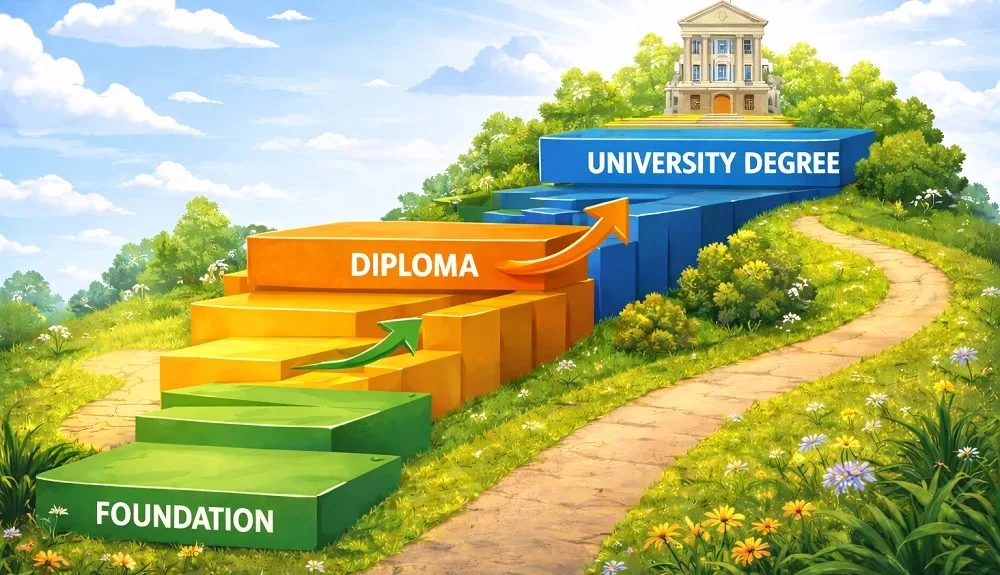
Alternative Pathways: Foundation and Diploma Options
Not every student meets the direct entry requirements for a psychology degree—and that’s completely okay.
Australian universities offer alternative pathways that allow students to gradually progress into a bachelor’s program instead of starting directly.
The two most common options are foundation programs and diploma programs.
Foundation programs are usually suitable for students who have completed Year 11 or whose academic results are slightly below the required level. These programs help build the academic and English skills needed to enter the first year of a bachelor’s degree.
Diploma programs, on the other hand, are equivalent to the first year of a university degree. This means that after completing a diploma, students can often enter directly into the second year of a bachelor’s program, depending on the university and course structure.
Pathway Options Overview
| Pathway | Entry Level | Duration | Outcome |
| Foundation Program | Year 11 or lower scores | 6–12 months | Entry into Year 1 of bachelor’s degree |
| Diploma Program | Year 12 (below required score) | 8–12 months | Entry into Year 2 of bachelor’s degree |
Important to understand:
Foundation and diploma programs do not lead directly to a psychology qualification. They are designed to prepare you for entry into an APAC-accredited bachelor’s degree, after which the standard psychology pathway continues.
These pathways are a great option for students who need additional preparation, but it’s important to ensure that the final degree you progress into is APAC-accredited, especially if your goal is to become a psychologist.
At Aussizz Group, we regularly guide students on whether a pathway option is suitable for their profile and help them choose the right progression route to avoid delays in their academic journey.
Cost of Studying Psychology in Australia for International Students
Studying psychology in Australia is a long-term commitment, so it’s important to understand the overall cost before you begin.
The total expense includes tuition fees, living costs, and other essentials such as Overseas Student Health Cover (OSHC). While the exact amount varies depending on the university and city, the following estimates can give you a general idea.
Estimated Cost Overview
| Study Level | Annual Tuition Fees (AUD) |
| Bachelor’s degree | 28,000 – 42,000 |
| Honours / 4th Year | 30,000 – 44,000 |
| Master’s Degree | 32,000 – 50,000 |
In addition to tuition fees, students should plan for living expenses. As per current guidelines, the estimated cost of living for international students in Australia is approximately AUD 29,710 per year.
It is important to note that psychology is not a short-term course. Since the full pathway can take 5–6 years, students should plan their finances for the entire duration of study, not just the first year.
This is also a key requirement for the Australian Student Visa (Subclass 500), where applicants must demonstrate sufficient financial capacity to support their stay in Australia.
At Aussizz Group, we assist students in understanding the overall cost, preparing financial documentation, and selecting the right OSHC plan—ensuring their visa application is well-prepared and compliant.
Scholarships for Psychology Students in Australia
Many international students explore scholarship options to reduce their overall study costs. While scholarships are available in Australia, it is important to understand that they are usually limited and competitive.
Some of the commonly available options include Australia Awards Scholarships, Destination Australia Scholarships, university-specific merit scholarships, and Research Training Program (RTP) scholarships for postgraduate students.
In most cases, scholarships provide partial fee reductions rather than full funding, particularly at the undergraduate level.
Students should plan their finances independently and consider scholarships as an added benefit rather than relying on them completely.
At Aussizz Group, we help students identify suitable scholarship opportunities based on their academic profile and guide them through the application process.
Career Outcomes After Studying Psychology in Australia
One of the most important questions students have is, “What can I do after studying psychology?”
The answer depends largely on how far you go in your studies.
If you complete only a bachelor’s degree, your career options will be limited to entry-level roles. These may include positions in human resources, community support, or research assistance. While these roles provide valuable experience, they do not allow you to work as a psychologist.
To become a registered psychologist, you must complete the full pathway, including postgraduate study or supervised training. Once you achieve registration, your career opportunities expand significantly. You can work across a variety of sectors, including healthcare, education, corporate organisations, and private practice.
Career Progression Overview
| Qualification Level | Career Opportunities |
| Bachelor’s degree | HR Assistant, Support Worker, Research Assistant |
| Honours / 4th Year | Entry-level roles + pathway eligibility |
| Registered Psychologist | Clinical, community, education, private practice roles |
| Specialised Psychologist | Clinical psychologist, organisational psychologist, mental health specialist |
In Australia, registered psychologists are in demand, particularly in mental health and community services. With experience, professionals in this field can earn between AUD 70,000 to 100,000 or more, depending on their area of specialisation.
Students should also understand that career outcomes depend not only on the qualification but also on factors such as experience, performance, and ongoing professional development.
At Aussizz Group, we guide students in choosing courses that align with their long-term career goals, ensuring they follow the right pathway from the beginning.
How to Become a Registered Psychologist in Australia?
Becoming a registered psychologist in Australia involves completing an approved and structured pathway rather than a single course.
To be eligible for registration, students must:
- Complete an APAC-accredited sequence of study (minimum 4 years)
- Undertake postgraduate study or supervised training (such as a master’s degree or internship pathway)
- Meet English language requirements set for professional registration
- Satisfy the registration standards set by the Psychology Board of Australia under the Australian Health Practitioner Regulation Agency (AHPRA)
Once all requirements are met, students can apply for general registration as a psychologist in Australia.
It is important to understand that registration is based on completing the correct accredited pathway. Choosing the right course from the beginning plays a critical role in ensuring you are eligible to apply later.
Student Visa and Genuine Student (GS) Considerations
To study psychology in Australia, international students need to apply for a Student Visa (Subclass 500).
While the application process may seem straightforward, one of the most important parts of the visa assessment is the Genuine Student (GS) requirement.
In simple terms, this means you need to clearly explain:
- Why you have chosen this course
- How it connects to your previous studies or experience
- How it will help you in your future career
For psychology students, this becomes even more important because the pathway is long and structured. Visa officers often assess whether you understand the full journey—from your bachelor’s degree to postgraduate study—and whether your plan is realistic.
Another key requirement is financial capacity. You must demonstrate that you have sufficient funds to cover your tuition fees, living expenses, and other costs for your stay in Australia.
It is also important that your course choice makes sense for your profile. A well-aligned academic plan strengthens your visa application, while unclear or inconsistent choices can raise concerns.
At Aussizz Group, we assist students in preparing strong GS statements, organising financial documents, and ensuring that their entire application is clear, consistent, and aligned with visa requirements.

Final Advice: Plan Smart, Choose Right
Studying psychology in Australia can lead to a rewarding and respected career, but success in this field depends on making the right decisions from the beginning.
Understanding the pathway, choosing an accredited course, and planning your long-term journey are all essential steps. A small mistake at the start—such as selecting the wrong course—can lead to delays, additional costs, or limited career options later.
This is why it’s important to approach your study plans with clarity and proper guidance. With the right support, the process becomes much simpler and more structured.
At Aussizz Group, we work closely with international students to help them make informed decisions at every stage—from selecting the right course and university to preparing student visa applications and planning future pathways.
👉 If you’re considering studying psychology in Australia, connect with Aussizz Group today for personalised guidance and take the first step toward building your future with confidence.
Frequently Asked Questions (FAQs)
1. Can I become a psychologist in Australia with a 3-year degree?
No, a 3-year bachelor’s degree alone is not enough to become a registered psychologist in Australia. You must complete a minimum of 5–6 years of approved study, including a fourth year and postgraduate qualification or supervised training.
2. What is APAC accreditation and why is it important?
APAC (Australian Psychology Accreditation Council) accredits psychology programs in Australia. Only APAC-accredited courses are recognised for progressing toward psychologist registration. Choosing a non-accredited course can limit your career options.
3. How long does it take to become a psychologist in Australia?
On average, it takes 5 to 6 years to become a registered psychologist. This includes a bachelor’s degree, honours year, and postgraduate study or supervised training.
4. Can international students register as psychologists in Australia?
Yes, international students can become registered psychologists if they complete an APAC-accredited study pathway and meet all registration requirements set by the Psychology Board of Australia.
5. Is a Master of Counselling the same as a psychology degree?
No, a Master of Counselling is different and does not usually lead to psychologist registration. Students must follow an APAC-accredited psychology pathway to become a registered psychologist.
6. What IELTS score is required for psychology courses in Australia?
For undergraduate courses, IELTS is usually around 6.0–6.5. For postgraduate courses, it is typically 6.5–7.0, depending on the university.
7. Can I study psychology if I don’t meet direct entry requirements?
Yes, students can choose alternative pathways such as foundation or diploma programs. These help you progress into a bachelor’s degree, after which the standard psychology pathway continues.
8. Are scholarships available for psychology students in Australia?
Yes, scholarships such as Australia Awards, Destination Australia, and university merit scholarships are available. However, they are competitive and usually provide partial fee support.
9. Is psychology in demand in Australia?
Yes, there is growing demand for mental health professionals in Australia. However, career opportunities depend on completing the full pathway and obtaining registration.
10. Does studying psychology lead to PR in Australia?
Psychology-related occupations may appear on Australia’s skilled occupation lists, but PR outcomes depend on multiple factors such as qualification level, experience, and migration policies. Students should focus on the right study pathway first.
Changing courses in Australia can look simple on the surface. A student may feel the course is too hard, too expensive, not the right fit, or not leading where they hoped. But in 2026, course switching is not just an academic decision. In some situations, it can create real student visa problems, especially if the change affects your course level, provider, enrolment status, visa conditions, or future plans.
That is why students need to stop thinking of course switching as only an education issue. It is also a student visa compliance issue. Home Affairs says if your study situation changes, you should tell the Department before making changes and make sure you continue to meet your visa conditions. It also says transferring to a lower AQF level course, or from an AQF course to a non-AQF Award course, is a breach of Student visa condition 8202 unless a limited exception applies.
This is exactly where many students get into trouble. They assume that if a new college is willing to enrol them, the visa side must also be fine. That is not always true. A provider transfer, a drop in AQF level, a rushed onshore move, or a poorly explained course change can all raise issues under the Student visa framework. In 2026, this matters even more because the system is focused heavily on genuine study, proper enrolment, and provider compliance.
Course switching becomes risky when it changes more than just your classroom
A student visa is granted on the basis of a real study plan. That plan includes the course, provider, study level, and your reason for studying in Australia. So when you switch courses, the Department is not only asking, “Did you change subjects?” It may also be asking:
- Did you move to a lower-level qualification?
- Did you change providers too early?
- Did you stay enrolled properly?
- Does the new course still match your visa conditions?
- Does the new course still make sense under the Genuine Student requirement?
Home Affairs’ visa condition guidance says Student visa holders must maintain enrolment in a registered course that is the same AQF level or higher than the course for which the visa was granted, unless moving from AQF level 10 to level 9. That is one of the clearest legal risk points for course changes in 2026.
The most dangerous switch is usually moving to a lower AQF level
This is the biggest course-switching risk students need to understand clearly.
If your visa was granted for a higher-level course and you move down to a lower AQF level course, that can breach your visa condition. Home Affairs says transferring to a lower AQF level course, or from an AQF course to a non-AQF Award course, is a breach of the Student visa condition unless an exception applies.
AQF level changes that raise risk quickly
| Example change | Risk level | Why it is risky? |
| Master’s to Bachelor’s | High | Lower AQF level |
| Bachelor’s to Diploma | High | Lower AQF level |
| Diploma to Certificate course | High | Lower AQF level |
| AQF course to non-AQF award | High | Can breach visa condition 8202 |
| PhD to Master’s | Limited exception may apply | Home Affairs notes AQF 10 to 9 exception |
This is why a student cannot assume that a “cheaper” or “easier” course transfer is harmless. Even if the new provider accepts the student, the visa may no longer line up properly with the new study arrangement.
Changing providers in the first six months can trigger transfer restrictions
Another major risk comes from switching providers too early.
Under Standard 7 of the National Code, overseas students generally cannot transfer between registered providers before completing six calendar months of their principal course, unless they get a release from the current provider or fall within a limited exception. The Department of Education explains that the principal course is usually the main or final course of study, and that the first six months are counted from the date the student starts that principal course.
This rule catches many students by surprise because they think the six-month period is counted from the first course in a package or from visa grant. That is not the standard rule for most students. It is based on the principal course.
Provider transfers: when risk is highest
| Situation | Main risk |
| Transfer before 6 months of principal course | Standard 7 restriction applies |
| No release from current provider | New provider may not be able to enrol you lawfully |
| Transfer arranged casually through agent pressure | Compliance and documentation risk rises |
| Student stops attending before transfer is settled | Enrolment and attendance issues can follow |
The Department of Education also noted in January 2026 that the National Code was amended to ban education agent commissions for onshore transfers, which shows how seriously regulators are treating transfer behaviour and integrity concerns.
A course change can also damage your Genuine Student position if the new plan stops making sense
Even where the student does not breach the transfer rule or AQF-level rule, a course switch can still create risk if the new study plan no longer looks genuine.
Home Affairs now applies the Genuine Student (GS) requirement to Student visa applications lodged on or after 23 March 2024, and it asks why the student chose the course and provider, how the course benefits them, and what their current circumstances are. If a student later changes into a completely unrelated, lower-value, or poorly explained course, that can affect how the overall study story looks.
This matters especially for students who later apply for another visa, extend their stay, or face scrutiny over whether they remained compliant with the purpose of their student visa. A course switch is not automatically bad. But a course switch with weak logic can make the file look inconsistent.
Concurrent enrolment is not a safe shortcut around transfer rules
Some students have tried to avoid transfer restrictions by using concurrent enrolment arrangements. The Department of Education specifically warned about this in its concurrent studies update, saying the PRISMS concurrent study function had been identified as a way to avoid transfer restrictions under Standard 7.
That means students should be very careful about any advice that sounds like “just add another course first and move quietly.” If the purpose is really to get around provider-transfer restrictions, that can create compliance problems instead of solving them.

Course switching can also affect your future 485 and PR strategy
A lot of students focus only on surviving the current semester. But the course you complete can affect much more than your present enrolment.
For example, the Australian study requirement for the Temporary Graduate visa subclass 485 requires at least 16 calendar months of study in Australia and completion of eligible study requirements. If a student switches badly, loses time, changes into a weaker qualification path, or interrupts study in the wrong way, that can affect future post-study options.
This is especially important for students who are switching courses for cost reasons or because they believe a cheaper diploma or different provider will still lead to the same migration outcome. Sometimes it will not. A course switch can change the whole value of the education pathway.
When course switching is usually safer?
Not every course change is a visa disaster. Some changes are much more manageable when done properly.
Lower-risk course switch situations
| Situation | Why it is generally safer? |
| Same provider, same AQF level, related course | Lower compliance disruption |
| Higher AQF level move | Usually does not trigger lower-level breach issue |
| Provider transfer after 6 months of principal course | Standard 7 transfer restriction usually no longer applies |
| Well-documented change with ongoing enrolment | Reduces compliance risk |
| Course change that still makes strong academic/career sense | Helps preserve genuine study logic |
The key point is that safer switching is usually about alignment. If the new course still makes sense academically, still fits the visa conditions, and is handled through the right process, risk is lower.
When course switching becomes a serious red flag?
The most concerning course-switch cases usually involve more than one issue at once.
High-risk course switching patterns in 2026
| Pattern | Why it causes trouble? |
| Switch to lower AQF level | Possible breach of visa condition 8202 |
| Change provider inside first 6 months without proper release | National Code transfer restriction issue |
| Move to a course with no clear link to prior study | Can weaken genuine study logic |
| Stop studying while transfer is being arranged | Risks enrolment and reporting problems |
| Use concurrent enrolment to avoid rules | Regulators have flagged this behaviour |
| Choose a cheaper course without checking future visa impact | Can weaken 485 or PR pathway later |
This is where many students go wrong. The course switch itself is not always the problem. The way it happens is often the real problem.
Students should tell the Department before making major study changes
Home Affairs’ “Your study situation has changed” guidance is very direct: tell the Department before you make changes, and make sure you still meet your visa conditions. That is simple advice, but it is one of the most important practical steps in 2026.
Students sometimes speak only to the new provider, or only to an education agent, and assume the immigration side is automatically covered. It is not. A provider may be able to discuss enrolment, but visa compliance is still the student’s responsibility.
The smartest course-switch
That is the real distinction.
Many students can change courses. But the safe way to do it depends on:
- whether the new course is the same or higher AQF level,
- whether the student is inside or outside the first six months of the principal course,
- whether a provider release is needed,
- whether the new course still supports the student’s broader study and migration goals,
- and whether the student remains fully compliant during the change.
Aussizz Group has helped 200,000+ applicants to their Australian Dreams, and this is exactly where careful advice matters. A rushed course switch can create avoidable visa problems. A planned, properly documented course change is often much safer. If you are thinking of changing courses, providers, or study levels in Australia, book a consultation with Aussizz Group before you move so your student visa strategy stays compliant and future-ready.

FAQs
Q1. Can I change my course on a Student visa in Australia?
Yes, but it depends on how you change it. You must continue to meet your visa conditions, and some changes can trigger transfer restrictions or visa-condition issues.
Q2. Can changing to a lower-level course affect my visa?
Yes. Home Affairs says moving to a lower AQF level course, or from an AQF course to a non-AQF award course, is a breach of Student visa condition 8202 unless a limited exception applies.
Q3. What is the 6-month transfer rule for international students in Australia?
Under Standard 7, overseas students generally cannot transfer between registered providers before completing six calendar months of their principal course unless they get a release or meet a limited exception.
Q4. Do I need a release letter to change providers?
If you are still within the first six months of your principal course, usually yes, unless one of the recognised exceptions applies.
Q5. What is the principal course?
The principal course is usually the main or final course of study for which the student visa was issued, especially in a packaged study arrangement.
Q6. Can I switch providers after 6 months?
Generally yes, the Standard 7 transfer restriction usually no longer applies after completing six calendar months of the principal course, though you still need to stay compliant with your visa conditions.
Q7. Can changing courses affect my 485 visa plans?
It can. Poorly planned changes can affect the value of your completed qualification and your ability to build toward the Australian study requirement, which is important for subclass 485 planning.
Q8. Does switching courses affect the Genuine Student requirement?
It can affect how your overall study story looks, especially if the new course appears weakly connected, lower value, or inconsistent with your original study purpose. This is an inference based on Home Affairs’ GS framework.
Q9. Should I tell Home Affairs before changing my study situation?
Yes. Home Affairs says if your study situation changes, you should tell the Department before making changes and ensure you continue to meet visa conditions.
Q10. Is concurrent enrolment a safe way to avoid transfer restrictions?
Students should be very careful. The Department of Education has warned that concurrent studies were being used to avoid transfer restrictions, and this area has drawn regulatory attention.
When people talk about the NSW Skilled Migration Program, they often mention Pathway 1, Pathway 2 and Pathway 3.
These three pathways belong specifically to NSW nomination for the Skilled Work Regional visa (subclass 491), not to the whole NSW skilled migration system. NSW’s official subclass 491 page says the visa is a points-tested provisional visa that lets skilled workers live and work in regional NSW, and it sets out three separate ways to seek NSW nomination: Pathway 1 for people employed with a regional NSW employer, Pathway 2 for people invited by Investment NSW, and Pathway 3 for recent graduates from a regional NSW institution.
That is the first thing applicants need to understand. If you are researching subclass 190 and subclass 491 together, it is easy to assume these three pathways apply across both visas. They do not. Subclass 190 has its own nomination process. Pathway 1, 2 and 3 are NSW’s structure for subclass 491 only.
NSW Pathway 1, Pathway 2 and Pathway 3 are three different routes into the same subclass 491 visa
The visa at the end is the same, but the way you qualify for NSW nomination is different depending on your circumstances. NSW says all three pathways lead to nomination for the same Skilled Work Regional visa (subclass 491), but each one is built for a different type of applicant.
NSW 491 pathways at a glance
| Pathway | Who it is for | Main idea |
| Pathway 1 | People already working for a regional NSW employer | Direct application based on current regional skilled employment |
| Pathway 2 | People who are not applying directly but want NSW to select them from SkillSelect | Invitation-based pathway |
| Pathway 3 | Recent graduates from a regional NSW institution | Direct application based on eligible regional study |
That sounds simple, but the strategy is very different under each route. The stronger your understanding of that difference, the better your chances of choosing the right move.
Pathway 1 is for people already working in regional NSW in skilled employment
Pathway 1 is the most direct route for applicants who are already established in regional NSW. NSW says this pathway is for people currently employed with a regional NSW employer and working in a designated regional area of NSW. To qualify, you must have continuously worked there for the past six months, and that qualifying skilled employment must be in your nominated occupation or a closely related occupation, with the same regional NSW-based employer, and paid at least the TSMIT/CSIT salary rate in that occupation at the time of applying. Your nominated occupation must also be eligible for the subclass 491 visa.
In plain language, Pathway 1 is for applicants who are already proving themselves through real work in regional NSW. This is why many people see it as one of the strongest practical routes. You are not just saying you want to contribute to regional NSW. You are already doing it.
There is also an important salary detail. NSW notes a TSMIT/CSIT concession under Pathway 1 for certain eligible occupations and under limited conditions, including rules around at least 90% of the TSMIT/CSIT and how monetary and non-monetary earnings are treated. NSW lists example occupations for that concession such as Cafe or Restaurant Manager, Medical Laboratory Scientist, Agricultural Technician, Pharmacy Technician, Motor Mechanic, Panel Beater, Vehicle Painter, Stonemason, Pastry Cook, Butcher, Cook, Veterinary Nurse, and Residential Care Officer. But NSW also says the employer must apply for the concession on the applicant’s behalf, and that application stream is currently closed along with Pathway 1 for new applications this program year.
Pathway 2 is the invitation-based route and the one most people misunderstand
Pathway 2 is the route many offshore and onshore skilled applicants are actually talking about when they say, “I’m waiting for NSW 491.” NSW describes it very clearly: Pathway 2 is for people invited to apply by Investment NSW. That means you do not apply directly to NSW nomination under this route the way you would under Pathway 1 or Pathway 3. Instead, you first make yourself visible through a valid SkillSelect EOI and then wait to be selected in an invitation round.
To be considered under Pathway 2, NSW says you must be skilled in an occupation that is within an ANZSCO unit group on the NSW Regional Skills List and is eligible for the visa. You must also meet one of the residency criteria: working in NSW in your nominated occupation, residing in NSW continuously for at least three months, or residing offshore continuously for at least three months.
This matters because many applicants assume Pathway 2 is just “submit EOI and hope.” It is more structured than that. NSW says invitation rounds happen throughout the financial year and that when selecting EOIs it considers factors such as age, English language ability, education, points score and total years of skilled work experience, with the highest-ranking EOIs within an ANZSCO unit group being invited.
So Pathway 2 is not passive. It is competitive. Your EOI needs to be accurate, occupation-aligned, and strong enough to compete inside your unit group.
Pathway 3 is for recent regional NSW graduates, but only if the study is the right kind of study
Pathway 3 is aimed at recent graduates from regional NSW institutions. NSW says this pathway is for people who recently graduated from a Regional NSW institution, and to apply under it you must have completed a bachelor’s degree, master’s degree (coursework or research), or PhD from an institution located in a designated regional area of NSW. NSW also states that to use this pathway you must be eligible to claim points for “Study in regional Australia” based on your qualifying study, and those points must be listed in your EOI.
This is where many applicants get caught out. Not every course, not every campus, and not every study history will automatically fit Pathway 3. The study must be the right level, in the right regional location, and correctly reflected in your EOI.
The biggest difference is simple: Pathway 1 and 3 are direct application routes, Pathway 2 is selection-based
This is the cleanest way to compare the three.
How the three NSW 491 pathways differ
| Point of comparison | Pathway 1 | Pathway 2 | Pathway 3 |
| Main basis | Current regional NSW employment | NSW invitation from SkillSelect | Recent regional NSW study |
| Directly apply to NSW? | Yes | No, you wait to be invited | Yes |
| Best suited to | Workers already employed in regional NSW | Strong EOIs in occupations on the NSW Regional Skills List | Regional NSW graduates |
| Key extra focus | Same employer, 6 months’ qualifying work, salary threshold | Ranking, points, occupation group, residency | Eligible regional degree and regional study points |
This is why applicants should not ask only, “Which pathway is easiest?” The better question is, “Which pathway actually matches my current profile?”
The NSW Regional Skills List is central to Pathway 2 and still matters across strategy
NSW’s official skills-list page says the NSW Regional Skills List is used for subclass 491 and helps identify the critical skills needed across the state. It also makes an important point: the list is shown at the ANZSCO unit group level, and not all occupations within a unit group are automatically eligible. Only occupations eligible for the visa are considered.
That is why people sometimes make the mistake of seeing their broad field on a list and assuming they are safe. Pathway 2 still depends on the right occupation fit, correct EOI claims, and being competitive enough to receive an invitation.
Residency rules can decide whether Pathway 2 is realistic
Pathway 2 is often described as open to both onshore and offshore applicants, but the residency rules still matter. NSW says applicants under subclass 491 Pathway 2 and Pathway 3 must show one of the following: working in NSW in the nominated occupation, residing in NSW for at least three continuous months, or residing offshore for at least three continuous months.
This is important because people often assume offshore applicants are at a major disadvantage. That is not automatically true. NSW expressly includes an offshore residence option in its residency criteria for Pathway 2 and 3. But being offshore does not remove competition. It just means offshore residence itself can still satisfy the residency-rule part if the rest of the profile is strong enough.
Document validity is one of the most overlooked parts of all NSW nomination pathways
Even when applicants understand the right pathway, they often miss the document rules. NSW says supporting documents for nomination must be valid at the time of application and must remain valid for at least five days after submission. If your documents do not meet that requirement, NSW says you are not eligible to apply for nomination. NSW also notes that you may request expedited assessment in limited cases, such as when your visa, passport, English test, or skills assessment is close to expiry, or when age would reduce your points below the minimum.
That means pathway strategy is not just about choosing the right route. It is also about making sure your evidence is ready when your moment comes. This is especially important for Pathway 2, because if you are invited, you have only a short window to act and support every point claim properly. NSW says invited Pathway 2 applicants have 14 days to complete their nomination application.
So what should you choose?
If you are already working in regional NSW with the same employer in your nominated or closely related occupation, Pathway 1 is usually the most natural fit in principle, although it is currently closed for new applications this program year.
If you are a strong applicant whose occupation sits on the NSW Regional Skills List and you can satisfy the residence rule, Pathway 2 is the route to understand most carefully right now. It is competitive, but it is the active invitation-based route.
If you have completed a qualifying bachelor, master’s, or PhD in regional NSW and can claim regional study points, Pathway 3 is the relevant graduate route in principle, though it is also currently closed to new applications for this program year.
Aussizz Group has helped 200,000+ applicants to their Australian Dreams, and this is exactly where the right advice matters. A lot of people talk about NSW Pathway 1, 2 and 3 without actually checking which one fits their profile. If you want to know whether your NSW subclass 491 strategy should be built around regional work, invitation-based selection, or regional study, book a consultation with Aussizz Group and get your case mapped properly.
FAQs
Q1. What are Pathway 1, Pathway 2 and Pathway 3 in NSW skilled migration?
They are the three NSW nomination routes for the Skilled Work Regional visa (subclass 491): Pathway 1 for people employed with a regional NSW employer, Pathway 2 for people invited by Investment NSW, and Pathway 3 for recent graduates of a regional NSW institution.
Q2. Do Pathway 1, 2 and 3 apply to NSW subclass 190?
No. These pathways are specific to NSW subclass 491 nomination, not subclass 190. NSW subclass 190 has its own nomination process.
Q3. What is Pathway 1 in NSW 491?
Pathway 1 is for applicants currently working in a designated regional area of NSW with a regional NSW-based employer, with at least six months of continuous qualifying work in the nominated or closely related occupation and generally at the required salary threshold.
Q4. What is Pathway 2 in NSW 491?
Pathway 2 is the invitation-based route. Applicants submit an EOI in SkillSelect and may be invited by Investment NSW if their occupation is on the NSW Regional Skills List and their profile is competitive.
Q5. What is Pathway 3 in NSW 491?
Pathway 3 is for recent graduates who completed a bachelor’s, master’s, or PhD at an institution located in a designated regional area of NSW and who can claim points for study in regional Australia.
Q6. Can offshore applicants be considered under Pathway 2?
Yes. NSW says Pathway 2 residency can be met by applicants residing offshore continuously for at least three months, provided they also meet the other nomination requirements.
Q7. How does NSW choose people under Pathway 2?
NSW says it considers factors such as age, English, education, points score, and total years of skilled work experience, and invites the highest-ranking EOIs within an ANZSCO unit group.
Q8. What documents must stay valid for NSW nomination?
NSW says supporting documents must be valid when you apply and remain valid for at least five days after submission.
For skilled migration applicants watching New South Wales closely, an April invitation round update changes the immediate focus from waiting to preparation.
There has been a recent announcement regarding two upcoming NSW invitation round windows: one for the Skilled Nominated visa (subclass 190) in the week beginning 13 April 2026, and one for the Skilled Work Regional visa (subclass 491) in the week beginning 27 April 2026. This is also a reminder for the applicants to update their SkillSelect EOIs before the stated cut-off dates in the notice.
NSW invitation rounds are competitive because nomination is selective, not automatic
NSW does not treat every eligible EOI the same. Its official subclass 190 page says all valid EOIs in occupations within ANZSCO unit groups identified on the NSW Skills List are eligible for consideration, but it also says NSW selects the highest-ranking EOIs within an ANZSCO unit group and that invitation is entirely at the discretion of the NSW Government. It specifically warns applicants not to depend only on NSW nomination because demand is exceptionally high.
That means being technically eligible is only the starting point. A candidate with valid points, the right skills assessment, and the right occupation can still miss out if the EOI is weaker than others in the same group. This is why invitation-round updates matter so much. They create a short preparation window, but they do not lower the competition.
The difference between NSW 190 and NSW 491 matters more than many applicants realise
A lot of applicants treat subclass 190 and subclass 491 as almost the same pathway. They are not.
The NSW subclass 190 pathway is for a points-tested permanent visa for highly skilled workers who can contribute to the NSW economy. The NSW subclass 491 pathway is for a points-tested provisional regional visa that allows skilled migrants to live, work and study in designated regional areas of NSW for five years. NSW’s official pages separate them clearly, and the 491 pathway also has different nomination pathways and regional requirements.
NSW 190 vs NSW 491 at a glance
| Visa | Main outcome | NSW focus | Key point applicants should remember |
| Subclass 190 | Permanent residency | Statewide skilled nomination | You must be invited and your occupation must align to the NSW Skills List |
| Subclass 491 | Provisional regional visa | Regional NSW nomination | Regional criteria and pathway conditions matter much more |
This matters because your best strategy may not be the one you first prefer. Many applicants want permanent residency immediately through subclass 190, but in practice their stronger pathway may be subclass 491 if their regional links, work history, or occupation fit better there.
Your EOI needs to be NSW-specific, current, and supported by valid documents
One of the most important NSW rules is also one of the most overlooked. NSW says that to be considered for an invitation round, your EOI in SkillSelect must target a single visa subclass and specifically seek NSW nomination. If you select multiple subclasses or choose “Any” state, NSW says the EOI will be disqualified from NSW invitation-round consideration.
That alone makes EOI cleanup one of the most important tasks before an invitation round. NSW also says that if you are invited, you must support every claim in your EOI with valid, non-expired documents, and the invitation is valid for only 14 days.
What NSW applicants should review before an invitation round
| Area to review | Why it matters |
| Visa subclass selected | NSW requires a single targeted subclass in the EOI |
| State selection | NSW nomination must be specifically selected |
| Skills assessment | It must be valid and match the nominated occupation |
| English test | It must still be valid when you apply |
| Points claims | Every claim must be supported if invited |
| Work history | It affects ranking and must be documented properly |
| Residency details | NSW residency rules differ between 190 and 491 |
This is where a lot of strong applicants weaken their own case. They may have the right occupation and points, but the EOI is outdated, the English test is close to expiry, the work dates are wrong, or the state selection is too broad. NSW’s document-validity guidance says supporting documents must be valid at the time of application and must remain valid for at least five days after submission.
NSW Skills Lists are the real filter behind invitation-round excitement
NSW’s official Skills Lists page explains that the lists operate at the ANZSCO unit group level and help identify the skills in demand across the state. It also cautions that not every occupation inside an ANZSCO unit group is automatically eligible for nomination. For subclass 190, your occupation must fall within an identified ANZSCO unit group on the NSW Skills List and also be eligible for the visa. The same principle applies to subclass 491 under the relevant NSW regional list pathways.
This is why invitation-round announcements often create false confidence. People hear “round announced” and assume the round itself creates opportunity. In reality, the round only matters if your occupation is actually aligned to the relevant NSW Skills List and your EOI is competitive within that pool.
Residency rules can change which visa is realistic for you
NSW uses different residency thresholds for subclass 190 and subclass 491, and this can change strategy completely.
For subclass 190, NSW says you must meet one of these criteria: working in NSW in your nominated occupation, residing in NSW continuously for at least six months, or residing offshore continuously for at least six months. For subclass 491 Pathway 2 and Pathway 3, NSW’s guidance says the residency requirement is shorter: working in NSW in your nominated occupation, residing in NSW continuously for at least three months, or residing offshore continuously for at least three months.
That means some applicants who are not yet strong for 190 may still be realistically positioned for 491. It also means you should not treat the two visas as interchangeable just because both are points-tested and state-linked. The eligibility logic is not the same.
NSW 491 is not just “the backup option”
A lot of applicants still see subclass 491 as the visa they settle for if 190 does not happen. That mindset often leads to poor planning.
NSW’s official 491 page shows there are three pathways: Pathway 1 for applicants employed with a regional NSW employer, Pathway 2 for people invited by Investment NSW, and Pathway 3 for recent graduates from a regional NSW institution. The page also confirms that regional NSW residence, qualifying regional work, and occupation-list fit all matter.
For many people, this makes subclass 491 a serious strategy rather than a fallback. If your regional work or study profile is stronger than your broader statewide competitiveness, 491 may be the path that actually moves. The wrong mistake is waiting only for 190 while your stronger regional case stays underused.
Timing matters, but preparation matters more than timing
One of the most useful official NSW reminders is that the submission date or amendment date of your EOI does not affect your likelihood of being invited. What matters is the quality and competitiveness of the EOI itself. NSW says rounds occur throughout the financial year and that there are no predetermined or publicly announced dates as a general rule. That means the image you shared should be treated as a prompt to prepare, not as a guarantee that simply updating your EOI at the last moment will improve your chances.
That is an important distinction. Updating your EOI is only useful if the update makes it more accurate, stronger, or more competitive. Fixing expired English, adding a completed skills assessment, correcting work history, or adjusting points based on a real improvement can help. Randomly editing the EOI just because a round is coming does not.
The strongest NSW applicants usually do four things before an invitation window
First, they confirm the occupation is properly aligned to the correct NSW Skills List pathway. Second, they make sure the EOI is targeted correctly to NSW and to one subclass only. Third, they verify that all documents that support points and eligibility are still valid. Fourth, they think beyond one round and one state, because NSW itself advises applicants to explore alternative migration pathways and not rely solely on an invitation.
That last part matters more than people expect. NSW nomination is prestigious and attractive, but it is not the only way forward. Skilled migration works best when the applicant has a strategy, not just hope around one round date.
Aussizz Group has helped 200,000+ applicants to their Australian Dreams, and this is exactly where the right planning makes a difference. An invitation-round update is not just news. It is a deadline to check whether your profile is actually ready. If you are unsure whether your NSW subclass 190 or subclass 491 EOI is competitive, occupation-aligned, and document-ready, book a consultation with Aussizz Group and get your profile reviewed before the round moves ahead.
FAQs
Q1. What is the difference between NSW subclass 190 and subclass 491?
Subclass 190 is a permanent skilled nominated visa for NSW, while subclass 491 is a provisional regional skilled visa linked to designated regional areas of NSW and different nomination pathways.
Q2. Can I apply directly for NSW 190 nomination?
No. NSW says you cannot apply directly for subclass 190 nomination. You must submit an EOI in SkillSelect and be invited by NSW to apply.
Q3. Does updating my EOI closer to the round improve my chances?
Not by itself. NSW says the date you submit or amend your SkillSelect EOI does not affect your likelihood of being invited. What matters is the competitiveness and accuracy of the EOI.
Q4. Does my occupation need to be on the NSW Skills List?
Yes. For both subclass 190 and relevant subclass 491 pathways, your occupation must align to the relevant NSW Skills List settings and also be eligible for the visa. NSW also notes that its lists are at the ANZSCO unit group level and not every occupation within a unit group is automatically eligible.
Q5. How long do I have to apply if NSW invites me?
NSW says a subclass 190 invitation to apply is valid for 14 days only, and this window is not extended.
Q6. What residency rules apply to NSW 190?
For subclass 190, NSW says you must either be working in NSW in your nominated occupation, residing in NSW continuously for at least six months, or residing offshore continuously for at least six months.
Q7. What residency rules apply to NSW 491 Pathway 2 and 3?
For subclass 491 Pathway 2 and Pathway 3, NSW says applicants must be working in NSW in their nominated occupation, residing in NSW continuously for at least three months, or residing offshore continuously for at least three months.
Q8. What documents must be valid for NSW nomination?
NSW says supporting documents must be valid at the time of application and remain valid for at least five days after submission. This includes documents such as passports, English tests, and skills assessments where relevant.
Q9. Is NSW 491 just a backup if I miss 190?
Not necessarily. NSW’s 491 program has distinct regional pathways, and for many applicants with regional work, study, or residency links, it may be the more realistic and practical option.
A lot of students search for the same thing: the cheapest course in Australia that can lead to PR. But the real answer is a little more complicated.
In 2026, the cheapest study pathway is not automatically the best migration pathway. A low-cost course can save money upfront, but permanent residency usually depends on a bigger picture: whether your qualification fits an eligible occupation, whether you qualify for a post-study visa, whether a state wants your occupation, and whether an employer is willing to sponsor you later. Australia’s current skilled migration settings also show that PR outcomes are spread across multiple channels, including employer-sponsored, state-nominated and regional pathways, not just independent skilled migration.
So the smarter question is not, “What is the cheapest course?” It is, “What is the lowest-cost study route that still gives me a realistic path into a skilled occupation and later PR options?”
Cheap study and PR are not the same thing
This is where many students go wrong. They choose the lowest-fee course they can find, then only later discover that the course does not align well with a skills assessment, a Temporary Graduate visa stream, or a skilled occupation list.
Home Affairs makes that risk very clear through the current skilled occupation framework and Temporary Graduate visa rules. The skilled migration system uses occupation lists such as the MLTSSL, STSOL, ROL and CSOL, and for the Post-Vocational Education Work stream of subclass 485, applicants with an associate degree, diploma or trade qualification need a qualification relevant to an occupation on the skilled occupation list and must meet the relevant skills assessment authority requirements. That means not every cheap diploma is a migration-friendly diploma.
At the same time, Study Australia says Australia’s VET and TAFE sector is designed for practical, industry-linked training, and many VET courses are shorter than university degrees, which can reduce total study cost. That is one reason affordable VET pathways attract so much attention. But “shorter and cheaper” only becomes useful if the course also supports a real skilled pathway afterward.
The lowest-cost study pathways that still make migration sense
There is no single perfect answer, but in practice, the most cost-effective PR-supportive pathways usually fall into three broad groups:
1. VET or TAFE pathways linked to skilled trades or technical occupations
This is often the cheapest serious migration strategy. VET and TAFE programs can cost much less than university study, and some diploma, associate degree and trade qualifications can support the Post-Vocational Education Work stream of subclass 485 if the qualification is relevant to a skilled occupation and the applicant meets the relevant skills assessment rules.
2. Lower-cost bachelor pathways in occupations with stronger demand
These are more expensive than VET, but they often give broader migration flexibility. A degree-level qualification can support the Post-Higher Education Work stream of subclass 485, and degrees in strong sectors such as teaching or healthcare may align better with state nomination or employer sponsorship later. Skilled visa processing priorities also currently place healthcare and teaching occupations ahead of many others, which is a useful signal for applicants planning long-term.
3. Regional study pathways where the cost is moderate but the migration leverage is better
Regional study is not always the cheapest by tuition alone, but it can be one of the best value pathways if it gives access to regional employer sponsorship, subclass 491, subclass 494, subclass 191, or a second post-higher-education 485 pathway after an eligible degree. Home Affairs says regional skilled visa holders can later qualify for permanent residence through subclass 191 if they meet the rules, and the second post-higher-education work stream remains available for eligible graduates with a degree from an Australian institution in a regional area.
The best-value pathways
| Pathway type | Upfront cost profile | PR usefulness | Main caution |
| VET / TAFE diploma or trade in a skilled field | Usually lowest | Can be strong if tied to a skilled occupation and 485 post-vocational rules | Not every cheap VET course supports migration well |
| Bachelor degree in a priority occupation | Medium to high | Often broader PR flexibility through 485, state nomination and employer sponsorship | Costs more than VET |
| Regional degree pathway | Medium to high | Stronger long-term leverage through regional visas and second 485 options | Regional location commitment matters |
| Very cheap generic business-style course | Often low | Usually weaker for PR unless it clearly fits an occupation and later strategy | Cheap does not equal migration-friendly |
That table captures the main truth: the cheapest pathway that still makes sense is usually a skilled VET path, not the cheapest course on the market.
The best-What current course prices suggest about affordability
The Study Australia course search makes the price gap very clear. For example, current listings show:
- Diploma of Automotive Technology at Kangan Institute, TAFE VIC at AUD 8,400
- Diploma of Community Services at Kangan Institute at AUD 19,980
- Advanced Diploma of Engineering Technology – Electrical at TAFE International WA at AUD 32,432
- Bachelor of Early Childhood Education and Care (Birth–5) at TAFE NSW at AUD 60,000 total
These are provider examples, not universal benchmarks, and fees vary by campus, intake and provider. But they show the broad pattern clearly: TAFE and VET pathways can cost dramatically less than bachelor degrees. That is why they are often the first place students look when they want affordable study in Australia.
The catch is that the migration value of these courses is not equal. A cheap course only helps if it lines up with an occupation, a skills assessment route, and a later visa path.
The cheapest pathways that still have real migration logic
Skilled trades and technical VET pathways are often the cheapest serious option
For students trying to keep fees down, trade and technical VET pathways often give the strongest cost-to-migration ratio. That is because VET is designed for employment-focused skill building, and some trade, technical and diploma qualifications can fit the Post-Vocational Education Work stream if they are relevant to an occupation on the skilled list. Home Affairs specifically warns applicants in this stream to ensure they meet the requirements set by the skills assessment authority for their nominated occupation.
That means automotive, engineering technology, construction-linked, electrical or similar pathways may sometimes offer better migration value than low-cost generic business courses. Not because they are easier, but because they more often connect to recognised skilled occupations.
Community and care pathways can be affordable, but must be checked carefully
Some care and community qualifications look affordable on paper, and some related occupations can be valuable in employer-sponsored or regional pathways. But this is exactly the kind of area where students should avoid assumptions. A course may be affordable, but the matching occupation, skills assessment route and visa strategy still need to be checked carefully. Affordable does not mean migration-safe by default.
Lower-cost teaching pathways can cost more upfront but often make strategic sense
Teaching is not usually the cheapest tuition path, but it can be one of the best-value PR paths because teaching occupations remain important in skilled migration and are currently listed in skilled visa processing priorities. That does not guarantee PR, but it does show that choosing a slightly more expensive course in a stronger occupation can sometimes be smarter than choosing the cheapest possible course in a weaker one.
What usually fails as a “cheap PR pathway”
One of the most common mistakes is choosing a low-fee course only because it seems affordable, without checking what happens after graduation.
Weak-value pathway warning signs
| Warning sign | Why it is risky |
| Course is cheap but not clearly linked to a skilled occupation | May not help much with skilled migration |
| Course does not support a strong 485 pathway | Reduces time to build work experience |
| Student is relying only on “study in Australia = PR later” | PR is not automatic after study |
| Course choice ignores regional and employer routes | Misses stronger practical options |
| No clear occupation or skills assessment plan | Cheap study can become expensive dead-end study |
This is the core message students need to hear: a cheap course with no migration logic can become more expensive in the long run because it costs time, visa opportunities and career alignment.
Why regional study can be better value than the absolute cheapest option
Regional study deserves more attention here. Home Affairs says regional skilled migrants have access to pathways such as subclass 491, subclass 494, and later subclass 191 permanent residence, provided they meet the requirements. The second post-higher-education work stream also remains relevant for eligible graduates with a qualifying regional degree.
So even if a regional bachelor costs more than a city-based diploma, it may still offer better migration value per dollar because it can create more room for work experience, nomination and employer support later.
In other words, the cheapest tuition is not always the cheapest overall route to PR.
A practical way to compare “cheap” and “PR-capable”
Which type of student usually suits which pathway?
| Student profile | Usually stronger option |
| Wants lowest possible tuition and is open to trades/technical work | Skilled VET / TAFE path |
| Wants broader 485 and state nomination flexibility | Degree in a priority occupation |
| Open to regional living for better long-term migration value | Regional degree pathway |
| Wants “any cheap course” and hopes PR comes later | Usually a risky approach |
That is usually the clearest way to plan this in 2026.
The safest rule: choose the cheapest path that still fits a real occupation
Home Affairs’ current visa framework makes one thing very clear: PR pathways depend on occupations, qualifications, visas and regional or employer strategy. Australia’s current migration planning levels also show large numbers in the Employer Sponsored, State/Territory Nominated and Skilled Regional categories, which reinforces the idea that students should think beyond the old “189-only” mindset. For 2025–26, the planning levels are 44,000 Employer Sponsored, 33,000 State/Territory Nominated, 33,000 Skilled Regional, and 16,900 Skilled Independent.
So the smartest study strategy is usually this:
Choose the lowest-cost course that still supports
- a real skilled occupation,
- the right 485 stream if relevant,
- state, regional or employer sponsorship options later,
- and a believable career plan.
Aussizz Group has helped 200,000+ applicants to their Australian Dreams, and this is exactly where good planning matters. The goal is not to find the cheapest course in Australia. The goal is to find the most affordable study pathway that still supports a real PR strategy.
Book a consultation with Aussizz Group if you want help comparing affordable study options in Australia based on course cost, post-study visa eligibility, regional benefits and realistic PR pathways.
FAQs
Q1. What is the cheapest study pathway in Australia that can still support PR?
Usually, a skilled VET or TAFE pathway in a trade or technical field offers the lowest upfront cost while still potentially supporting later skilled migration, but only if it aligns with an eligible occupation and the relevant visa rules.
Q2. Can a diploma in Australia lead to PR?
A diploma can support a migration strategy, but it does not guarantee PR. In some cases, a diploma relevant to a skilled occupation may support the Post-Vocational Education Work stream of subclass 485 and later skilled, state or employer pathways.
Q3. Is TAFE cheaper than university in Australia for international students?
Often yes. Current Study Australia course examples show many TAFE/VET programs costing much less than bachelor degrees, although fees vary by provider and course.
Q4. Does studying in regional Australia improve PR chances?
Regional study can strengthen long-term migration options because regional pathways include visas such as 491, 494 and later 191, and eligible regional graduates may also access the second post-higher-education 485 pathway.
Q5. Is a cheap business diploma a good PR pathway?
Not always. A cheap course is only useful if it fits an eligible occupation, later visa options and a real skills pathway. Many very low-cost generic courses are weaker migration choices than slightly more expensive courses in stronger occupations.
Q6. Which study route is better for PR: diploma or bachelor?
It depends on the occupation and visa plan. Diplomas can be cheaper and sometimes support the post-vocational 485 route, while bachelor degrees often offer broader post-study and nomination flexibility through the post-higher-education 485 route and employer/state options.
Q7. Can employer sponsorship be part of a student-to-PR strategy?
Yes. Australia’s current skilled migration settings include large employer-sponsored pathways, and some students move from study to skilled work and later employer sponsorship where the occupation and employer fit.
Q8. Is PR guaranteed after studying in Australia?
No. Studying in Australia does not guarantee PR. Permanent residence depends on occupation eligibility, visa rules, state nomination, employer sponsorship, regional requirements and the applicant’s overall profile.
A lot of students ask the same question before applying: can I get an Australian student visa with low funds?
The honest answer is: sometimes, but not if the financial story looks weak, unclear, or unrealistic. In 2026, the issue is not only whether your bank balance looks small. The real issue is whether you can prove that enough money is genuinely available for your tuition, living costs, travel, and any dependants, and whether the rest of your application still looks like a genuine student case. Home Affairs says student visa applicants must have sufficient funds available for their stay in Australia, and some other sources says international student visa applicants must provide proof of at least AUD 29,710 for living costs, with more needed for accompanying family members and course-related expenses.
That means “low funds” does not always mean automatic refusal. But it also does not mean you can lodge with a weak account balance and hope the case officer ignores it. A student visa file becomes stronger when the funds are traceable, the sponsor is credible, the course choice makes sense, and the application is lodged as a decision-ready file with the right supporting documents. Home Affairs explicitly tells applicants to check the document checklist, upload a current CoE, include English evidence if required, and submit a complete application the first time.
What “low funds” really means in a student visa case
Many applicants use the term “low funds” very loosely. Sometimes they mean they do not personally have large savings. Sometimes they mean their parents are sponsoring them. Sometimes they mean they can show money, but only recently. And sometimes they mean they can cover tuition, but not clearly show the full living-cost requirement.
That distinction matters because Home Affairs is not simply asking whether you personally are rich. It is assessing whether sufficient funds are genuinely available for your stay and whether the financial evidence supports the story you are telling in the application. Under the Genuine Student requirement, case officers also look at your current circumstances, why you chose the course and provider, and how the course will benefit you. So weak funds combined with weak course logic or weak GS responses can make the whole file riskier.
The current 2026 financial benchmark students should understand
Before looking at real scenarios, it helps to understand the baseline numbers applicants are commonly working with.
Student visa financial capacity guide
| Cost area | Amount commonly referenced for current applications |
|---|---|
| Main student living costs | AUD 29,710 |
| Partner / spouse or de facto partner | AUD 10,394 |
| Dependent child | AUD 4,449 |
| Annual school costs for a school-aged child | AUD 13,502 |
These figures reflect the updated financial capacity requirement introduced from 10 May 2024, and they continue to be referenced in current official guidance for student visa applications. Study Australia also repeats the AUD 29,710 minimum proof figure for student applicants.
This is exactly why “low funds” is not a simple yes-or-no issue. If a student says, “I only have AUD 8,000 in my account,” that is not enough information by itself. The case officer would still want to know:
- Who is paying tuition?
- Who is paying living costs?
- Are there parents or sponsors?
- Are the funds recent or stable?
- Does the file explain the source clearly?
- Is the course and GS story otherwise strong?
A small personal balance is not always fatal if the sponsor story is strong
This is one of the most common real-life scenarios.
A student may not personally hold a large amount of money, but their parents or a close family sponsor may be funding the studies. That can still work if the sponsor relationship is clear, the sponsor’s financial capacity is believable, and the documents actually support the claim. Home Affairs’ guidance focuses on whether sufficient funds are available, not only whether they sit in the student’s own account.
Scenario 1: Low funds in the student’s account, but strong parental support
| Profile | Risk level | Why it may still work |
|---|---|---|
| Student has limited personal savings | Medium | Not fatal by itself |
| Parents are sponsoring | Lower if well documented | Sponsor relationship can support the file |
| Stable income / savings evidence from sponsor | Lower | Supports genuine financial capacity |
| Course and GS logic are strong | Lower | Helps the whole file look credible |
In plain language, this type of case is not refused just because the student’s own account looks small. It becomes workable when the sponsor documents are clear, the relationship is proven, and the financial position looks stable rather than artificial.
Recently deposited funds are much riskier than genuinely held funds
One of the biggest problems in student visa finance cases is the “sudden money” issue. A file may show the required amount on paper, but if the balance appears only shortly before visa lodgement and the source is unclear, it can still look weak. This is where many applicants misunderstand the process. They think showing the number is enough. It often is not.
Home Affairs says more weight is given to statements supported by evidence, and the department encourages decision-ready applications with proper supporting documents. A weakly explained bank balance does not automatically look genuine just because it hits the minimum figure.
Scenario 2: Full funds shown, but only just before lodgement
| Profile | Risk level | Main issue |
|---|---|---|
| Bank balance looks sufficient | Medium to High | Number alone is not enough |
| Large recent deposit | High | Source may look unclear |
| No clear supporting explanation | High | Can damage credibility |
| Weak GS and course logic too | Very High | Multiple concerns combine |
This is why some “technically funded” cases still fail. The application may meet the number on the surface, but the story behind the number is not convincing.
Tuition covered but living costs not properly supported is still a weak case
Another very common misunderstanding is this: “I have paid tuition, so the rest should be okay.”
That is not how the student visa test works. Home Affairs and Study Australia both make it clear that financial capacity is broader than tuition. The applicant needs to show enough money for the stay in Australia, including living expenses, and where relevant, travel and dependant costs as well.
Scenario 3: First-semester fee paid, but no strong living-cost evidence
This type of profile often looks better than it really is. Paying the tuition deposit can help show seriousness, but it does not replace the need to show broader financial capacity. If the rest of the funds position is weak or unclear, the case can still become risky.
The best way to think about this is simple: tuition shows commitment to the course, but living-cost evidence shows you can realistically stay and study in Australia. Both matter.
Low funds become more dangerous when the rest of the profile is already weak
A borderline finance case can sometimes still be manageable. But when low funds are combined with a weak course choice, a generic GS response, missing English evidence, or poor documentation, the refusal risk rises sharply.
Under the Genuine Student requirement, applicants must show they are genuine students and that studying in Australia is the primary reason for applying. The application form asks about current circumstances, why the course and provider were chosen, and how the course will benefit the applicant. Home Affairs also prefers responses in the form itself, supported by evidence.
When “low funds” becomes a major red flag
| Combined issue | Why it is risky |
|---|---|
| Low or unclear funds + weak course progression | Looks less like a genuine study plan |
| Low or unclear funds + generic GS responses | Reduces overall credibility |
| Low or unclear funds + incomplete documents | Makes the file look rushed or unprepared |
| Low or unclear funds + work-heavy narrative | Can make study look secondary |
| Low or unclear funds + unexplained study gaps | Raises more questions than answers |
This is why there is no safe one-line answer to the question “Can I apply with low funds?” A weaker funds profile can sometimes survive in a strong case. In a weak case, it often becomes the deciding problem.
Can an education loan or sponsor help if personal funds are low?
In many practical cases, yes. The key question is not whether the student alone has cash sitting in a savings account. The key question is whether the overall financial arrangement is real, available, explainable, and properly documented.
That can include parental support, close-family support, or other acceptable financial evidence that fits the applicant’s circumstances. Study Australia explicitly notes that there are a range of options to prove financial capacity. But whichever option is used, it still needs to be credible and consistent with the rest of the application.
The strongest low-funds cases usually share the same features
Some lower-funds or borderline-funds profiles do get approved. Usually, they are not approved because the finances were ignored. They are approved because the case as a whole was well structured.
What makes a lower-funds profile more workable?
| Stronger factor | Why it helps |
|---|---|
| Clear sponsor relationship | Makes the financial story believable |
| Traceable source of funds | Reduces doubt around money movements |
| Sensible course progression | Supports Genuine Student credibility |
| Specific GS responses | Shows this is a genuine study plan |
| Complete document pack | Helps the case look decision-ready |
| Current CoE and required evidence | Avoids avoidable refusal issues |
Home Affairs says applicants should lodge a current CoE, use the Document Checklist Tool, include English evidence where required, and respond quickly to information requests. These basics matter even more when the finance side of the file needs careful handling.
Real scenarios: when low funds may work and when they usually do not
Quick comparison of common low-funds situations
| Scenario | Can it work? | Practical view |
|---|---|---|
| Student has low own savings, but parents have stable and well-documented funds | Often yes | Usually workable if the file is clean |
| Student shows required amount only through a last-minute deposit | Sometimes, but risky | Needs very strong source explanation |
| Tuition is paid, but living-cost evidence is weak | Risky | Tuition alone is not enough |
| Student has low funds and a weak GS/course story | Usually difficult | Multiple refusal risks combine |
| Student has modest funds but a strong sponsor, clear career logic and complete documents | Often more workable | Whole-file strength matters |
This is the most useful way to understand the topic. Low funds do not automatically mean no visa. Weakly explained funds often do.
What applicants should do before lodging if funds are tight
The safest move is not to rush the application. If funds are borderline, the rest of the file needs to be especially clean. That means checking whether your course choice is logical, your GS answers are personal and specific, your sponsor documents are complete, and your financial evidence is properly traceable.
Home Affairs also requires applicants to upload a current CoE and says complete applications are more likely to get faster outcomes. It warns students to check twice before submitting because missing or poor-quality information can delay the case or lead to refusal.
Aussizz Group has helped 200,000+ applicants to their Australian Dreams, and this is exactly where proper guidance matters. A low-funds case should never be prepared casually. If you want to know whether your Australia student visa profile is financially strong enough for 2026, book a consultation with Aussizz Group and get your case assessed before you apply.
FAQs
Q1. Can I get an Australian student visa with low funds?
Sometimes, yes. But the application still needs to show that sufficient funds are genuinely available for tuition, living costs, travel, and dependants if applicable. A weak or unclear financial story can increase refusal risk.
Q2. How much money do I need to show for an Australian student visa in 2026?
Current official guidance commonly refers to AUD 29,710 for the main student’s living costs, with extra amounts for a partner, dependent children, and school costs where relevant.
Q3. Can my parents sponsor my student visa application?
Yes, parental sponsorship can support a student visa case if the relationship and financial capacity are properly documented and the money is genuinely available.
Q4. Is paying tuition enough for student visa approval?
No. Tuition helps, but applicants also need to show broader financial capacity for living expenses and related costs.
Q5. Are sudden deposits risky in a student visa application?
They can be. A recent large deposit without a clear source explanation can make the financial evidence look weak or artificial, especially if the rest of the file is also weak. This is an inference based on Home Affairs’ emphasis on evidence-backed claims and decision-ready applications.
Q6. What is the Genuine Student requirement?
The Genuine Student requirement applies to student visa applications lodged on or after 23 March 2024. Applicants must show they are genuine students and that studying in Australia is the primary reason for applying.
Q7. What documents help prove financial capacity for a student visa?
Home Affairs and Study Australia indicate that applicants need evidence showing sufficient funds are available, and that there are different ways to prove financial capacity depending on the case. Applicants should follow the official document checklist for their circumstances.
Q8. Does a stronger GS statement help if funds are borderline?
It can help the whole case look more credible, but it does not replace the need to show sufficient funds. A strong student visa case usually needs both believable finances and believable study intent.
Q9. Is OSHC still compulsory for student visa approval?
Yes. Study Australia says students must have Overseas Student Health Cover for the duration of their stay, and if proof is not provided, the visa application will be refused.
Q10. What is the safest way to apply if my funds are not very strong?
The safest approach is to avoid rushing. Build a clear sponsor and finance story, make sure the course choice and GS responses are logical, and lodge a complete, decision-ready file with the correct supporting documents.
Applying for an Australian student visa in 2026 is not only about getting admission. It is about showing that your full profile makes sense: your course choice, your finances, your documents, your English, and your reasons for studying in Australia all need to line up clearly. The Department of Home Affairs now assesses Student visa applicants under the Genuine Student (GS) requirement for applications lodged on or after 23 March 2024, and it says applicants must show that studying is their primary reason for applying.
That is why a “high-risk profile” does not always mean a bad profile. In many cases, it simply means the application raises unanswered questions. A weak course progression, generic GS answers, poor financial evidence, missing documents, or a study plan that feels more work-driven than study-driven can all increase refusal risk. Home Affairs is also urging applicants to lodge decision-ready applications with the right supporting documents from the start.
What a high-risk student visa profile usually looks like in 2026
A high-risk student visa profile is usually a profile with inconsistencies, not just one with low marks or limited funds. Home Affairs looks at your current circumstances, ties to your home country, why you chose your course and provider, and how the course will benefit you. So if the story in your documents does not match the story in your statement, the file can become risky very quickly.
Quick snapshot of the biggest risk areas
| Risk area | Why it becomes a problem | What usually fixes it |
|---|---|---|
| Weak course progression | The chosen course doesn’t align with previous studies or work experience | Provide a clear academic or career progression with logical justification |
| Generic GS answers | Responses sound copied, vague, or not personalized | Write specific, personal answers supported by real examples and evidence |
| Poor financial evidence | Funding sources appear unclear, inconsistent, or unsupported | Show a transparent, traceable source of funds with proper sponsor documentation |
| Missing documents | Application appears incomplete or hastily prepared | Submit a complete, decision-ready application with all required documents |
| Weak English evidence | Raises doubts about academic ability or eligibility | Provide valid test results and strengthen explanations if needed |
| Work-driven narrative | Application appears to be focused on work rather than study | Clearly position study as the primary purpose of travel |
| Timing/provider issues | Late or rushed submission can negatively affect outcomes | Apply early with a well-prepared, complete application |
This table is useful because it shows the core issue clearly: most high-risk files are not refused because of one dramatic problem. They are refused because several small weaknesses combine into one unconvincing application.
When your course choice does not make sense, the whole visa story becomes weaker
One of the most common refusal risks is poor course logic. Home Affairs specifically asks why you want to study that course in Australia with that education provider, and how the course will benefit you. So your course choice is not only an admission issue. It is a visa credibility issue as well.
This becomes risky when an applicant chooses a course with no clear link to past academics or work experience, or when there is a major study gap with no proper explanation. It can also become a problem when the chosen course is at a lower level than the applicant’s previous qualification, but the application does not explain why that still makes sense. A file like that can look random, or worse, like the course was chosen only because it seemed easy or migration-friendly.
How to fix weak course progression
The best fix is not to over-explain. It is to explain properly. Show how the course connects to your background, current situation and future career. If you are changing fields, explain the reason with a real career logic. If you had a study gap, account for it with truthful detail and supporting evidence. If the course level looks unusual, explain why it still adds practical value. The stronger the logic, the safer the profile.
Generic GS answers are still one of the biggest avoidable mistakes
A lot of applicants still submit GS responses that sound almost identical: “Australia has a world-class education system,” “I want global exposure,” or “This course will help my future.” Those lines are not enough on their own. The Department asks for much more than that. It wants to understand your actual circumstances, why the course and provider make sense for you, and what benefit the course will bring after completion.
This is where many high-risk files fail in 2026. The GS statement may not be legally separate from the rest of the application, but it often acts like the glue that holds the file together. If it feels copied, migration-heavy, or disconnected from your documents, the whole application can lose credibility. Home Affairs also makes it clear that future plans, including possible permanent residence later, do not automatically count against you. But studying must still be the primary purpose of the visa application now.
What stronger GS answers usually do better
| Weak approach | Stronger approach |
|---|---|
| Talks generally about Australia | Explains why this course and this provider fit the applicant |
| Uses copied wording | Uses personal, specific details |
| Focuses too much on PR or work | Keeps study as the main reason |
| Gives no context about current life | Explains present circumstances clearly |
| Sounds emotional but vague | Sounds practical and evidence-based |
A stronger GS answer does not need fancy language. It needs clarity, consistency and honesty. That is usually what reduces risk.
Weak financial evidence still causes major student visa problems
Financial capacity remains one of the most important parts of a Student visa application. Under the simplified student visa framework, applicants must have sufficient funds available for their stay in Australia, and Home Affairs has updated financial settings in recent years to align more closely with the real cost of living.
A high-risk finance profile is not always a profile with no money. Sometimes the issue is poor evidence. For example, large recent deposits with no explanation, unclear sponsor documents, mismatched income evidence, or a funding story that does not line up with the rest of the file can all make the case look weak. If parents or another family member are sponsoring you, the relationship and their funding ability should be easy to understand from the documents.
How to fix finance-related risk
Make the financial story simple and traceable. Show where the money comes from, who is funding you, and how that person can realistically support your studies. Do not rely on unexplained balances. Do not assume a bank statement alone tells the whole story. A financially strong application is one where the documents and explanation support each other clearly.
Incomplete documents can make a decent profile look risky
Home Affairs says applicants should use the Document Checklist Tool, upload a current Confirmation of Enrolment (CoE), include English evidence where required, and respond quickly to further document requests. It also says complete applications are more likely to be finalised faster.
This became even more important after the onshore rule change that took effect on 1 January 2025. Home Affairs says it no longer accepts Letters of Offer from people applying in Australia for a Student visa. Onshore applicants need a CoE, not just an offer letter. That means outdated advice can create avoidable refusals or delays if applicants lodge with the wrong document set.
Documents that applicants should be extra careful about
| Document area | Why it matters in 2026 |
|---|---|
| Current CoE | Mandatory for proper student visa lodgement |
| English evidence | Needed where the checklist asks for it |
| Identity documents | Must match across the file |
| Financial documents | Must support the sponsor or funding story |
| GS-related evidence | Should align with your written answers |
| OSHC | Must cover the required period |
| Translations and uploaded copies | Poor quality uploads can weaken a file |
This is where many risky profiles can be improved very quickly. A better-prepared file often looks stronger even before the case officer reads the deeper details.
English ability can affect both eligibility and credibility
English is another area where some applicants underestimate the risk. Home Affairs announced in March 2024 that the minimum score required for a Student visa increased from IELTS 5.5 to 6.0, or the equivalent in another accepted test. It also updated the accepted English language tests for Australian visa purposes on 7 August 2025.
That means two things matter in 2026. First, the score itself must meet the current rule where required. Second, the test evidence must still be from an accepted test and within the accepted validity framework. In some cases, the real issue is not just the score. It is that the broader application does not show the applicant is genuinely ready for the course they chose.
How to fix English-related risk
Use valid English test evidence, check that your test is still accepted for visa purposes, and make sure the rest of your application supports your study readiness. English should strengthen your story, not sit there as a disconnected score report.
When the file looks work-driven instead of study-driven, risk increases
A Student visa is a study visa, not a work visa. Home Affairs says applicants must show that studying in Australia is the primary reason for applying. Student visa holders are generally subject to work restrictions, and Home Affairs’ conditions guidance notes the current general limit of 48 hours per fortnight, unless an exception applies.
This does not mean you cannot mention work at all. But if your course choice, GS statement and financial story all suggest that work opportunities in Australia matter more than your actual study plan, the application can start to look less genuine. That is especially risky if the chosen course itself already looks weak or poorly matched.
How to fix a work-driven-looking profile
Keep the file study-led. Explain academic value, skill development and realistic career outcomes. Do not build the application around part-time work rights or migration hopes. Those are not the centre of a Student visa case.
Provider choice and timing matter more than many students realise
Student visa processing for offshore Subclass 500 applications is being prioritised under Ministerial Direction 115, which applies to applications lodged on or after 14 November 2025. Home Affairs says prioritisation is linked to the education provider of the main CoE and that provider’s progress toward allocation thresholds. It also makes clear that processing priority affects order and speed, not whether the visa is granted or refused.
So a student may have a genuine file and still experience different timing depending on the provider and when the application is lodged. That is why late filing, incomplete filing, or poor provider planning can add pressure even if the case is otherwise workable.
The practical fix: build a stronger overall case, not just a longer file
The safest Student visa applications in 2026 usually share the same features: a sensible course progression, clear GS answers, well-supported finances, current CoE, valid English evidence where required, proper OSHC, and a complete, decision-ready document pack. Home Affairs’ own guidance points applicants back to exactly these basics.
Aussizz Group has helped 200,000+ applicants to their Australian Dreams, and this is where strong preparation matters most. A high-risk student visa profile is often still fixable before lodgement, but only if the risk points are identified properly and corrected early. If you want to know whether your 2026 Australia Student visa application has refusal risks, book a consultation with Aussizz Group and get your profile reviewed before you apply.
FAQs
Q1. What is considered a high-risk student visa profile in Australia in 2026?
A high-risk profile usually includes issues like weak course progression, generic GS answers, poor financial evidence, missing documents, weak English support, or an overall application that does not clearly show study as the main purpose.
Q2. What is the Genuine Student requirement?
The Genuine Student requirement applies to Student visa applications lodged on or after 23 March 2024. Applicants must show they are genuine applicants for entry and stay as students and that studying in Australia is their primary reason for applying.
Q3. Is a CoE compulsory for an Australian Student visa?
Yes. Home Affairs says applicants should upload a current Confirmation of Enrolment (CoE), and from 1 January 2025 onshore applicants can no longer rely on a Letter of Offer instead.
Q4. What is the minimum IELTS score for an Australian Student visa?
Home Affairs raised the minimum Student visa English requirement from IELTS 5.5 to 6.0 in 2024, or the equivalent in another accepted English test.
Q5. Did the accepted English tests change in 2025?
Yes. Home Affairs says the approved English language tests for Australian visa purposes changed on 7 August 2025.
Q6. Does weak financial evidence increase refusal risk?
Yes. Student visa applicants must have sufficient funds available, and unclear or poorly evidenced finances can weaken the application significantly.
Q7. How many hours can an international student work in Australia?
Student visa holders are generally subject to a work limit of 48 hours per fortnight, unless an exception applies.
Q8. Does processing priority guarantee visa approval?
No. Home Affairs says processing priority only affects how applications are ordered for processing, not whether they are granted or refused.
Q9. What is the best way to reduce student visa refusal risk in 2026?
The best way is to lodge a complete, decision-ready application with a logical course choice, strong GS responses, clear finances, correct English evidence, current CoE and proper OSHC coverage.
For many applicants, the hardest part of planning Australian permanent residency is not the paperwork. It is choosing the right pathway.
Some people are better suited to an independent skilled visa. Some have a much stronger chance through state nomination. Others may reach PR faster or more realistically through employer sponsorship. The problem is that many applicants compare these options the wrong way. They focus only on points, or only on one visa subclass, or only on what worked for someone else.
The better way to choose is to understand how each PR pathway actually works in 2026.
At a simple level, there are three common directions people look at. The first is Skilled Independent, which usually means subclass 189. The second is State Nomination, which usually means subclass 190, and in many cases subclass 491 as a regional step toward PR. The third is Employer Sponsorship, which usually means subclass 186 for direct permanent residency, and sometimes subclass 494 as a regional pathway that can later lead to subclass 191 permanent residency. The Department of Home Affairs treats these as separate pathways with different rules, different risks and different advantages.
A quick comparison of the 3 PR pathways
| Pathway | Main visa options | Is it permanent from the start? | Main deciding factor | Best for |
| Skilled | Subclass 189 | Yes | Points score + invitation | Strong applicants with high points and no need for state or employer support |
| State | Subclass 190, sometimes 491 leading to 191 | 190: Yes / 491: No | State nomination + occupation fit + points | Applicants whose profile matches a specific state’s priorities |
| Employer | Subclass 186, sometimes 494 leading to 191 | 186: Yes / 494: No | Employer nomination + job eligibility | Applicants with a genuine employer willing to sponsor them |
This table already shows the most important truth: these pathways are not competing on the same terms. A 189 visa rewards a strong independent profile. A 190 or 491 pathway rewards state fit. A 186 or 494 pathway rewards employer support and job alignment.
Skilled PR is the most flexible, but usually the most competitive
When people say they want PR “without depending on anyone,” they are usually talking about the Skilled Independent visa, subclass 189. This visa lets invited workers with skills Australia needs live and work permanently anywhere in Australia. It is points-tested, and you need to be invited before you can apply. The Department’s SkillSelect system is used to manage this process.
That flexibility is the biggest advantage of the skilled pathway. You are not tied to a state. You are not tied to an employer. Once granted, it is permanent residency from day one. For many applicants, that makes 189 the most attractive option on paper.
But it is also where competition can become intense. While the minimum threshold to be eligible for points-tested visas like 189, 190 and 491 is 65 points, real invitation levels are often much higher depending on occupation and round size. The Department’s SkillSelect pages make it clear that being eligible is not the same as being invited.
So who should seriously look at the skilled pathway? Usually, applicants who already have a strong points profile through age, English, qualifications and skilled work experience, and who do not want the limits that come with state or employer dependence. If your points are genuinely strong and your occupation is performing well in invitation rounds, 189 can be the cleanest route. If your score is just touching the minimum, it is often not the most realistic first choice.
State nomination can be the smarter option when your profile fits a state better than the national pool
A lot of applicants think state nomination is only a backup. In reality, for many people it is the most strategic pathway.
State nomination generally means subclass 190 or subclass 491. Subclass 190 is a permanent visa for skilled workers nominated by a state or territory. Subclass 491 is a regional provisional visa for skilled workers nominated by a state or territory government, or sponsored by an eligible family member, to live and work in regional Australia. The state and territory nomination allocations page confirms that states nominate applicants mainly for subclass 190 and subclass 491, and each state or territory applies its own criteria.
This is where many applicants miss a big opportunity. A profile that is not strong enough for subclass 189 may still be very competitive for subclass 190 if a state wants that occupation. And if subclass 190 is not available or is too competitive, subclass 491 may still open a strong route into regional Australia, with subclass 191 as the later permanent residence step once eligibility is met.
State nomination works best when your file lines up with what a particular state needs. That can include your occupation, whether you are onshore or offshore, whether you studied locally, whether you are already working in the state, and in some cases whether you are willing to live in a regional area. State nomination is still points-based through SkillSelect, but it is not just a points contest. It is also a “fit” contest.
That makes the state pathway very useful for applicants who are good candidates, but not necessarily top-of-the-pool candidates nationally. It is often the difference between waiting endlessly for a 189 invite and moving forward through a practical 190 or 491 strategy.
Employer sponsorship is often the most practical pathway for people already working in Australia
Employer sponsorship becomes very important when an applicant has real job traction in Australia.
The best-known permanent employer-sponsored visa is subclass 186, the Employer Nomination Scheme visa. This is a permanent visa for skilled workers nominated by an employer. The Department currently lists streams such as Direct Entry, Temporary Residence Transition and Labour Agreement. In many cases, applicants must usually be under 45 at the time of application, although exemptions can apply in some situations.
There is also subclass 494, the Skilled Employer Sponsored Regional visa, which is not permanent from day one but allows sponsored workers to live and work in designated regional areas for 5 years. That pathway can later lead to subclass 191 permanent residence if the criteria are met.
What makes employer sponsorship powerful is that it is not points-tested in the same way as 189 or 190. That means someone with modest points, but strong employer support and the right occupation setup, may have a more realistic PR strategy through employer nomination than through the general skilled pool.
Of course, employer sponsorship has its own pressure points. The employer must be willing and eligible to nominate. The role must meet visa and salary requirements. The position must be genuine. In regional employer pathways, the location matters as well. Home Affairs also publishes salary requirement rules for employer nominations.
For applicants already working in Australia, especially those on temporary skilled visas or in jobs where the employer wants to retain them, employer sponsorship is often one of the strongest and most practical routes to PR.
Which PR pathway suits which type of applicant?
| Applicant type | Usually the strongest option | Why |
| High points, strong English, no employer, no preferred state | Skilled (189) | Maximum flexibility if invitation chances are strong |
| Good profile, but not enough for a competitive 189 | State (190 or 491) | State nomination can improve realistic chances |
| Already living and working in Australia with a supportive employer | Employer (186 or 494) | Employer support can outweigh a weaker points profile |
| Happy to live in regional Australia | State 491 or Employer 494 | Regional pathways can be more achievable |
| Wants immediate PR if possible | 189, 190 or 186 | These are permanent visas from grant |
| Can accept a step-by-step path to PR | 491 or 494 leading to 191 | More practical for some regional applicants |
This is why there is no single “best PR pathway.” The best pathway is the one that matches your actual profile, not the one that sounds most attractive on social media.
The key differences that matter before you choose
If flexibility matters most, skilled independent is hard to beat
Subclass 189 gives the most freedom because you are not tied to a state or employer after grant. That is a major advantage for applicants who want control over where they live and work. But this freedom usually comes with more competition.
If your occupation is in demand in a specific state, state nomination can be smarter than waiting for 189
State nomination often rewards applicants whose occupation and background match local labour demand. If your file is strong for a particular state, 190 or 491 may be more achievable than holding out for an independent invitation.
If you already have a serious job opportunity, employer sponsorship can be more practical than chasing points
This is especially true for applicants who are already proving themselves in the workplace. A genuine employer willing to nominate can change the entire PR strategy. Instead of spending years trying to improve points, the applicant may move through 186 or 494 in a more direct way.
Common mistakes people make when choosing between skilled, state and employer pathways
| Mistake | Why it causes problems | Better approach |
| Choosing only by visa popularity | Popular does not mean realistic for your case | Choose by profile fit |
| Ignoring 491 or 494 because they are not PR on day one | This can close off workable regional pathways | Compare long-term result, not just first visa label |
| Waiting only for 189 with borderline points | Can waste valuable time | Keep state and employer options active too |
| Assuming employer sponsorship is easy | It still needs a genuine nomination and compliant role | Check employer eligibility properly |
| Applying to every state blindly | States use different criteria and priorities | Build a targeted state strategy |
| Thinking the minimum 65 points is enough | Eligibility is not the same as competitiveness | Look at invitation reality, not just minimum rules |
This is where many applicants lose time. Not because they are ineligible, but because they start with the wrong pathway and stay there too long.
So, what should you choose in 2026?
If your profile is strong enough to compete independently and you want maximum freedom, the skilled pathway is often the cleanest choice.
If your occupation has a better chance through a state, and especially if you are open to regional options, state nomination is often the smarter and faster strategy.
If you already have a strong employer relationship in Australia, employer sponsorship may be the most practical route of all.
The real answer is not “which pathway is best?” The real answer is “which pathway gives your exact profile the best realistic chance of reaching PR?” and Apart from that you should opt for all possible options to go further for PR rather than just relying on specific pathway.
That is where proper migration strategy matters. Aussizz Group has helped 200,000+ applicants to their Australian Dreams, and this is exactly the kind of decision that should be based on eligibility, competitiveness and timing together, not guesswork.
If you want to know whether subclass 189, subclass 190, subclass 491, subclass 186 or subclass 494 makes the most sense for your situation, book a consultation with Aussizz Group and get a pathway strategy built around your profile.
FAQs
Q1. Which is better for PR in Australia: skilled, state or employer sponsored?
There is no single best option for everyone. Skilled independent is best for applicants with very strong points and no need for state or employer support. State nomination is often better for applicants whose occupation fits a specific state. Employer sponsorship can be strongest for applicants with a genuine sponsoring employer.
Q2. Is subclass 190 PR or temporary?
Subclass 190 is a permanent visa.
Q3. Is subclass 491 PR?
No. Subclass 491 is a provisional regional visa. It can lead to permanent residence later, usually through subclass 191 if the eligibility requirements are met.
Q4. Is employer-sponsored PR points-tested?
Subclass 186 is not a points-tested visa like subclass 189 or 190. It depends on employer nomination and stream requirements instead.
Q5. What is the minimum points score for subclass 189, 190 and 491?
The points threshold to be eligible is 65, but actual invitation levels can be much higher depending on the visa, occupation and invitation round.
Q6. Can subclass 494 lead to PR?
Yes. Subclass 494 is a regional provisional employer-sponsored visa and can lead to permanent residence through subclass 191 if the requirements are met.
Q7. Which pathway is easier for onshore applicants?
For many onshore applicants, employer sponsorship can be very practical if they have a genuine employer willing to nominate them. State nomination can also be strong where the applicant has local work or study links.
Q8. Can I apply for more than one PR pathway?
In many cases, applicants keep more than one strategy active, such as a SkillSelect profile while also exploring state nomination or employer sponsorship. The right combination depends on the applicant’s profile and current visa situation.
Q9. Is subclass 186 direct PR?
Yes. The Employer Nomination Scheme visa, subclass 186, is a permanent residence visa.
Q10. Is subclass 189 better than subclass 190?
Not always. Subclass 189 offers more flexibility because it is independent, but subclass 190 can be more realistic for many applicants because it uses state nomination. The better option depends on competitiveness and fit.
A lot of applicants still believe that if someone got invited at 85 or 90 points, the same result should apply to everyone in that occupation. But that is not how state nomination is working in practice. In 2026, states are looking beyond points. They are paying closer attention to occupation demand, whether you are onshore or offshore, your English level, relevant work history, local study or employment links, and how well your profile fits the state’s current priorities. That broader state-by-state approach is reflected in official program settings across Victoria, Queensland, New South Wales and South Australia.
2026 invitation round snapshot by state
| State | What the data suggests in 2026 | Strong visible pattern | Best suited for |
| Victoria | Broad selection across multiple occupations | Balanced profile matters more than points alone | Applicants with strong overall profiles, good English and relevant work history |
| Western Australia | More structured invitation flow | Stream fit matters heavily | Graduates, applicants with strong English and clear pathway alignment |
| Queensland | Practical, workforce-linked selection | Onshore work and local connection matter a lot | Applicants already living and working in Queensland |
| New South Wales | Selective and competitive | Sector demand matters strongly | Strong profiles in health, ICT, education, infrastructure and agriculture |
| South Australia | Clearer public signals than many states | Priority sectors and invitation categories matter | Applicants aligned to health, engineering, ICT, education and related sectors |
This matters because the real question in 2026 is no longer just, “What points are needed?” The better question is, “Which state is more likely to value my exact profile?”
Victoria shows that strong overall profiles are winning, not just high points
Victoria’s 2025–26 skilled visa nomination program is open with 3,400 places in total: 2,700 for subclass 190 and 700 for subclass 491. Victoria also uses a Registration of Interest, which means applicants are not being assessed only through their SkillSelect EOI. The state is applying an extra selection layer when deciding whom to invite.
That helps explain why Victoria often looks broad rather than rigid. In the data made from Aussizz Group guided applicants, the Victorian sample covers multiple occupations, including ICT roles, health occupations, engineering-related roles and teaching-linked occupations. Victoria appears to be rewarding profiles that look well-rounded and migration-ready.
In plain language, Victoria is not behaving like a state where points alone drive the outcome. A profile with the right occupation, solid English, good experience and a clean, consistent EOI can be more competitive than a profile with slightly higher points but weaker overall alignment.
That is exactly why many applicants misunderstand Victoria. They compare only the points total and ignore the rest of the file. But Victoria’s structure suggests the state is choosing people it sees as a better match for its broader skilled migration goals, not just the highest-scoring applicants on paper.
Western Australia looks more structured and stream-driven
Western Australia is often watched closely because applicants see it as one of the more rules-based states. WA’s State Nominated Migration Program is open for both subclass 190 and subclass 491, and the state has confirmed that invitation rounds for the 2025–26 program began in late 2025, with published invitation data by round. WA’s official criteria also make it clear that invitations are ranked using factors such as residency status, occupation list and EOI settings, rather than being random selections.
A large number of invited cases are sitting inside clearly defined streams like Graduate Stream Higher Education, Graduate Stream Vocational Education and Training, and General Stream under WA occupation schedules. Repeated occupations in the Aussizz Group WA data include Registered Nurse, Chef, Cook, Civil Engineering Draftsperson, Architectural Draftsperson and Early Childhood-related roles.
The visible pattern here is important: WA is not simply inviting “high-point people.” It is inviting people who match a stream properly. In many cases, English level also appears to matter a lot, with several invited profiles showing Proficient or Superior English.
So if Victoria looks broad and profile-based, WA looks more pathway-based. That can actually help applicants, because a structured state is easier to plan for. But it also means that simply having the occupation is not enough. Your qualification, stream, English and category fit need to line up cleanly.
Queensland is showing one of the clearest workforce-linked patterns
Queensland’s 2025–26 State Nominated Migration Program opened with 2,600 places: 1,850 for subclass 190 and 750 for subclass 491. Migration Queensland also clearly states that, for many onshore pathways, recent work and residence in Queensland are important. For example, skilled workers living in Queensland generally need to have been living and working in Queensland for the past 9 months for subclass 190, or in regional Queensland for the past 6 months for subclass 491.
Many of the listed cases are onshore, already working in Queensland, and in occupations like Registered Nurse, Mechanical Engineer, Electronics Engineer, Counsellor, Analyst Programmer, Dietitian, Social Worker, Urban and Regional Planner, Civil Engineer, Architectural Draftsperson, Chef and Retail Pharmacist.
Queensland is clearly rewarding applicants who already have a labour market connection to the state. If you are living in Queensland, working in your field, and your occupation is eligible, your profile may become much stronger than someone with similar points but no Queensland connection.
That is why Queensland often feels less random than applicants expect. It is not only asking whether you qualify. It is also asking whether you are already contributing to the state’s workforce needs.
NSW remains attractive, but it is still highly competitive and less predictable
NSW is still one of the most in-demand states for skilled migration, but it remains less transparent than some other states when it comes to public cut-offs or fixed invitation timing. NSW states that invitation rounds occur throughout the financial year and that there are no set dates. It also makes clear that because of very high demand, applicants should explore all pathways and not simply wait for a NSW invitation.
NSW also highlights key sectors for subclass 190 and 491. For subclass 190, the state points to health, education, ICT and infrastructure. For subclass 491, the listed key sectors include health, education, ICT, infrastructure and agriculture. NSW’s subclass 491 pathway page also confirms three broad nomination pathways: employer-based regional work, invited pathway and recent regional NSW graduates.
NSW is selective, demand-driven and more competitive than many people assume. Strong sector alignment matters a lot.
For applicants, NSW should usually be treated as part of a broader strategy, not the only strategy.
South Australia is giving applicants clearer signals than many other states
South Australia has 2,250 nomination places for 2025–26, including 1,350 for subclass 190 and 900 for subclass 491. That alone makes it a serious state to watch. But what makes SA especially useful for applicants is that it is publishing clearer invitation information than many others. Its March 2026 update confirmed that invitations would continue monthly, and it published category-level invitation numbers across professional groups.
That is helpful because it gives applicants real market signals. In the March 2026 invitation update, SA showed invitations across categories such as health professionals, engineering-related groups, ICT, education-linked occupations and business-related categories. In other words, SA is not closed off to only one profession. It is selecting across multiple sectors, but it is doing so in a visible and structured way.
Compared with NSW, South Australia gives applicants a little more clarity. Compared with Queensland, it is less directly tied to one simple onshore work test. Compared with Victoria, it may feel slightly easier to read. But the same core truth still applies: stream fit and state priority fit matter more than copying somebody else’s invitation result.
What actually improves your chances in subclass 190 and 491
| Factor | Why it matters in 2026 | Impact on invitation chances |
| Occupation demand | States are selecting based on labour shortages and priority sectors | High |
| Total points | Still important, but not the only deciding factor | High |
| Onshore or offshore status | Some states clearly prefer onshore applicants in key pathways | High |
| English score | Often separates similar applicants | High |
| Relevant work experience | Makes the profile more employment-ready | Medium to High |
| State work or study connection | Especially important in QLD, WA, SA and regional pathways | High |
| Salary or current employment | Can support practical workforce demand | Medium to High |
| Stream eligibility | Many states are inviting through specific pathways, not just general pools | High |
A complete profile usually means the occupation is eligible, the skills assessment is valid, the English result is competitive, the points claims are accurate, and there is a believable connection between the applicant and the state’s labour needs.
Common occupation trends visible in the shared applicant data
| Occupation group | Visible in Aussizz Group Data | Trend observed |
| Registered Nurses / Nursing roles | Yes | Strong and repeated across multiple states |
| Engineering occupations | Yes | Active and competitive in several states |
| ICT occupations | Yes | Good traction where aligned with demand |
| Early Childhood / Education roles | Yes | Repeated in graduate-linked and general pathways |
| Drafting / Construction-linked occupations | Yes | Strong in WA and visible elsewhere |
| Chef / Cook occupations | Yes | Visible in WA and some state nomination pathways |
| Social and health support occupations | Yes | Consistently relevant where shortages exist |
| Planning / Technical specialist roles | Yes | Viable where local demand is clear |
This does not mean every applicant in these occupations will receive an invite. But it does show where traction is visible in the data. It also shows that health, engineering, ICT, education and construction-related roles are still among the more active areas in the nomination landscape.
State nomination comparison
| Question | Victoria | Western Australia | Queensland | NSW | South Australia |
| Is points score alone enough? | No | No | No | No | No |
| Does stream fit matter? | Yes | Yes, strongly | Yes | Yes | Yes |
| Is onshore profile useful? | Often yes | Often yes | Very important in many pathways | Often yes | Often yes |
| Is English a differentiator? | Yes | Very much | Yes | Yes | Yes |
| Are occupation priorities important? | Yes | Yes | Yes | Yes | Yes |
| Is a state-specific strategy needed? | Yes | Yes | Yes | Yes | Yes |
This table really sums up the 2026 picture. Different states may look different on the surface, but they are all moving in the same direction: they want profiles that fit their own needs, not just high scores.
The biggest mistakes applicants are making in 2026
| Common mistake | Why it is risky | Better approach |
| Copying someone else’s points score | Same points does not mean same invitation chance | Compare the full profile, not just score |
| Focusing only on subclass 190 | May ignore stronger 491 or regional options | Assess both 190 and 491 properly |
| Ignoring state-specific rules | Every state is selecting differently | Build a state-by-state strategy |
| Assuming one round sets the long-term trend | Invitation rounds can shift with allocations and sector demand | Watch patterns over time |
| Neglecting English improvement | English often separates similar applicants | Maximise English where possible |
| Applying without checking stream fit | Eligibility alone is not enough | Match the pathway carefully |
This is where many good applicants lose time. They are not necessarily weak candidates. They are just using the wrong comparison method.
What the 2026 data actually shows
Invitation rounds are becoming more selective, but also more readable if you focus on the right things.
Not just points.
Not just occupation title.
Not just one invitation screenshot online.
What matters now is profile fit.
That means looking at your occupation, English, work history, study background, onshore or offshore position, state connection and stream eligibility together. A person with 85 points and a strong state fit may be more realistic than a person with 95 points and weak alignment. That is the part many applicants miss.
Aussizz Group has helped 200,000+ applicants to their Australian Dreams, and this is exactly where proper strategy matters. In 2026, the smartest migration plans are not based on guesswork or copied cases. They are based on reading the invitation trend correctly and matching your profile to the state most likely to value it.
If you want to understand where your subclass 190 or subclass 491 profile stands in 2026, book a consultation with Aussizz Group and get a strategy built around your occupation, points, state fit and real nomination chances.
FAQs
Q1. Are subclass 190 and 491 invitations based only on points?
No. Points still matter, but states are also considering occupation demand, English, work experience, local study or employment links, and stream eligibility.
Q2. Which states are easier to understand in 2026?
Queensland, Western Australia and South Australia are showing clearer structural patterns right now. Queensland is heavily workforce-linked, WA is stream-driven, and SA is publishing more public invitation signals.
Q3. Is NSW still a good option for subclass 190 or 491?
Yes, but it is highly competitive. NSW runs invitation rounds throughout the financial year and does not publish fixed dates, so applicants should treat it as part of a broader strategy.
Q4. Does Queensland prefer onshore applicants?
In many pathways, yes. Migration Queensland requires recent residence and work in Queensland or regional Queensland for key onshore pathways.
Q5. What are Victoria’s 2025–26 nomination places?
Victoria has 3,400 places in total: 2,700 for subclass 190 and 700 for subclass 491.
Q6. What are Queensland’s 2025–26 nomination places?
Queensland has 2,600 places in total: 1,850 for subclass 190 and 750 for subclass 491.
Q7. What are South Australia’s 2025–26 nomination places?
South Australia has 2,250 places in total: 1,350 for subclass 190 and 900 for subclass 491.
Q8. Which occupations look stronger in current trends?
Based on the shared applicant data and current state settings, health, engineering, ICT, education, construction-related roles and some regional workforce occupations continue to show better traction than many others.
Q9. Why do two people with the same points get different outcomes?
Because states are not selecting on points alone. English, occupation demand, local work or study links, stream fit and profile strength can all change the result.
From 1 July 2026, Australia’s employer sponsored visa salary thresholds are set to rise again. This matters if you’re planning an employer-sponsored nomination (or negotiating a job offer) for visas like Skills in Demand (subclass 482) or Employer Nomination Scheme (subclass 186)-because if the salary doesn’t meet the minimum threshold (and the market salary rate), the nomination usually can’t proceed.
In plain language: even if you have the right job and the right occupation, the salary has to meet the new minimum from July 2026.
Aussizz Group has helped 200,000+ applicants move closer to their Australian dreams. This guide explains the change clearly-what’s increasing, who it affects, and what to do if your salary offer is close to the line.
What is the salary threshold and why does it keep increasing?
For employer-sponsored skilled visas, Australia uses minimum income thresholds as a safety and integrity measure-so sponsored workers aren’t underpaid and the system targets genuinely skilled roles.
These thresholds are indexed each year in line with wage movement data (AWOTE-Average Weekly Ordinary Time Earnings). The Australian Bureau of Statistics (ABS) published the November 2025 AWOTE release on 26 February 2026, which shows annual growth around the high-3% range, and this is what the indexation is based on.
The key point: July updates are normal. The big mistake is assuming “my salary is fine” without checking which financial year threshold applies to your nomination lodgement date.
Current threshold vs 1 July 2026 threshold (the headline numbers)
Australia currently uses two main thresholds for the 482 program:
- Core Skills Income Threshold (CSIT)
- Specialist Skills Income Threshold (SSIT)
Home Affairs confirmed the 1 July 2025 indexation (CSIT rising to AUD 76,515).
From 1 July 2026, widely reported indexation for the 2026–27 year indicates:
- CSIT increases from AUD 76,515 → AUD 79,499
- SSIT increases from AUD 141,210 → AUD 146,717
These figures are being reported as the indexed amounts that apply to nominations lodged on or after 1 July 2026 for the relevant streams.
Which employer-sponsored visas are affected by the July 2026 increase?
Skills in Demand visa (subclass 482) – the most directly affected
The 482 visa has different streams, and the threshold depends on the stream:
- Core Skills stream: tied to CSIT (moving to AUD 79,499 from 1 July 2026)
- Specialist Skills stream: tied to SSIT (moving to AUD 146,717 from 1 July 2026)
Home Affairs notes skilled visa income thresholds increase in line with AWOTE for 482-related pages.
Employer Nomination Scheme (subclass 186) – often aligned with the “core” threshold
Multiple professional migration updates note that the 186 salary floor is aligned with the “core” threshold settings used for employer sponsored pathways, meaning the July 2026 increase matters for many 186 nominations as well.
What about subclass 494 (regional employer sponsored)?
Regional employer sponsorship rules can involve different threshold settings (often discussed using “TSMIT” terminology). Because the exact mechanics can vary and may require separate updating, the safest planning approach is: assume salary compliance will be checked tightly from 1 July 2026 and confirm the threshold that applies to your exact stream before lodging.
How the rule works in real life: you must meet the threshold AND the market salary rate
This is where many people get confused.
Think of it like a “two-step salary test”:
- Minimum threshold test (CSIT or SSIT, depending on stream)
- Market salary test (you must be paid at least what an Australian worker would be paid for the same role in the same location)
So even if your salary meets the threshold, you still need it to make sense for the role. And if the market salary is higher than the threshold, the market salary is what matters.
What this means for employers (and why July 2026 changes your planning)
If you’re an employer (or you’re working with one), July 2026 affects three practical things:
1) Budgeting for new nominations and renewals
If your nomination is lodged on or after 1 July 2026, the proposed annual earnings may need to be lifted to meet the new floor.
2) Contract and offer letter wording
Employers should ensure offer letters and contracts clearly show:
- base salary and guaranteed earnings
- role title and duties
- location
- full-time hours
This reduces back-and-forth and avoids nomination delays when the case officer checks salary compliance.
3) Timing decisions if the salary is “close”
If a role is currently sitting near AUD 76,515 (or a specialist role near AUD 141,210), lodging timing can matter. Many advisory notes recommend reviewing pipelines early and lodging before 1 July where possible-because after 1 July the minimum floor rises.
What this means for visa applicants (how to protect your nomination)
If you’re on a job offer: confirm the salary in writing early
Many candidates only discover the salary issue right before lodgement. The simple habit that avoids this:
- Ask the employer: “Will my nomination be lodged before or after 1 July 2026?”
- Then match the offer to the correct year’s threshold.
If your salary is under the new threshold: don’t panic, pivot
There are only a few realistic pathways:
- Negotiate salary to meet the threshold
- If eligible, consider a different stream/pathway that matches your pay level
- Consider regional or state-nominated options if employer sponsorship becomes unrealistic
What usually doesn’t work: “lodge anyway and explain later.”
If you’re a graduate or early-career candidate: plan earlier than you think
Employer sponsorship is a long game. If your pay is likely to rise over the next 6–12 months, it may be smarter to plan nomination timing around:
- salary progression
- role stability
- evidence readiness
“Should I lodge before 1 July 2026?” – the practical answer
If your employer is ready and the salary is close to the current threshold, earlier lodgement can reduce salary pressure.
But don’t rush blindly. A failed or weak nomination costs more time than waiting a few weeks to lodge properly.
A good rule:
- Lodge early only if the file is complete and the role is clearly compliant.
- If not, focus on strengthening the nomination (duties, market salary, documents) so you don’t create delays or refusal risk.
Common mistakes people make with salary thresholds
Mistake 1: Assuming “salary threshold” means your take-home pay
These thresholds are about guaranteed annual earnings for nomination purposes. If your package relies heavily on variable bonuses, commissions, or non-guaranteed extras, that can create issues.
Mistake 2: Using the wrong stream threshold
482 has different streams with different thresholds (CSIT vs SSIT), and employers need to use the right one for the stream they are nominating under.
Mistake 3: Ignoring the market salary requirement
Even if you clear CSIT/SSIT, market salary still matters. If the salary looks unrealistic for the occupation/location, it can raise questions.
Mistake 4: Leaving it too late
Once July 2026 hits, nominations lodged after that date are assessed against the new thresholds.
What to do now (simple checklist)
- Confirm whether your nomination will be lodged before or after 1 July 2026
- Match the offer to the correct threshold: CSIT/SSIT
- Check market salary alignment (role + location)
- If salary is close, plan the timeline now (don’t wait until June)
- Keep documents ready so the nomination is “decision-ready”
FAQs
Q1. What is CSIT and what will it be from 1 July 2026?
CSIT is the Core Skills Income Threshold. It is AUD 76,515 for the 2025–26 period (after the July 2025 indexation), and is widely reported to rise to AUD 79,499 from 1 July 2026 for relevant nominations.
Q2. What is SSIT and what will it be from 1 July 2026?
SSIT is the Specialist Skills Income Threshold. It is AUD 141,210 for 2025–26 and is widely reported to rise to AUD 146,717 from 1 July 2026 for specialist stream nominations.
Q3. Which visas does the July 2026 threshold increase affect?
It directly impacts employer sponsored nominations using CSIT/SSIT-most notably Skills in Demand (subclass 482) and commonly discussed alignment impacts for ENS 186 nomination pathways.
Q4. If my nomination is lodged before 1 July 2026, will the new threshold apply?
Commonly, the threshold that applies is based on the lodgement date of the nomination (pre-1 July vs post-1 July). If you’re close to the threshold, timing can matter.
Q5. Does this affect existing visa holders already in Australia?
In most cases, the immediate impact is on new nomination applications lodged on or after 1 July 2026. If you are extending/changing employer, the new nomination may need to meet the new threshold-so it’s still important for planning.
Q6. Why does Australia increase these thresholds every year?
The thresholds are indexed in line with wage growth signals such as AWOTE. The ABS November 2025 release (Feb 2026) shows the wage movement used for annual indexation planning.
Q7. What if my salary is below the new threshold?
Usually, the options are:
- negotiate the salary to meet the threshold,
- consider a different eligible pathway,
- or restructure timing and strategy (sometimes including state nomination or regional options).
Book a consultation with Aussizz Group
If your employer-sponsored plan is sitting near the threshold, the biggest risk is wasting months due to salary misalignment or lodgement timing mistakes.
Aussizz Group has helped 200,000+ applicants move closer to their Australian dreams.
Book a consultation with Aussizz Group to:
- confirm which threshold applies to your stream (CSIT vs SSIT),
- check whether your salary meets both the minimum threshold and market salary expectations,
- plan the smartest lodgement timing before/after 1 July 2026, and
- build a backup pathway so you’re not stuck if sponsorship timing changes.