
 AUS
Australia
AUS
Australia
 IND
India
IND
India
 UAE
UAE
UAE
UAE
 CA
Canada
CA
Canada
 SL
Srilanka
SL
Srilanka
What is the Working Holiday Maker Program?
The Working Holiday Maker (WHM) program in Australia allows young people to holiday and work legally in Australia, funding travel while gaining life-experience and sometimes second-year or third-year stay opportunities.
It includes:
- The Subclass 417 (Working Holiday Visa) for passport-holders of a number of partner countries.
- The Subclass 462 (Work and Holiday Visa), which involves additional education requirements and is used by a larger set of partner countries including China, India, Vietnam for the 2025-26 program.
Key benefits: travel in Australia, work part-time or full-time, do short-term study, see different parts of Australia.
What’s New for 2025-26 / 2026 in the Working Holiday Visa Program?
New Countries & Ballot Systems
- For the 2025-26 program year, the Department of Home Affairs opened a ballot registration process for nationals of China, India and Vietnam under Subclass 462.
- only applicants who receive an invitation through the ballot may lodge a visa application within the time specified in that invitation.
- Example: Registration opened 24 June 2025 and ended 15 July 2025 for certain countries.
Specified Work & Regional Incentives
- The list of eligible postcodes for “specified work” (to qualify for second or third year WHV) was expanded on 5 April 2025.
- “specified work” must be paid and lawful employment.
- This means working in bush-fire recovery, flood recovery or other designated regional work can now count for WHV extensions.
Program Year & Cap Information
- The program year runs 1 July to 30 June. There are annual caps for certain partner countries under Subclass 462.
- Example: For India the cap for first Work and Holiday visas is 1,000 eligible citizens for the program year.
Cost, Conditions & Other Changes
- Some sources note that the national minimum wage increase and changes to superannuation may impact WHV holders from 1 July 2025.
- It’s important to check any new conditions for the 2026 intake.
Who Can Apply & Eligibility Checklist?
Age, Passport & Country Requirements
- For Subclass 417: Generally aged 18-35 (for some bilateral countries up to 30).
- For Subclass 462: Aged typically 18-30 (country specific) and certain education level needed (e.g., two years post-secondary).
- Your passport must be from an eligible partner country.
Other Requirements
- Meet health and character requirements.
- Have sufficient funds (approx AUD 5,000) to support yourself when you arrive.
- For second/third year WHV – you may need to have done specified work in a regional/eligible area.
Key Points for 2026 Applicants
- If you’re from India, China or Vietnam and applying under Subclass 462, you must register for the ballot when registration opens.
- Timing matters: apply as soon as you’re eligible and watch for ballot/invitation notifications.
- Note that for ballot countries, you cannot lodge until selected; other countries remain first-come, first-served.
- Understand the “specified work” definitions and ensure any extension/re-entry strategy aligns with the latest eligible regions.
How to Apply: Step-by-Step Guide?
Step 1 – Check Eligibility & Choose Your Stream
Decide: Are you applying for 417 or 462 (based on nationality) and confirm age/passport/education.
Step 2 – Prepare Documents
Typical documents: valid passport, proof of funds, health/character checks, proof of education (if 462), country-specific requirements.
Step 3 – Register / Submit Application
- For Subclass 462 ballot countries: register for ballot when open.
- For both streams: lodge the online application within time and pay the application fee.
Step 4 – Travel to Australia & Activate Your Visa
Once granted, you must enter Australia within 12 months of the visa grant for first entry.
Step 5 – Plan for Work, Regional Specified Work & Extensions
- You may work for the duration of your stay but there are limits: e.g., may not work for one employer for more than 6 months (check current conditions).
- If you want to qualify for a second or third year WHV, plan and undertake eligible specified work in regional areas or declared locations.
Step 6 – Consider Long-Term Options
A WHV can be a stepping-stone, gain Australian work experience, build networks, and explore post-WHV pathways such as student, skilled or employer-sponsored routes. And note that Aussizz Group has advised many travellers and visa applicants, and can support your journey.
What Can You Do on a Working Holiday Visa? & What You Need to Know?
Work Rights & Study
- You may work in Australia to fund your holiday, full-time, part-time, casual.
- You may study for up to 4 months (check subclass conditions).
Travel & Entry Conditions
- Multi-entry allowed: you can leave and re-enter Australia during your visa period (12 months) provided conditions met.
- Your allowance for “time in Australia” and “work per employer” may have conditions.
Regional Work & Extensions
- Undertaking “specified work” (in agriculture, clearing land, construction etc in regional/eligible postcodes) allows you to apply for second/third year visas. The eligible postcodes list was expanded in 2025.
Popular Jobs & Make-the-Most-of Tips
Working holiday jobs often include hospitality, farm/seasonal work, tourism, retail. Use your time to network, build skills, explore Australia beyond the cities.
Compliance & Limitations
- Make sure you are aware of rules (e.g., cannot stay past visa expiry, must comply with working rights, tax obligations, superannuation).
- Ignore outdated advice: conditions may change, so always refer to latest official information.

How the Working Holiday Visa in 2026 Compares to Previous Years?
| Feature | Pre-2025 WHV | 2025-26/2026 WHV Updates |
| Partner countries | Many established countries (UK, Canada, France, etc) | New additions: e.g., India joined the WHM partner list for Subclass 462 in September 2024. |
| Ballot system | Some countries unlimited/first-come | For China, India, Vietnam under Subclass 462: ballot registration introduced for 2025-26. |
| “Specified work” eligibility | Region/farm work required for extension | Postcodes list expanded 5 April 2025 to include more disaster-recovery work. |
| Age limit & education | Varies by country | Remains, with country-specific age caps and education requirements for Subclass 462. |
| Program caps | Varied by country | Caps now clearly in place for certain countries (eg 1,000 for India). |
Takeaway: The 2026 working holiday landscape has more opportunity (new source countries) but also more structure (ballots, specified work requirements, regional work incentives). Planning matters.
Common Questions Answered
Q1. What is the difference between Subclass 417 and Subclass 462 working holiday visas?
The Subclass 417 (Working Holiday Visa) is for passport-holders of specific bilateral countries and typically ages 18-35, with no strong education requirement. The Subclass 462 (Work and Holiday Visa) applies to other partner countries, often ages 18-30, and usually requires some post-secondary study and sometimes a Letter of Concurrence. For 2026, nations such as China, India and Vietnam participate under the 462 stream and require registration in a ballot.
Q2. When is the best time to apply for the WHV for 2026?
Apply as soon as possible once you meet the eligibility criteria, especially if you are from a country where a ballot system applies (e.g., India, China, Vietnam). The program year begins 1 July and the earlier you apply (or register for the ballot) the better your chances of securing a spot.
Q3. Can I extend my stay in Australia beyond one year on the WHV?
Yes – if you meet the conditions such as doing eligible “specified work” in regional areas (for example agriculture, bushfire/flood recovery, construction) you may qualify for a second year working holiday visa, and even a third year in some cases. The expansion of eligible postcodes in 2025 means more opportunities for that extension. Add that applicants must have completed three months (88 days) or six months (176 days) of specified work respectively.
Q4. Will I be able to get permanent residency via the WHV program?
The WHV is primarily a temporary holiday-work visa, not a direct pathway to PR. However, the work experience you gain in Australia can help you qualify for other visas (student-to-skilled, employer-sponsored, regional migration) in the future.
Why Partner With Aussizz Group For Your WHV?
- Extensive experience: 180,000+ visa clients supported.
- Up-to-date on 2025-26 WHV changes, partner country additions, ballot systems and specified work conditions.
- Offers end-to-end assistance: eligibility check, application lodging, job/region advice, transition planning.
- Provides personalised guidance tailored to your origin country (India/China/Vietnam/Europe) and your travel/work aspirations in Australia.
Start Planning Your 2026 Aussie Adventure
If you’re ready to live, work and travel in Australia for up to a year (or more):
- Book a consultation with Aussizz Group now to check your eligibility, especially if your country (India/China/Vietnam) is part of the ballot process.
- Start job-/region-research: consider what work you’ll do, where you’d like to travel in Australia, and how you might gain specified work for an extension.
Conclusion
The Australia Working Holiday Visa 2026 is a golden opportunity to combine travel, work and life-experience in one of the world’s most iconic destinations. With new partner countries, ballot systems, expanded regional work options and useful updates for 2025-26, this is the time to prepare.
Australia has 50+ partner countries, with India’s inclusion confirmed Sept 2024.Whether you’re looking to arrive in Sydney, Melbourne, Brisbane or explore regional Australia, your planning now will make all the difference. And with the expert support of Aussizz Group, trusted by more than 180,000 visa clients, you can approach your Working Holiday adventure with confidence, strategy and clarity.
What Are Regional Migration Incentives in Australia?
Australia continues to strengthen its regional migration strategy to drive population growth and meet skill shortages outside major cities like Sydney, Melbourne, and Brisbane.
Regional Migration Incentives are special provisions introduced by the Department of Home Affairs to attract skilled migrants to regional areas through:
- Extra migration points for regional nomination.
- Extended post-study work rights for international graduates.
- Dedicated visa subclasses such as 491 (Skilled Work Regional) and 494 (Skilled Employer Sponsored Regional).
These measures make regional migration one of the most promising pathways to Australian Permanent Residency (PR) in 2026.
What’s New in 2025–26: Regional Migration Updates and Concessions?
1. Streamlined Employer Sponsorships
From July 2025, regional employers enjoy faster visa processing (subject to Home Affairs processing priorities) for sponsoring foreign workers under regional streams – especially in healthcare, trades, and engineering.
2. Extended Post-Study Work Rights
International graduates from universities in regional areas (Category 2 & 3) can access an additional Temporary Graduate Visa duration, offering more time to gain experience and meet PR eligibility.
3. Revised Regional Definition
Australia now classifies locations into:
- Category 1: Major cities (Sydney, Melbourne, Brisbane)
- Category 2: Major regional centres (Adelaide, Perth, Canberra, Gold Coast, Sunshine Coast)
- Category 3: Other regional areas
Living or working in Category 2 or 3 areas grants access to regional migration benefits.
4. Pathways to Permanent Residence
Applicants under the 491 visa (Skilled Work Regional) can transition to 191 visa (Permanent Residence – Skilled Regional) after 3 years of living and working in a regional area.
Why Regional Incentives Matter More Than Ever?
- Greater PR Prospects: Regional visas often provide priority processing, extra points, and exclusive nomination streams from states and territories.
- Reduced Competition: Regional nomination quotas are less saturated compared to metropolitan streams, increasing your chances of selection.
- Financial and Lifestyle Advantages: Living in regional Australia means lower living costs, government relocation grants, and better work-life balance.
- Employer Concessions : Regional employers can now hire skilled workers through Designated Area Migration Agreements (DAMA) with streamlined visa conditions.
Step-by-Step: How to Benefit from Regional Migration Incentives
- Step 1 – Identify Your Regional Stream: Decide which regional category suits your goals—Subclass 491, 494, or 191 – and confirm your target region.
- Step 2 – Prepare a Strong Points Profile: Enhance your EOI (Expression of Interest) by improving English scores, work experience, and regional commitment.
- Step 3 – Get State/Territory Nomination: Each state offers unique nomination streams for regional migrants. Meeting work or study requirements in these areas can fast-track approval.
- Step 4 – Maintain Regional Obligations: Once granted a regional visa, you must live and work in the nominated area for 3 years before applying for PR.
- Step 5 – Seek Expert Assistance: Migration policies evolve annually. Working with Aussizz Group ensures your application stays compliant and competitive.
Comparing Pathways: Metropolitan vs Regional Migration (2026)
| Criteria | Metropolitan Skilled Pathway | Regional Migration Pathway |
| Eligible Areas | Sydney, Melbourne, Brisbane | Designated Category 2 & 3 regional areas |
| Points System | Standard points | Bonus points for regional nomination |
| Competition Level | High | Lower; faster invitation chances |
| Work Requirement | Flexible | Must live & work regionally (3 years) |
| Employer Sponsorship | Complex and costly | Streamlined via DAMA and regional concessions |
| PR Transition | Limited | Dedicated PR via Subclass 191 |
| Lifestyle Benefits | Urban amenities | Lower cost, community focus, better balance |
Takeaway:
For skilled professionals and graduates, choosing regional Australia offers faster PR eligibility, better career outcomes, and higher selection odds.
Common Questions Explained
Q1. What Are Regional Migration Incentives?
They’re government-backed programs offering bonus points, extended work rights, and easier PR pathways for those living and working in designated regional areas.
Q2. Which Areas Are Classified as ‘Regional’ in 2026?
All areas except Sydney, Melbourne, and Brisbane qualify as regional. Popular regions include Adelaide, Perth, Canberra, Darwin, Gold Coast, and Hobart.
Q3. How Does the Regional 491 Visa Work?
The 491 visa allows skilled workers to live and work in regional Australia for 5 years. After 3 years, you can apply for 191 PR visa.
Q4. Are There Employer Concessions in 2026?
Yes. Regional employers benefit from simplified sponsorship and faster approvals, especially under DAMA agreements, to fill labour shortages. subject to Home Affairs processing priorities.
Q5. Can I Study in Regional Areas for Extra Benefits?
Absolutely. Studying in a Category 2 or 3 region qualifies graduates for extended post-study work visas, improving PR prospects.
Secure Your Future in Regional Australia
If you’re planning to migrate or transition to a regional visa, now is the time to act.
Book a consultation with Aussizz Group’s migration experts.
Stay updated on state nomination openings and regional quota announcements.
Your dream to live, work, and settle in Australia could begin in a regional town today – with Aussizz Group guiding every step of the way.
What is the Core Skills Income Threshold (CSIT)?
- CSIT is the minimum annual salary amount that an employer must offer when nominating a foreign worker for certain employer-sponsored visas in Australia.
- It ensures that overseas workers are not paid below the standard salary levels that would apply to Australian workers doing the same job.
- It works in tandem with the Annual Market Salary Rate (AMSR) – whichever is higher applies. So, if the AMSR for your role is higher than CSIT, the employer must pay the AMSR.
- CSIT applies to key visa streams such as subclass 482, subclass 186, subclass 494 (regional) and others where employer nomination and salary obligations are involved.
What’s Changing in 2025: The Salary Threshold Hike?
The New Threshold
- From 1 July 2025, CSIT will increase from AUD $73,150 to AUD $76,515 per annum (excluding superannuation) for nomination applications lodged on or after that date.
- Applications lodged before 1 July 2025 will be assessed under the earlier threshold of AUD $73,150, provided all other conditions are met.
Why the Increase?
- The rise aligns with the annual indexation based on Average Weekly Ordinary Time Earnings (AWOTE) in Australia.
- The government’s goal is to protect Australian wage standards, discourage under-payment, and ensure the skilled migration program remains fair and sustainable.
Which Visas Are Affected?
- Employer-sponsored visas: Subclass 482 (SID) – Core/Specialist stream, Subclass 186 (ENS) – Direct Entry, Subclass 494 (Employer Sponsored Regional) as examples. The nomination salary must meet at least the new CSIT.
- Regional visas and other streams where CSIT is used as baseline. Note: always check specific visa subclass requirements and state/territory nomination conditions.
How This Affects Applicants & Sponsors: Key Implications?
For Skilled Workers / Applicants
- You must ensure that your job offer/sponsor contract offers salary at or above AUD $76,515 (from 1 July 2025) or the AMSR if higher. If your salary is below that threshold after that date, your nomination may be refused.
- For offers below CSIT, even if all other requirements are met (skills assessment, occupation match, English, etc.), the salary shortfall can lead to refusal.
For Employers / Sponsors
- Employers must review the salary structure for roles they intend to sponsor; many may need to increase salaries to meet the new threshold.
- Employers must also ensure their nomination provides – A) at least the CSIT; B) the AMSR if higher than CSIT; C) full-time employment and compliant terms (excluding bonuses, overtime unless contractually guaranteed).
- Particularly for smaller employers, regional employers or industries with traditionally moderate salaries (e.g., aged-care, hospitality) this increase may squeeze budgets and make sponsorship less viable.
- Some employers may need to consider alternative pathways such as labour agreements or look at roles with higher salary levels to satisfy the threshold.
Strategic Effects
- The increase may reduce the number of lower-salary occupations eligible for employer-sponsored migration, effectively narrowing the gateway to roles with sufficient pay.
- For applicants, it heightens the importance of negotiating a salary offer that meets the new threshold and making sure it is reflected early in the nomination stage.
- Timing becomes critical: applications lodged after the threshold change must meet the new level – so early planning matters.
Steps You Should Take Now if You’re Planning an Employer-Sponsored Visa
Step 1 – Assess Your Job Offer & Salary
Check whether your offered salary is at or above AUD $76,515 (or higher if AMSR requires it). Confirm it is full-time (not part-time equivalent) and reflects actual annual earnings excluding superannuation.
Step 2 – Review the AMSR for Your Occupation & Location
Your salary must also reflect the market for your role in your location (city/region). If the AMSR is higher than CSIT, that higher figure will apply.
Step 3 – Make Sure the Nomination & Contract Are Structured Correctly
Ensure the nomination covers the role with appropriate salary, terms of employment, and that the employer has demonstrated compliance with relevant obligations (labour market testing, sponsorship obligations).
Step 4 – Consult Expert Advice
With the threshold risen and compliance stakes higher, engaging a migration expert or an adviser (such as Aussizz Group with its track record of 180,000+ visa clients) can help you design the nomination strategy, salary benchmark, documentation and timing.
Why Choose Aussizz Group for Your Employer-Sponsored Visa?
- Proven experience: Having supported over 180,000 visa applicants, Aussizz Group brings deep knowledge of employer-sponsored migration, salary compliance and nomination strategy.
- Up-to-date with policy: We stay current with major changes such as the CSIT increase and can tailor advice specific to your occupation, location (Sydney, Melbourne, Brisbane, regional Australia) and employer situation.
- End-to-end support: From assessing your salary and contract, advising employer/sponsor obligations, to preparing the nomination and visa application and ensuring compliance post-grant.
- Client-centric: We help both applicants and employers navigate the complexity so that your application meets all critical thresholds and has the best chance of success.
Conclusion
The CSIT increase to AUD $76,515, effective from 1 July 2025, marks an important shift in Australia’s employer-sponsored visa landscape. For both applicants and employers, salary compliance is now more critical than ever. Whether you’re applying for the 482, 186 or 494 visa stream, making sure your salary offer not only meets the threshold but reflects the actual market rate is essential. With the expertise of Aussizz Group – trusted by over 180,000 visa applicants – you can effectively navigate this change, align your strategy and improve your likelihood of success.
FAQs
Q1. What happens if my salary offer is below the new CSIT after 1 July 2025?
If the offer is below AUD $76,515 and the market salary requirement is not higher, the nomination will likely be refused because meeting the CSIT is a non-negotiable condition for employer-sponsored streams. It’s essential to secure the correct salary level before nomination.
Q2. Does the salary threshold apply to current visa holders or only new nominations?
The increase only applies to nominations lodged on or after 1 July 2025. Existing visas and nominations lodged before that date are assessed under the previous threshold of AUD $73,150. So timing of your nomination makes a significant difference.
Q3. How do I know whether the AMSR for my occupation is higher than the CSIT?
You’ll need to benchmark your role locally – look at recent job ads, salary surveys, employer wage data and enterprise agreements. If the average salary for your role in your region is above AUD $76,515, then the AMSR applies, meaning your employer must pay that higher salary instead of the threshold.
Q4. Will this change affect regional employer-sponsored visas differently?
No separate lower threshold exists for regional visas; the same CSIT applies. However, regional roles often have lower salaries, so you’ll need extra attention to ensure your salary offer and contract meet both CSIT and AMSR in that regional context.
How can Aussizz Group support me with this change in CSIT?
Aussizz Group can: review your job offer salary and compare it with CSIT and AMSR, advise the employer on nomination structure, guide you on timing (pre/post 1 July 2025), assist with sponsorship and nomination documentation, and help plan your longer-term visa pathway beyond the employer-sponsored visa.
Introduction
Australia continues to stand out as a global education powerhouse — home to world-ranked universities, strong graduate employability, and clear migration opportunities.
For international students, completing a master’s degree in Australia opens doors to advanced skills, global recognition, and long-term career stability under the Subclass 485 Post-Study Work Visa.
At Aussizz Group, our experienced counsellors and migration experts help you choose the right program, prepare your visa, and plan a future aligned with your permanent residency goals.
Note: Many other Australian universities (public and private) also offer these programs. The universities listed below are representative examples with on-campus delivery and strong industry alignment.
The Medium and Long-Term Skilled Occupation List (MLTSSL) is reviewed regularly — occupations currently listed may change with government updates.
1. Master of Information Technology (IT)
Why It’s in Demand:
Australia’s technology workforce is projected to reach 1.2 million jobs by 2030, driven by AI, cybersecurity and automation (Tech Council of Australia, 2024). As digital transformation accelerates across finance, health and education, skilled IT professionals are in short supply.
- Popular Universities: Monash University, RMIT, Deakin University, University of Western Australia, Southern Cross University
- Tuition Fees: AUD 38,000 – 52,000 per year
- Career Outcomes: Software Engineer, Cybersecurity Analyst, Cloud Architect, Data Scientist, AI Engineer
- Migration Insight: ICT occupations frequently appear on the MLTSSL; verify current listings before applying.
- Average Salary: AUD 90,000 – 120,000 per year (Seek Australia, 2024)
2. Master of Engineering
Why It’s in Demand:
Australia’s infrastructure pipeline exceeds A$120 billion, with strong investment in renewable energy, construction and manufacturing (Infrastructure Australia, 2023). Graduates skilled in design, project management and sustainability remain in high demand.
- Popular Universities: University of Queensland, Curtin University, University of Adelaide, Charles Darwin University, Edith Cowan University
- Tuition Fees: AUD 40,000 – 65,000 per year
- Career Outcomes: Civil Engineer, Project Engineer, Mechanical Engineer, Environmental Engineer, Engineering Consultant, Mining Engineer
- Migration Insight: Engineering occupations generally remain PR-aligned but should always be confirmed at the time of visa application.
- Average Salary: AUD 80,000 – 130,000 per year (Engineers Australia Salary Guide 2024)
3. Master of Nursing Practice (Graduate Entry / Pre-Registration)
Why It’s in Demand:
Australia faces a shortage of more than 70,000 nurses by 2035 (Department of Health). Graduates gain AHPRA-accredited clinical training and enjoy one of the strongest PR-linked healthcare careers.
- Popular Universities: Deakin University, Charles Darwin University, La Trobe University, Southern Cross University, QUT
- Tuition Fees: AUD 34,000 – 52,000 per year
- Career Outcomes: Registered Nurse, Clinical Educator, Mental-Health Nurse, Community Health Nurse, Aged-Care Coordinator
- Migration Insight: Nursing roles remain among Australia’s most consistent PR pathways.
- Average Salary: AUD 75,000 – 110,000 per year (Seek Australia, 2024)
4. Master of Data Science
Why It’s in Demand:
Australia’s data-driven economy could add A$100 billion per year by 2030 through analytics and AI innovation (Tech Council of Australia, 2024). Graduates with analytical, statistical, and computational expertise are highly employable across sectors.
- Popular Universities: Deakin University, Monash University, University of Queensland, University of Canberra, RMIT, La Trobe University
- Tuition Fees: AUD 38,000 – 60,000 per year
- Career Outcomes: Data Scientist, Machine-Learning Engineer, BI Analyst, Statistician, Data Engineer
- Migration Insight: Data-related occupations regularly appear under ICT streams on the skilled lists.
- Average Salary: AUD 90,000 – 125,000 per year (Seek 2024)
5. Master of Social Work (Qualifying)
Why It’s in Demand:
Government programs like NDIS and My Aged Care are driving strong demand for qualified social-work professionals in counselling, community, and healthcare services (AIHW, 2023).
- Popular Universities: Southern Cross University, Charles Darwin University, Griffith University, CQUniversity
- Tuition Fees: AUD 35,000 – 45,000 per year
- Career Outcomes: Social Worker, Case Manager, Policy Advisor, Youth Worker, Family Support Worker, Community Program Leader
- Migration Insight: Social-work occupations remain migration-relevant; always confirm current skilled-list status.
- Average Salary: AUD 70,000 – 95,000 per year
6. Master of Pharmacy
Why It’s in Demand:
Pharmacists are vital to Australia’s healthcare and aged-care system. Ongoing demand in rural and hospital settings provides strong job security (Pharmaceutical Society of Australia, 2023).
- Popular Universities: University of Sydney, Curtin University, University of Canberra, Monash University
- Tuition Fees: AUD 38,000 – 55,000 per year
- Career Outcomes: Hospital Pharmacist, Community Pharmacist, Clinical Pharmacist, Regulatory Affairs Specialist, Research Pharmacologist
- Migration Insight: Pharmacy is a PR-aligned profession; verify registration and MLTSSL status.
- Average Salary: AUD 80,000 – 105,000 per year
7. Master of Occupational Therapy
Why It’s in Demand:
In 2022, 5.5 million Australians (21.4%) reported living with disability (ABS 2022), increasing demand for allied-health professionals across NDIS and aged care.
- Popular Universities: Charles Darwin University, Curtin University, La Trobe University, Swinburne University
- Tuition Fees: AUD 38,000 – 50,000 per year
- Career Outcomes: Occupational Therapist, Rehabilitation Consultant, Disability Support Advisor, Paediatric Therapist, Aged-Care Specialist
- Migration Insight: Occupational Therapy is PR-aligned; students should confirm current AHPRA and MLTSSL requirements.
- Average Salary: AUD 75,000 – 100,000 per year
8. Master of Teaching (Secondary)
Why It’s in Demand:
Australia’s shortage of qualified STEM and English teachers has made secondary education one of the most employable careers (Department of Education, 2023). States offer incentives for graduates to teach in priority areas.
- Popular Universities: Charles Darwin University, University of New England, University of the Sunshine Coast (UniSC), Southern Cross University, University of Melbourne
- Tuition Fees: AUD 32,000 – 44,000 per year
- Career Outcomes: Secondary Teacher, Curriculum Planner, Subject Coordinator, Education Consultant, Instructional Designer
- Migration Insight: Secondary School Teacher (ANZSCO 241411) is on the MLTSSL and eligible for state nomination in most regions.
- Average Salary: AUD 80,000 – 115,000 per year
9. Master of Counselling
Why It’s in Demand:
With increasing mental-health awareness and government investment in programs like Headspace and Better Access, the need for counsellors continues to rise (Department of Health, 2024).
- Popular Universities: Murdoch University, University of Queensland, University of the Sunshine Coast, Deakin University
- Tuition Fees: AUD 36,000 – 55,000 per year
- Career Outcomes: Counsellor, Psychotherapist, Family Therapist, School Counsellor, Trauma Specialist, Wellbeing Coach
- Migration Insight: Counselling roles may be eligible under regional nomination or community-services visa streams
- Average Salary: AUD 65,000 – 95,000 per year
10. Master of Teaching (Early Childhood)
Why It’s in Demand:
Australia’s Early-Childhood Education Reform Agenda is creating strong, long-term demand for qualified teachers to meet preschool participation targets (Department of Education, 2024).
- Popular Universities: Charles Darwin University, Edith Cowan University, Southern Cross University, Deakin University
- Tuition Fees: AUD 32,000 – 45,000 per year
- Career Outcomes: Early-Childhood Teacher, Kindergarten Director, Curriculum Designer, Education Coordinator, Centre Manager
- Migration Insight: Early-Childhood Teacher (ANZSCO 241111) is a high-demand occupation on the MLTSSL.
- Average Salary: AUD 70,000 – 100,000 per year
Living Costs & Post-Study Opportunities
- Estimated Living Cost: AUD 29,710 per year (DHA 2024 guidelines)
- Post-Study Work Visa (Subclass 485): 2 – 4 years depending on study level and location
- Regional Bonus: Studying at CDU, SCU or UniSC offers extended work rights and extra PR points
How Aussizz Group Supports You?
- Course Counselling: Programs aligned with academic profile & PR pathways
- Visa & GS Support: Full documentation for Subclass 500 applications
- Financial & OSHC Planning: Tailored budget and insurance guidance
- Migration Strategy: Advice from MARA-registered agents for 485 and Skilled Visas
Frequently Asked Questions (FAQs)
Q1. How can I check if my master’s course supports migration pathways?
Check whether your intended occupation appears on Australia’s Skilled Occupation Lists (SOL) — particularly the MLTSSL or STSOL, updated periodically by the DHA.
Q2. What if my occupation is removed from the skilled list while I’m studying?
You can still qualify for the 485 Post-Study Work Visa and later explore 491 Regional Nomination or Employer Sponsorship (482 / 186) options.
Q3. Can I bring dependants while studying?
Yes. Spouses and children can join you on a Subclass 500 Student Visa, and partners may work full-time while you study.
Q4. How many hours can students work?
International students can work 48 hours per fortnight during study sessions and full-time during semester breaks.
Q5. Are scholarships available?
Yes – including Destination Australia Scholarships, Vice-Chancellor’s Excellence Awards, and university merit scholarships.
Q6. How does regional study help with PR?
Regional study offers +5 PR points, longer 485 visa (up to 4 years), and priority for Subclass 491 Regional Nominations.
Q7. Can I apply for PR immediately after completing my Master’s?
Not directly – most students gain work experience on the 485 visa before applying for 189, 190 or 491 visas.
Q8. Is OSHC mandatory?
Yes – Overseas Student Health Cover (OSHC) is required for your entire study period and ensures access to healthcare.
Q9. What is the total cost of studying and living in Australia?
- Tuition: AUD 32,000 – 65,000 per year
- Living: AUD 29,710 per year (DHA minimum 2024)
Conclusion
Choosing the right master’s degree in Australia means aligning your education with career and migration goals. Programs such as IT, Engineering, Nursing, and Teaching offer global recognition and strong PR pathways.
At Aussizz Group, we combine education expertise with licensed migration guidance — helping you study smart, stay compliant and achieve your Australian dream.
📞 Start your 2026 journey today! Connect with our team for personalised course and visa guidance.
Introduction: Australia Tightens Student Visa Rules
Australia continues to attract thousands of international students each year, offering globally recognised qualifications, multicultural campuses, and long-term migration opportunities.
However, with the introduction of the Genuine Student (GS) framework, updated financial thresholds, and revised provider risk ratings under the Simplified Student Visa Framework (SSVF), visa applications are now subject to closer scrutiny than ever before. A small error or weak explanation can lead to a refusal – but with proper planning, most refusals are avoidable.
At Aussizz Group, our experienced team of education counsellors and registered migration agents ensure your Student Visa (Subclass 500) application is accurate, compliant, and well-prepared from the start.
Below are the key reasons why student visas are refused and how you can avoid them.
Incomplete or Incorrect Documentation
Incomplete or inaccurate information is one of the most common reasons for student visa refusals. The Department of Home Affairs (DHA) can refuse your application under Public Interest Criterion (PIC) 4020 if false, misleading, or inconsistent information is provided – even unintentionally.
Common issues include:
- Missing or untranslated academic documents
- Incorrect personal details in application forms
- Unverified financial or identity documents
How to avoid it:
- Use the official DHA Document Checklist Tool to confirm required documents.
- Ensure all non-English documents are translated and certified.
- Double-check every document for consistency before lodgement.
Aussizz Group ensures all documentation meets DHA’s verification and translation standards before submission.
Insufficient Financial Capacity
DHA must be satisfied that you can fund your studies and living costs in Australia. As of 2025–26, students must demonstrate at least AUD 29,710 per year in living expenses, plus one year’s tuition and return travel costs.
Common reasons for rejection include:
- Unexplained deposits or sudden large transfers
- Weak or unverifiable sponsor income
- Insufficient evidence of long-term financial support
How to avoid it:
- Maintain consistent financial history for at least 3–6 months.
- Provide tax returns, salary slips, and business registration documents for sponsors.
- Include proof of relationship if using a family sponsor.
Aussizz Group builds a verified financial matrix showing tuition, living, and travel costs supported by authentic, traceable income sources.
Weak or Generic Genuine Student (GS) Statement
The GS Statement, introduced in March 2024, is one of the most critical parts of your application. It helps assess your genuine intention to study and return home after completing your education.
Refusals commonly occur when:
- The statement is vague, copied, or irrelevant to your goals.
- There’s no clear link between previous education and the chosen course.
- The applicant doesn’t clearly explain their post-study plans.
How to avoid it:
- Explain your study motivation, course relevance, and future goals clearly.
- Justify why you chose your specific provider and why you’re studying in Australia.
- Show understanding of the course structure and outcomes.
Aussizz Group helps students draft personalised GS statements aligned with DHA expectations and the chosen study pathway.

Illogical Course Selection or Study Progression
Visa officers assess whether your chosen course logically follows your academic or professional background.
Applications may be refused if:
- The course is at a lower AQF level than your previous qualification.
- It’s unrelated to your prior studies or work experience.
- There are unexplained study gaps.
How to avoid it:
- Choose courses that demonstrate career or academic progression.
- Explain any gap years with valid supporting documents.
- Prefer enrolling with Level 1 or Level 2 institutions that have strong DHA compliance histories.
Aussizz Group matches your academic profile, work history, and future goals with the right course and provider.
Unsatisfactory English Language Proficiency
English proficiency is mandatory for both course admission and visa grant.
Common reasons for refusal:
- IELTS, TOEFL, or PTE scores below the required level.
- Expired English test results.
- Failing to include English test reports with the visa application.
How to avoid it:
- Ensure your English test results meet both DHA and provider requirements.
- If your score is slightly low, apply for a packaged ELICOS program before your main course.
- Retake the test if the results are more than two years old.
Aussizz Group recommends providers offering flexible English entry pathways and ensures your scores align with DHA standards.
Previous Visa Rejections or Non-Compliance
Your immigration history is closely examined. Past visa refusals, cancellations, or breaches can strongly influence future decisions.
How to avoid it:
- Be transparent about all previous visa refusals and reasons.
- Provide documentation showing compliance or improved circumstances.
- Do not conceal information – doing so may result in long-term bans under PIC 4020.
Aussizz Group reviews your visa history to address all previous issues and build a strong reapplication strategy.
Health and Character Requirements
Applicants must meet health and character standards under Public Interest Criteria 4005 and 4007.
Refusals may occur if:
- Medical examinations are incomplete or outdated.
- Police clearances are missing or expired.
- Past medical or legal issues were not disclosed.
How to avoid it:
- Complete your health checks with a DHA-approved panel doctor.
- Submit valid police certificates for all countries lived in for over 12 months.
- Declare any health or legal matters upfront with supporting documents.
Aussizz Group ensures your medical and police checks meet DHA compliance before submission.
Lack of Awareness About Provider and Country Risk Ratings
Under the Simplified Student Visa Framework (SSVF), each country and education provider is assigned a risk rating between Level 1 (low risk) and Level 3 (high risk).
Applicants from Level 2 or 3 countries, or those applying to Level 2 or 3 providers, may still need to provide full financial and English evidence – even if others are exempt.
How to avoid it:
- Check your risk rating using the DHA Document Checklist Tool.
- Avoid switching to a high-risk provider after arrival.
- Choose reputable institutions with strong visa compliance records.
Aussizz Group monitors provider and country evidence levels to guide students toward smoother visa processing pathways.
How Aussizz Group Strengthens Every Student Visa Application?
At Aussizz Group, our focus is on accuracy, compliance, and long-term student success.
Our expert services include:
- Course and university selection aligned with your academic and PR goals.
- GS statement and SOP guidance, reviewed by migration specialists.
- Financial assessment and document preparation based on DHA’s latest criteria.
- OSHC and OVHC assistance via GetMyPolicy.online.
- Visa assistance for student, graduate, skilled, family, and employer-sponsored categories.
- Post-study pathways, including 485 visa and PR strategy planning.

Conclusion: Plan Smart, Apply Confidently
An Australian student visa refusal can delay your study goals – but it’s preventable with the right preparation.
By understanding DHA’s expectations, choosing a compliant provider, and presenting clear, verified documentation, you can build a strong application that stands out for all the right reasons.
At Aussizz Group, we combine in-depth visa expertise with student-focused support to help you secure your study future in Australia confidently.
Contact Aussizz Group today to prepare a compliant and successful Student Visa (Subclass 500) application.
Frequently Asked Questions (FAQs)
Q1. If my student visa is refused under PIC 4020 for false or misleading information, can I reapply?
If your visa was refused offshore, you can lodge a new application after addressing the reasons for refusal, but you cannot appeal through the AAT.
If the refusal occurred while you were onshore, you may be eligible to apply for AAT review depending on your visa status at the time of the decision. Keep in mind, PIC 4020 refusals can lead to a three-year exclusion period unless you demonstrate exceptional circumstances or provide new verified evidence.
Q2. How does the Genuine Student (GS) requirement differ from the old GTE rule?
The GS framework focuses more on genuine academic intent and financial stability than the old GTE rule, which primarily assessed temporary entry intent.
Applicants must show a logical course progression, credible financial support, and strong ties to their home country. Aussizz Group helps students build clear GS responses supported by verifiable evidence.
Q3. My sponsor is a business owner. How can I strengthen my financial documents?
Provide a consistent financial trail with:
- Recent tax returns and GST filings
- Business registration and bank transaction statements
- Auditor or accountant certification of annual income
- DHA looks for regular, explainable cash flow, not sudden large deposits. Aussizz Group’s financial experts prepare a sponsor matrix that meets DHA’s financial integrity checks.
Q4. How do provider and country risk levels impact my student visa application?
Under the SSVF, the risk ratings of both your country and provider determine the evidence required. Even if your country is Level 1, applying to a Level 3 provider may require full financial and English documentation. Aussizz Group continuously tracks these evidence levels to help students choose suitable institutions.
Q5. What can I do if my student visa is refused due to the Genuine Student test?
Onshore applicants may be able to request a review with the AAT within the prescribed time. Offshore applicants cannot apply for AAT review but can reapply with stronger evidence and an improved GS statement that clearly addresses DHA’s refusal reasons. Aussizz Group helps students rebuild their GS case with a compliance-focused strategy.
Q6. Can health or character issues permanently prevent me from studying in Australia?
Not necessarily. DHA considers waivers in specific cases, particularly for minor health conditions or low-level character concerns. Providing updated medical reports, police clearances, and evidence of rehabilitation can help strengthen your case.
Q7. Can changing my course or provider affect my visa status?
Yes. Switching to a lower AQF level or non-CRICOS provider without permission may lead to visa cancellation. Always inform DHA and your institution before changing courses. Aussizz Group provides compliance counselling to help students manage these changes safely.
Introduction
Every international student dreams of studying in Australia – a country known for its world-class education, cultural diversity, and career opportunities. But before that dream begins, you must convince the Department of Home Affairs (DHA) that you are a Genuine Student (GS) – someone who truly intends to study and comply with visa conditions.
The Genuine Student (GS) requirement applies to all Student Visa (Subclass 500) applications lodged on or after 23 March 2024, replacing the previous Genuine Temporary Entrant (GTE) rule. Applications lodged before 23 March 2024 continue to be assessed under the GTE criterion.
At Aussizz Group, we guide students through every step – from course selection and financial documentation to preparing strong GS statements – ensuring every application meets DHA standards.
1. Understand What the Genuine Student (GS) Requirement Really Means
The GS requirement ensures that studying in Australia is your primary purpose for applying for a student visa – not merely a way to stay in the country. It also recognises that students who later gain skills Australia needs may go on to apply for permanent residence.
Applicants must show genuine intent and the ability to complete their course. The assessment focuses on:
- Your academic background and course relevance
- Employment, financial, and immigration history
- The value of the course to your future career
- Any other relevant personal circumstances
As part of your online application, you’ll answer four mandatory GS questions (maximum 150 words each):
- Details of your current circumstances, including family, community, employment, and financial situation.
- Why you wish to study this course in Australia with this education provider.
- How completing the course will benefit your future.
- Any other relevant information you’d like to include.
If you’re applying from a non-student visa or previously held a student visa, you’ll also answer an additional question explaining why you are lodging a new student visa.
Example:
“After completing my Bachelor of Science in Biotechnology and working in a laboratory for two years, I now wish to undertake a Master of Biomedical Science in Australia to enhance my research capabilities and career opportunities.”
2. Explain Your Current Circumstances Clearly
Begin with a concise summary of your education, work history, and family background. This helps officers understand your stability and motivation.
Example:
“I completed my Bachelor of Business Administration in 2022 and currently work as a marketing coordinator. My parents, who run a small business, will fund my studies. I’m eager to upgrade my skills in digital strategy to advance my career.”
At Aussizz Group, we help students ensure their GS statements match supporting evidence – from academic transcripts to work records and bank statements.
3. Justify Why You Chose Australia and This Institution
Show that your decision is based on research and genuine interest, not convenience. Emphasise Australia’s academic quality and course relevance.
Example:
“I chose Australia for its globally recognised, practice-based education. I selected Torrens University because its industry-focused Business Analytics program combines data analysis and business strategy — skills directly aligned with my goal to become a Marketing Data Analyst.”
Aussizz Group partners with leading universities and TAFEs to help you identify courses that match your academic profile, budget, and PR pathway.
4. Show How the Course Will Benefit Your Career and Future
The DHA checks whether your course has real career value. Explain how it fits into your professional growth plan.
Example:
“Studying the Master of Information Technology will strengthen my expertise in cybersecurity and cloud computing — fields growing rapidly in India’s IT sector. This qualification will help me progress from a support technician to a systems security specialist.”
At Aussizz Group, we help align your study choice with Skilled Occupation Lists (SOL) and Post-Study Work Visa (Subclass 485) opportunities.
5. Demonstrate Financial Capacity and Support
You must show you can meet tuition and living costs without relying on unauthorised work.
As of October 2024, the annual living-cost requirement is AUD 29,710 for the main applicant.
Provide verifiable evidence such as:
- Tuition-fee payment receipts (6–12 months)
- Bank statements or fixed deposits under your or sponsor’s name
- Salary slips, tax returns, or business-income proof of your sponsor
- Education-loan sanction letters from regulated financial institutions
Tip: Funds must show genuine access – clearly traceable, available for use, and supported by documents. Unverified or last-minute deposits may raise questions.
Example:
“My parents earn a combined annual income of AUD 65,000 and have maintained sufficient savings to cover my tuition and living expenses. Bank statements, salary slips, and tax returns are attached.”
Aussizz Group ensures your financial documentation is complete, transparent, and DHA-compliant.
6. Include Other Relevant Information That Strengthens Your Case
This is your chance to highlight personal motivation, home-country ties, or community involvement.
Example:
“After completing my Master of Social Work, I plan to return to Nepal and work with NGOs supporting vulnerable children. My prior volunteering with the Child Development Society deepened my passion for social welfare.”
Aussizz Group reviews each GS statement for consistency and authenticity across all evidence.
7. Supporting Evidence: Strengthen Every Claim
Alongside your GS responses, upload supporting documents to your ImmiAccount.
Recommended evidence includes:
- Previous study: academic transcripts, certificates, completion letters
- Study in Australia: course history, provider-change reasons, progress reports
- Current employment: employer letter, payslips, contact details
- Home-country ties: family information, property ownership, community roles
- Economic circumstances: 12 months’ business/employment records, potential job offers, ITRs, or bank statements
Example:
“I attached my Diploma of Nursing transcript, internship certificate, and employment letter from St Joseph’s Hospital, confirming my continuous professional development.”
8. How DHA Assesses Your GS Application
When assessing your GS statement, DHA considers:
- Your personal circumstances in your home country
- Value of the course to your education and career
- Your immigration history and visa compliance
- Your understanding of the course, provider, and living conditions in Australia
These factors are set out under Ministerial Direction No. 106 (2024), which guides DHA decision-makers when assessing the GS criterion.

Conclusion
Your Genuine Student (GS) statement is more than a visa formality – it’s your chance to tell your authentic story backed by facts. When your academic intent, financial readiness, and documentation align, your visa prospects improve significantly.
Whether you’re applying for the Subclass 500 Student Visa, planning a Subclass 485 Post-Study Work Visa, or exploring PR pathways, the right guidance makes all the difference.
At Aussizz Group, our expert education counsellors and registered migration agents provide end-to-end assistance — from admissions and GS preparation to visa lodgement, OSHC, and migration advice.
Start your Australian study journey with confidence.
Book your free consultation with Aussizz Group today!
Frequently Asked Questions (FAQs)
1. What is the Genuine Student (GS) requirement?
Introduced on 23 March 2024, it ensures students genuinely intend to study and understand that education is the primary reason for their visa.
2. How is GS different from GTE?
GTE focused on temporary stay intentions; GS focuses on academic intent, financial capacity, and ability to complete studies successfully.
3. What evidence strengthens a GS statement?
Include academic records, employment proof, financial evidence, and home-country ties (family, property, community). Avoid generic claims without proof.
4. Can I mention PR or migration goals in my GS statement?
Yes – as long as your primary intent is education. It’s acceptable to note that your course may open post-study or skilled migration pathways.
5. What factors does DHA consider when assessing GS?
- Personal and economic circumstances
- Course value and career relevance
- Immigration history and compliance
- Knowledge of the course and living in Australia
6. Do GS questions differ for onshore applicants?
Yes. If you previously held a student visa or are applying from another visa type within Australia, you must also explain why you are re-applying and any changes in your study plans.
7. What happens if my GS answers exceed 150 words?
The online form allows 150 words per question. Keep responses concise and attach supporting documents to expand on details if necessary.
8. Who can help me prepare a GS statement?
Aussizz Group’s experienced counsellors and migration agents can draft and review your GS statement to ensure it meets DHA requirements and strengthens your visa case.
Official Sources
For the latest information on student-visa requirements and the Genuine Student (GS) criterion, refer to:
Disclaimer: This blog is for informational purposes only. For the most up-to-date details, please consult the official Department of Home Affairs website or a registered migration agent.

What is an ART Appeal and Why Proper Documentation Matters:
The Administrative Review Tribunal (ART) is Australia’s independent body that reviews decisions made by the Department of Home Affairs (DHA) such as visa refusals or cancellations.
When you lodge an appeal, the strength of your documentation is often the difference between success and failure. Incomplete or weak evidence is one of the most common reasons appeals fail. This guide outlines the top 10 documents you must assemble, plus a free downloadable checklist to boost your chances of success.
Top 10 Documents That Win ART Appeals
Here are the key documents you should prepare, along with why each one matters in an ART appeal.
1. Decision Notification Letter
- The original refusal or cancellation letter from DHA, including reference numbers, decision date and reasons.
- Why it matters: Shows you are eligible for review, identifies the decision under review, and sets deadlines.
2. Complete Application Record & Review File
- Copy of your visa application, supporting documents, correspondence with DHA, and the review file if available.
- Why: The ART assesses what was before DHA and whether your appeal addresses the reasons for refusal.
3. Statement of Grounds / Written Submissions
- A legal or factual submission clearly outlining why the decision should be set aside, reference to applicable law/regulation, and addressing each refusal ground.
- Why: Demonstrates coherent arguments and that you understand the decision’s deficiencies.
4. Updated Evidence Supporting Eligibility
- For example: skills assessments, qualification recognition, English test results, employment evidence, character/health documents.
- Why: Many refusals relate to eligibility criteria, so updated proof is critical.
5. Credibility & Character Evidence
- Documents such as police clearances, employment references, statutory declarations explaining any discrepancies, travel records.
- Why: The ART considers credibility a key element, gaps or inconsistencies can be fatal.
6. Change in Circumstances or New Evidence
- Any new or changed facts since the original decision (e.g., new job offer, changed family circumstances, health issues improved).
- Why: The ART will consider new evidence; documenting changes strengthens your case.
7. Country/Regional Evidence (if relevant)
- For visas requiring regional commitments or evidence around regional employment/residence, or country risk for protection/cancellation appeals.
- Why: Ensures compliance with specific visa subclass criteria and supports region-based claims.
8. Legal/Policy Precedent or Expert Reports
- Expert opinion (e.g., migration agent review, legal advice), precedents for similar cases, relevant policy interpretation.
- Why: Helps demonstrate that your case aligns with accepted precedent or policy guidance.
9. Evidence of Hardship or Exceptional Circumstances
- If applicable: medical reports, family dependency affidavits, community ties, financial hardship documentation.
- Why: Especially for cancellation/character/health grounds, showing hardship or exceptional circumstances can tip the balance.
10. Compliance & Future Mitigation Plan
- A document outlining how you will comply with visa obligations (work/study/residence), remedial steps to fix issues, and future migration or visa pathway plan.
- Why: The ART wants assurance that granting the appeal won’t result in further issues. It’s a proactive step.

How These Documents Impact Your Appeal Success Rate?
Weak vs Strong Documentation Comparison
| Scenario | Weak Documentation | Strong Documentation |
| Eligibility evidence | Out-dated or incomplete skills/English proof | Fully current certification and clear qualification mapping |
| Credibility issues | Inconsistent statements, missing travel/employment records | Statutory declarations, substantiating documents, no gaps |
| New evidence of change | None provided | Clear new evidence of circumstances changed since decision |
| Hardship/factors for discretion | Little or no proof | Medical reports, financial/family dependency evidence |
| Future compliance plan | No documentation | Documented plan showing how you will comply and mitigate risk |
A well-documented appeal sends a strong signal to the ART member that you take your case seriously, have reflected on the reasons for refusal, and have prepared a compelling response.
How Aussizz Group Can Help You Prepare?
Aussizz Group has supported over 180,000 applicants to their Australian visas and appeals, so you benefit from our depth of experience when preparing for an ART review.
We can assist you by:
- Assessing the refusal decision and identifying key document gaps
- Drafting your Statement of Grounds and submissions
- Organising expert reports, legal precedents and updated evidence
- Providing a customised checklist and timeline to ensure you meet strict deadlines
- Advising on next-steps migration strategies post-appeal
Conclusion
If your visa has been refused or cancelled and you are eligible for merits review via the ART, the quality and completeness of your documentation can make all the difference. By assembling the top 10 documents outlined above, from the decision letter through to a future compliance plan, and using the free checklist, you’ll be far better positioned for success.
With Aussizz Group’s experience guiding more than 180,000 visa applicants, you have expert support on your side to build a compelling appeal, meet the strict deadlines, and enhance your chances of overturning the decision.
FAQs
Q1. What documents should I prioritise when preparing an ART appeal?
You should prioritise the decision notification letter (to confirm review rights and deadlines), the full application/record review file (to know what was considered), updated evidence of eligibility (such as English test result, employment/skills assessment), and a well-prepared Statement of Grounds addressing each reason for refusal.
Q2. How much time do I have to lodge an ART appeal and gather documents?
Timeframes are strict. In many cases you have 28 days from the date on your decision letter if you are not in immigration detention. Some decisions shorten the timeframe (e.g., 14 days). Always check your decision letter and act promptly.
Q3. Can new evidence be submitted in an ART appeal?
Yes, new or changed circumstances are admissible (exceptions apply). But you must clearly link the new evidence to the reasons for the refusal or cancellation, show its relevance, and ensure credibility. Late or irrelevant evidence may be given little weight.
Q4. Does having all these documents guarantee a successful appeal?
No, a strong documentation package improves your chance significantly, but the ART will still assess the merits of your case in full. Other factors (policy, credibility, decision-maker discretion) remain relevant. You should aim for the best possible preparation.
Q5. What if I need help preparing these documents and making the submission?
Working with a specialist migration consultancy or law firm with ART appeal experience is advisable. For example, Aussizz Group brings years of experience and has guided around 180,000 applicants, so their support can improve your chances of a robust, professionally prepared submission.
Introduction
Studying in Australia offers world-class education, vibrant cultural experiences, and the opportunity to build a global career. But being away from your loved ones can be one of the toughest parts of the journey.
Fortunately, the Australian Government allows eligible students to bring their family members under the Student Subsequent Visa (Subclass 500) – enabling spouses, partners, and children to join the main student visa holder during their studies.
At Aussizz Group, we understand that success abroad feels complete only when your family is with you. Our expert education counsellors and registered migration agents simplify the process – from eligibility checks and document preparation to visa lodgement and post-arrival support.
What Is the Student Subsequent Visa (Subclass 500)?
The Student Subsequent Entrant Visa (or dependent visa) allows the spouse, de facto partner, or dependent child of an international student to live in Australia for the same duration as the main visa holder.
Eligible dependents include:
- A legally married spouse or de facto partner.
- Dependent children under 18 years of age.
If family members were not declared in the original student visa, a valid explanation and evidence of the pre-existing relationship must be provided.
When and How to Apply?
You can apply either:
- With the main applicant: as part of the same Student Visa (500) application; or
- Later as a “Subsequent Entrant”: once the student is already in Australia.
Application process:
- Gather supporting documents.
- Lodge online through ImmiAccount.
- Pay the Visa Application Charge (VAC).
- Complete medicals and biometrics.
- Wait for a decision from the Department of Home Affairs (DHA) (average 8–16 weeks).
At Aussizz Group, we help ensure all documents and statements meet DHA policy standards, minimising delays or refusals.
Visa Charges and Associated Costs (Effective 1 July 2025)
| Applicant Type | Base Visa Application Charge (AUD) | Typical Additional Costs |
| Primary Student | 2,000 | OSHC, medical (AUD 350–450), biometrics (~30–40) |
| Dependent (18 yrs or over) | 1,225 | OSHC family plan, biometrics |
| Dependent (under 18 yrs) | 400 | OSHC family plan, school fees (AUD 6,000–12,000 p.a.) |
Note: Fees are base VAC only and subject to change. Confirm latest figures on DHA’s official site.
Required Documents
A complete application should include:
- Valid passport for each applicant.
- Marriage certificate or de facto proof (shared lease, bank accounts, photos, etc.).
- Birth certificates for dependent children.
- Main student’s CoE and current visa copy.
- OSHC policy covering family members.
- Proof of financial capacity (bank statements, ITRs, payslips, sponsor declarations).
- Genuine Student (GS) statement explaining intent and temporary stay.
Minimum funds required (2024–25 DHA update):
- Student – AUD 29,710 per year
- Partner – AUD 10,394 per year
- Each child – AUD 4,449 per year

Rights and Conditions for Dependents
- Bachelor’s degree: Partner may work up to 48 hours per fortnight.
- Master’s / PhD: Partner can work full-time (no limits).
- Children (5–17 yrs): Must attend school (public or private).
- All family members must hold valid OSHC throughout their stay.
How Aussizz Group Supports You?
Our services cover:
- Eligibility Assessment & Planning
- GS Statement & Document Preparation
- Visa Lodgement & Follow-Up
- OSHC and School Admissions Assistance
- Post-Study PR and 485 Pathway Guidance
With offices across Australia and abroad, Aussizz Group is your one-step partner for education and migration success.
Practical Tips Before Applying
- Keep your student visa and CoE valid.
- Provide verifiable financial evidence (avoid cash or gold loans).
- Maintain strong academic records and attendance.
- Apply early – processing can take several months.
- Seek professional advice to avoid refusals under Public Interest Criteria.
Frequently Asked Questions (FAQs)
Q1. Can my dependents apply from inside Australia?
Yes. If they currently hold an eligible visa (without a “no further stay” condition), they can apply onshore and will receive a Bridging Visa while waiting for a decision.
Q2.How much funding must I show to add dependents later?
You must demonstrate enough funds to cover living expenses for all family members plus tuition and travel costs – AUD 29,710 (for student) + AUD 10,394 (per partner) + AUD 4,449 (per child). Proof must be from verifiable sources such as bank accounts or education loans.
Q3.Can my partner work full-time while I study?
If you are enrolled in a Master’s or PhD program, your partner has unrestricted work rights. Otherwise, the limit is 48 hours per fortnight.
Q4.What if I change my course or provider after my family’s visa is granted?
Major changes (such as moving to a lower AQF level or switching institutions often) may trigger re-assessment of Genuine Student criteria. Always consult your migration agent before making changes.
Q5.Can dependents study full-time in Australia?
Yes. Dependents can undertake short courses (up to 3 months). For longer programs, they must apply for their own Student Visa (500).
Q6. What happens if my student visa is cancelled or expires?
Dependents’ visas are linked to the main student visa and will also cease if yours is cancelled or expires. You must either apply for a new visa or depart Australia immediately.
Conclusion – Build Your Future Together
Australia gives you the chance to learn, grow and create a life with those you love. The Student Subsequent Visa (Subclass 500) lets you study confidently while your family shares your journey.
At Aussizz Group, we’ve helped thousands of families successfully reunite and settle in Australia – from course advice and visa applications to migration pathways and PR planning.
What is the MATES Program?
The MATES program, officially the Mobility Arrangement for Talented Early-professionals Scheme under the Subclass 403 visa – is a joint initiative between the governments of Australia and India, designed to allow eligible Indian graduates and early-career professionals to live and work in Australia for up to two years.
Key features:
- Up to 3,000 places annually for primary applicants.
- No employer sponsorship required.
- Applicants can bring dependents (spouse / children) who can also work in Australia; dependents are not counted towards the 3,000 cap.
- Targeted fields of study/skills: renewable energy, mining, engineering, ICT, AI, FinTech, AgriTech.
- Age and qualification restrictions: e.g., up to age 30; recent graduate (within 2 years) etc.
What’s New & Key Updates for 2025?
First Intake & Timelines
- First ballot registrations were announced to open 9 December 2024 and close 7 January 2025 for program year 2024-25 and successful applicants should have received their visa for 2024-25 program year.
- For the program year 2025-26, registrations are slated to open 1 November 2025 and close 14 December 2025.
- Once selected in the ballot, applicants will be invited to apply for the visa.
Eligibility & Fields
- Age: Be aged 18 to 30 years (Inclusive) at the beginning of the ballot registration open period.
- Recent graduate: Bachelor’s degree (or higher) in one of the eligible target fields, within 2 years of ballot registration open period from an eligible educational institution.
- English proficiency: e.g., IELTS overall 6.0 with minimum 5.0 in each band (or equivalent) for some sources.
Benefits & Conditions
- Duration: Stay in Australia for up to 24 months (2 years) after first entry.
- Multiple entries allowed.
- No job offer required. You can work in Australia, potentially in any field (though subject to visa conditions) while you gain experience.
- Opportunity to bring family members (spouse / dependent children).
Why This Pathway is Significant for Indian Graduates & Professionals?
- Australia has launched this pilot with the aim to bring in talent to sectors of high demand while deepening bilateral India-Australia cooperation.
- For recent graduates and early-career professionals, MATES offers a work mobility opportunity without needing employer sponsorship—a rare option.
- Gaining 12-24 months of Australian work experience can strengthen your career profile and potentially feed into future migration pathways (skilled visas, etc.).
- For organisations like Aussizz Group (which has guided around 180,000 applicants through various Australian visas), there is expertise available to help you maximise this opportunity.
How to Apply: Step-by-Step Guide?
Step 1 – Check Your Eligibility & Prepare Documents
- Confirm age, recent graduation status (within 2 years), target field degree, English proficiency, Indian passport, no previous participation in MATES.
- Prepare documents: academic transcripts, English test results, passport, identity/character/medical checks as required.
Step 2 – Register for the Ballot
- Submit your ballot registration at the announced start date (e.g., 1st Nov 2025 to 14th December 2025 for 2025-26). The registration fee is AUD $25.
- Wait for selection. If selected, you receive an invitation to apply for the visa.
Step 3 – Submit Visa Application
- Once invited, apply for the Subclass 403 MATES stream visa as per instructions on the Department of Home Affairs website. Provide all supporting documents and pay the visa application fee.
- Ensure you meet the visa conditions (making first entry within 12 months, staying within allowed period, etc.).
Step 4 – Plan Your Stay & Work in Australia
- Once granted, you can live, work and (depending on visa conditions) study in Australia for up to 24 months.
- Use the time to build professional networks, gain experience, understand the Australian labour market and explore pathways (if applicable) to longer-term visas.
- Consider consulting with Aussizz Group to map out next steps beyond the MATES visa.
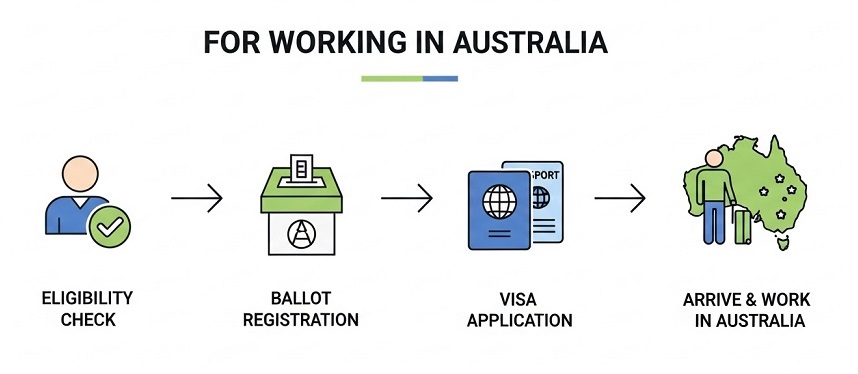
How MATES Compares With Other Australian Work & Migration Options?
MATES vs Standard Temporary Work Visas
| Feature | MATES Stream (403) | Typical Employer-Sponsored Work Visa (e.g., Subclass 482) |
| Sponsorship required | No employer sponsorship needed for MATES. | Employer sponsorship required. |
| Target group | Recent Indian graduates / early career professionals in targeted fields. | Wider pools of skilled workers, many age and experience thresholds. |
| Annual cap | 3,000 places per year for MATES. | Varies by visa subclass and labour agreement. |
| Duration | Up to 2 years stay. | Can vary 2–4 years based on subclass. |
| Pathway to PR | Not automatic; participants need to explore other visa pathways afterwards. | Some employer-sponsored visas provide direct pathways to PR under certain conditions. |
MATES vs Skilled Migration Visas
- Skilled visas (e.g., Subclass 189, Subclass 190) are designed for long-term/permanent migration, require skilled assessment, points-test, nomination.
- MATES is a mobility program, primarily for gaining experience and temporary stay in Australia, especially for Indian graduates in high-demand fields.
- If your goal is permanent residency, you may use MATES period to gain experience and then transition into a skilled migration stream or employer-sponsored option.
Key Questions Addressed
Q1. What is the MATES Program and who can apply?
The MATES programme is the Mobility Arrangement for Talented Early-Professionals (under Subclass 403) offered by Australia for Indian nationals. It allows eligible Indian graduates and early-career professionals (18 to 30 years(Inclusive), recent graduates from specified fields) to live and work in Australia for up to two years, under a ballot-based allocation of up to 3,000 places annually.
Q2. How does the ballot and application process for MATES work?
Applicants must first register a pre-application ballot when the registration window opens. A fee of AUD $25 is payable for registration. If selected in the ballot, the applicant receives an invitation and must then lodge the full visa application for the Subclass 403 MATES stream within the timeframe and meet all visa criteria.
Q3. What benefits does the MATES visa provide and are there any restrictions?
Benefits include the opportunity to live and work in Australia for up to 24 months, bring family members (spouse or children) who can also have full work rights, and enter Australia multiple times during the visa period. Restrictions include the age, qualification and field-of-study eligibility, the annual cap of 3,000 applicants, and it being a temporary visa without an automatic pathway to permanent residency.
Q4. Can the time spent on the MATES visa count towards Australian Permanent Residency (PR)?
While the MATES visa itself does not guarantee PR, the time working and living in Australia under the visa can enhance your profile and experience. If you meet the eligibility criteria for a skilled migration or employer-sponsored visa in the future, your Australian experience may strengthen your application—but you’ll still need to meet all requirements of the subsequent visa.
Q5. What role can Aussizz Group play in my MATES visa journey?
With a strong track record of guiding over 180,000 applicants to their Australian visas, Aussizz Group can assist you with eligibility assessment, documentation preparation, ballot registration timing, visa application strategy, and planning next-stage pathways (such as skilled migration) so you maximise your MATES opportunity and beyond.
Take the Next Step Now
The MATES programme is a ground-breaking mobility pathway between India and Australia for 2025, offering Indian graduates and early-care professionals an exceptional chance to live and work in Australia for up to two years-without employer sponsorship. By preparing early, leveraging your eligibility in targeted fields such as engineering, AI, FinTech or renewable energy.
Seize the opportunity by booking a consultation with Aussizz Group and make your Australian dream come true.
Introduction
If you’re someone who loves hands-on work, creativity, and building a stable career, then studying a trade course in Australia is one of the smartest paths you can take.
From carpentry and fabrication to horticulture and automotive repair, trade programs are designed for students who want to turn their skills into real, employable opportunities. These qualifications are highly practical, industry-driven, and form a key part of Australia’s Skills Priority List – offering strong job outcomes and Permanent Residency (PR) pathways.
At Aussizz Group, our expert education counsellors and registered migration agents help you choose the right trade course, secure your visa, and map out your long-term PR strategy.
Why Choose a Trade Course in Australia?
Trade courses combine technical expertise with practical, job-ready training. They’re ideal for students who prefer real-world skills over purely theoretical learning.
Top Benefits:
- High demand across construction, manufacturing, automotive, and horticulture industries.
- PR eligibility through the Skilled Occupation List (SOL) and MLTSSL.
- Hands-on learning through workshops, site experience, and apprenticeships.
- Strong earning potential with consistent job opportunities nationwide.
- Flexible study levels – Certificate III, IV, and Diploma programs.
Trade courses offer more than skills – they open doors to a long-term career and migration success.
Popular Trade Course Options in 2026
Based on the official register training.gov.au, here are the most in-demand trade qualifications for international students in 2026:
| Trade Course | Qualification Pathway | Career Opportunities | PR Eligibility |
| Carpentry (CPC30220) | Cert III → Cert IV | Carpenter, Site Supervisor | Yes |
| Bricklaying / Blocklaying (CPC33020) | Cert III → Cert IV | Bricklayer, Mason | Yes |
| Automotive Technology (AUR30620 / AUR40216) | Cert III → Cert IV → Diploma | Mechanic, Auto Electrician | Yes |
| Panel Beating (AUR32120) | Cert III → Cert IV | Automotive Body Repairer, Panel Beater | Yes |
| Wall & Floor Tiling (CPC31320) | Cert III → Cert IV | Tiler, Site Worker | Yes |
| Commercial Cookery (SIT30821) | Cert III → Cert IV → Diploma of Hospitality Mgmt | Chef, Cook | Yes |
| Painting & Decorating (CPC30620) | Cert III → Cert IV | Painter, Decorator | Yes |
| Solid Plastering (CPC31020) | Cert III → Cert IV | Plasterer, Renderer | Yes |
| Cabinet Making (MSF30322) | Cert III → Cert IV | Furniture / Cabinet Maker | Yes |
| Engineering – Fabrication Trade (MEM30319) | Cert III → Cert IV | Welder, Metal Fabricator | Yes |
| Glass and Glazing (MSF30422) | Cert III → Cert IV | Glazier, Glass Installer | Yes |
| Horticulture (AHC30722) | Cert III → Cert IV → Diploma | Gardener, Landscape Technician, Nursery Supervisor | Yes |
You can explore detailed qualification structures on training.gov.au.
Course Fees & Intake Dates for 2026 Trade Programs
Trade courses in Australia are among the most affordable and high-value study options for international students. The table below provides an overview of average tuition fees and key intakes for 2026:
| Course | Duration | Average Annual Fee (AUD) | 2026 Intakes |
| Carpentry (CPC30220) | 2 years | $12,000 – $18,000 | Feb / Jun / Oct |
| Bricklaying / Blocklaying (CPC33020) | 2 years | $10,000 – $16,000 | Feb / Jun / Oct |
| Wall & Floor Tiling (CPC31320) | 2 years | $11,000 – $17,000 | Feb / Jun / Sep |
| Solid Plastering (CPC31020) | 2 years | $10,000 – $15,000 | Feb / Jun / Sep |
| Fabrication (MEM30319) | 2 years | $13,000 – $20,000 | Feb / May / Sep |
| Glass & Glazing (MSF30422) | 2 years | $11,000 – $16,000 | Feb / Jun |
| Horticulture (AHC30722) | 1.5 – 2 years | $10,000 – $17,000 | Feb / Jul |
| Panel Beating (AUR32120) | 2 years | $13,000 – $19,000 | Feb / Jul / Oct |
| Cabinet Making (MSF30322) | 2 years | $11,000 – $16,000 | Feb / Jun |
| Commercial Cookery + Hospitality Mgmt (SIT30821) | 2.5 – 3 years | $15,000 – $22,000 | Feb / Jul / Oct |
| Automotive Technology (AUR30620) | 2 years | $12,000 – $18,000 | Feb / Jul / Oct |
Note: Fees may vary depending on provider, state, and location.
Many trade colleges also offer rolling monthly intakes for programs such as Automotive, Fabrication, and Horticulture, ensuring faster enrolment and flexible start dates.
Tip: Apply early to secure your seat and streamline your Subclass 500 Student Visa application.

Our Top Trade Course Recommendations for 2026
If your goal is PR and high employability, focus on trades currently in shortage:
- Fabrication (Metal / Welding) – Key MLTSSL occupation.
- Carpentry – High PR success rate and steady demand.
- Bricklaying & Solid Plastering – Critical for housing and infrastructure growth.
- Horticulture – Emerging PR pathway under regional occupation lists.
- Panel Beating (Automotive Body Repair) – In-demand in urban and regional service industries.
- Wall & Floor Tiling – Reliable employment across Australia.
Each qualification is recognised by Trades Recognition Australia (TRA) for skills assessment and PR eligibility.
Demand for Trade Occupations in Australia
According to the SkillSelect EOI Data Dashboard (Department of Employment & Workplace Relations):
- Carpenters & Joiners (331212) remain top for 189, 190 & 491 visa invitations.
- Welders (322313) and Metal Fabricators (322311) show strong demand regionally.
- Chefs (351311) and Automotive Technicians (321211) remain consistently nominated.
- Horticulturists (362311) and Panel Beaters (324111) show rising demand, especially under state-sponsored migration programs in QLD, SA, and WA.
- Bricklayers (331111) and Solid Plasterers (333212) remain critical for Australia’s housing projects.
These trends confirm that trade courses continue to be top PR pathways for international students.
Career & PR Pathways After Completing a Trade Course
- Graduate → Apply for a Temporary Graduate Visa (Subclass 485).
- Obtain Provisional Skills Assessment (PSA) from TRA.
- Gain 12 months of skilled work experience in Australia.
- Apply for a Full Skills Assessment.
- Pursue PR via Subclass 189, 190, 491, or Employer Sponsored Visas (482/186).
How Aussizz Group Supports You?
At Aussizz Group, we provide complete guidance from course selection to PR strategy, including:
- Course & College Selection: Choose trade programs aligned with your career and migration goals.
- Visa Assistance: For student (500), graduate (485), skilled (189/190/491), and employer-sponsored visas.
- OSHC & OVHC Arrangements: Via GetMyPolicy.online – affordable, DHA-compliant coverage.
- TRA Skills Assessment Support: Documentation, guidance, and submission.
- Migration Pathway Planning: Long-term PR and sponsorship advice.
- Professional Year & Job Preparation: Gain experience and PR points.
With 30+ offices globally, Aussizz Group is your trusted partner for achieving a skilled career and permanent future in Australia.
Conclusion
Build a Career That’s as Solid as Your Skills
Trade qualifications are your foundation for job stability, migration opportunities, and hands-on success in Australia. Whether you’re crafting furniture, welding metal, shaping gardens, or fixing cars, your skills can shape a long-term Australian future.
At Aussizz Group, we simplify the process – from course selection to visa lodgement – helping you study, work, and settle confidently.
Contact Aussizz Group today to explore 2026 trade course options and take your first step toward your Australian skilled career.