
 AUS
Australia
AUS
Australia
 IND
India
IND
India
 UAE
UAE
UAE
UAE
 CA
Canada
CA
Canada
 SL
Srilanka
SL
Srilanka
The Australian Skilled – Nominated Visa (subclass 190) is for skilled workers who are nominated by a state or territory. The visa allows to live & work in Australia permanently and include certain family members in the application.
If you are an overseas worker looking to apply for this visa, you need to first submit an Expression of Interest through Skill Select. You are required to score at least 60 points in total, including 5 points from state, on the points test to be eligible for this visa.
To score 60 points in Expression of Interest, you must:
- Nominate an occupation that is listed on the state’s Nominated Occupation List.
- Be under 45 years at the time of nomination.
- Commit to live in the state that nominated you for 2 years from the date of your arrival
- Have a positive General Skilled Migration skills assessment from the relevant authority.
- Have Competent English (IELTS 6 in each band)
- Meet the health and character requirements.
Each state maintains a list of occupations in demand as part of their State Migration Plan. They may also have additional requirements that you are required to meet to be eligible to apply for subclass 190 visa.
Let’s take a look at each of them!
South Australia
- South Australia Nomination Occupation List :
- Applicants can apply for occupations listed as ‘Available’ or ‘Low Availability’ on the State Nominated Occupation List. Each occupation listed has a planning level which should be reached; the occupation will then be listed as “Special Conditions Apply”. To apply for these occupations, you must meet the requirements listed under Special conditions apply & Supplementary skilled list
One must also have:
- at least one year of skilled work experience (at least 20 hours per week of paid employment) in the past three years (or more in case of higher work experience requirement).
- Evidence for the amount of work experience, if additional work experience is listed for your occupation.
- Sufficient fund to settle in Australia. For South Australia, you should have $20,000 to $40.000 cash depending on the number of dependants on your application.
- the Occupation available for direct application without any special condition.
Canberra ACT
- Canberra ACT Nomination Occupation List https://www.canberrayourfuture.com.au/portal/migrating/article/act-occupation-list/
- If your occupation is ‘closed’ on the ACT Occupation List, you may still be eligible to apply for ACT nomination if you have close ties (job offer or family) in Canberra.
- If you do not have a genuine job offer, you must research the ACT labour market and provide evidence that there are sufficient employment opportunities in your nominated occupation in Canberra.
- Your skills and work experience must be relevant to the nominated occupation and to the ACT economy.
- You must also have access to sufficient financial assets to fund your migration and settlement in Canberra while you seek employment.
Tasmania
- Tasmania Nomination Occupation List: https://www.legislation.gov.au/Details/F2017L00850
- You must have received a formal job offer and it should be relevant to your nominated occupation
- You or any of your dependants must not have lived in another Australian state or territory within the last 12 months
- You need to be able to provide evidence of your employment claims
- Your employer must have been actively involved in business in Tasmania for the past 12 months before applying for visa
- There needs to be a genuine need for your position and the business must have the capacity to sustain nominated occupation
Northern Territory
- Northern Territory Nomination Occupation List https://www.australiasnorthernterritory.com.au/migrate/migrate-to-work/northern-territory-government-visa-nomination/nt-migration-occupation-list
- For a number of occupations on N-T Migration Occupation List, you must provide evidence of an offer of employment in your nominated occupation or in a closely related skilled occupation
- You must have evidence of full-time employment in your nominated occupation for at least 12 months out of the last 24 months
- You must also demonstrate of living and working in the Northern Territory Evidence that you have done detailed research into living and working in the NT to show that you have a realistic knowledge of the NT including climate, relocation costs and living expenses.
Victoria
- Victoria Nomination Occupation List
- Each occupation in Victoria nomination list has got separate English requirement, work experience and additional requirements
- One must have financial resources ranging from $30,000 to $80,000, depending on the number of additional applicants on your application
Western Australia
- Western Australian Nomination Occupation List: https://migration.wa.gov.au/services/skilled-migration-western-australia/occupation%20lists
- If you are nominating an ANZSCO Major Occupation Group 1 or Group 2 then you must have 7 in each band in IELTS while all other occupations require 6 in each band
- You must have a contract of full time employment for at least 12 months in WA in the nominated occupation
- Sufficient funds to cover your settlement costs.
New South Wales
- NSW has two steam
Stream One: Occupations on the NSW 190 Priority Occupation List
Stream Two: Very highly ranking candidates in eligible occupations
The highest ranking candidates in occupations on the NSW 190 Priority Skilled Occupation List will be invited first. - No Experience is required for any occupation except cook. Cook occupation will require 2 years of experience.
- If you have 80 points including state nomination but your nominated occupation is not listed in NSW occupation list, then you might have high chances of getting an invitation under stream 2.
- Applicants with IT, Accounting and Engineering as their nominated occupation are required to have higher points to get invitation.
Need further assistance on 190 visa? Drop your queries and get them resolved right away by our experts on Aussizz Group Forum.
OccuSearch is now live! Download now and get information on your eligibility to migrate to Australia.
Nursing has become one of the most popular course choices amongst international students these days. Nurses work closely with different health professionals, patients and their families. They encounter people during the most difficult times of their lives and others during the most exciting times. This makes nursing a career that is both rewarding and versatile.
If you are a nursing aspirant dreaming to jump start your career in the Health sector, then you should have a very clear idea about the entry requirements for various nursing programs. The most important factor that determines admission to a nursing course is the level of English of the student.
Here are some FAQ’s explaining the English language requirement for admission into nursing courses in Australia.
Do I need to provide an English test score for studying nursing in Australia? If yes, what are the acceptable English tests for admission?
Yes, English is an important requirement for admission into nursing program.
The accepted English test results vary per educational provider, but most commonly accepted tests are IELTS (Academic), PTE (Academic), OET and TOEFL iBT.
What is the English Test score I need to study nursing?
Get an IELTS score of 7 Band if you want to study nursing in Australia.
What if I do not meet the English requirement for these courses?
If you do not meet the English language requirement, there are course packages available that can assure you admission to your preferred course.
Do I need to meet English language requirement to qualify for the IRON Program (Bridging program for overseas registered nurses) as well?
Yes, you need to meet the requirement of IELTS 7 each or equivalent score in PTE, OET or TOEFL iBT. For any of the above test, within 6 months of the duration of first exam, results can be combined from two sittings as long as the minimum score for the specific test is reached.
What is the English requirement to get myself registered as an EN (Enrolled Nurse) or an RN (Registered Nurse) in Australia?
This requirement is same as for IRON Program, i.e., you need to have IELTS 7 each or equivalent score in PTE, OET or TOEFL iBT. For any of the above test, within 6 months of the duration of first exam, results can be combined from two sittings as long as the minimum score for the specific test is reached.
Are there any exceptions to this requirement for registration with AHPRA?
There are few exemptions to this standard as below:
- You don’t have to present any test result if English is your primary language i.e. at least 6 years of your primary and secondary education was taught and assessed in English in any of the recognised countries which are Australia, United States, United Kingdom, Canada, New Zealand, The Republic of Ireland and South Africa.
- Besides, if you have completed five years full-time equivalent of education taught and assessed in English in any of the recognised countries which includes your nursing study.
Must Read – Your Guide To Get Into A Nursing Program In Australia
So if you are looking for more information on Nursing Program in Australia, don’t hold back or delay. Call us right away to Book for a Free Consultation with our Experienced Education Consultants. It is time to make your international dreams come true.
If you are still hung up on doubts and queries, then just resolve them by asking the Experts on our International Student Forum.
Australia is one of the friendliest and fun countries. You have plenty to explore when you come to study and live in Australia. However, the first concern of all the International Students in Australia is money. With the 20 hours work limitation on their visa and the difference in the dollar value of their native currency and AUD, money can be tight.
To make your student life a bit easier there are plenty of hacks which may help you to save some money here and there.
Student Edge
Join studentedge.org for FREE. If you are a student edge member then you can receive discount in categories like Technology, Fashion, Entertainment, Food, Travel, Health and more.
ISIC (International Student Identity Card)
You can get ISIC card for just $30 per year. It will allow you to grab the cost-effective travel deals, money off online shopping, attractive discounts on restaurants, cafes and takeaways. This globally recognised student ID gives you access to over 150,000, discounts all over the world.
Unidays
You can join Unidays for free and become a member. They provide discounts from classroom, tech must-haves, fitness products to new outfits.
Even without signing any of the above-mentioned memberships students can still enjoy discounts. Lots of business always has special offers for students. Here are some of the best discounts
Technology
In this current generation of technology advancement all the students are required to be up to date with the new technology. If you have your student ID card, then you will be eligible for following student-specific deals:
- 25% off on Microsoft products
- 10% off on Surface and Xbox and 25% off on accessories.
- Deals from Adobe.
- Apple has a specific store for university buyers. They run offer like get Beats free on your purchase.
Travel
Next time you buy air ticket make sure you visit following websites like Student Flights, Virgin Australia, Cheap o Air, STA Travel as they always have a very attractive deals for the students. The flight prices they offer are comparatively cheaper than their normal flight prices. You can definitely save some big bucks simply using your student ID card.
Not only air travel but also you can get the Ferry, Buses, and Train rides at a concession price if you present your Student ID card.
Fitness
As a student you may want to stay fit and join gym. The gym membership can be very expensive. But there are lot of fitness places that offer huge student discount. That means you can stay on budget and still be fit.
These are some of the fitness places that provide student discounts;
- Fitness First
- Anytime Fitness
- Jetts 24 Hour
- Genesis
Fast Food and Chain Restaurants
If you sign up for the loyalty cards and membership cards at the restaurants and cafes, then you can save few bucks here and there. Places like Boost Juice, Oporto, Nando’s, Salsa’s etc. all have birthday bonuses and also general student discounts like buy one get one free.
Always look for a bargain because there is a good chance of finding one, all you have to do is ask.
Make sure you reap the benefits of being a student in Australia and enjoy the best of both worlds with incredible discounts!
Go grab the amazing discounts and be safe from paying hefty. In case you need a friendly advice for your visa or any other issues, you can always reach out to our education counsellors
For more precise queries, you can always get in touch with the Experts at our International Student Forum
Due to the changing social trends, busy lifestyle and diminishing leisure time of the Australian population there has been a significant growth in the number of restaurants in Australia. This, in turn, has increased the demand for well-trained and qualified chefs. Commercial Cookery course is perfect for those seeking for a career as a chef. The culinary industry definitely has bright and attractive opportunities for you and your cookery ideas to blossom.
The minimum requirement to study Commercial Cookery is
- 5.5 overall in IELTS with no band less than 5
- a minimum of Year 11 schooling or equivalent completed
The full Commercial Cookery course comprise of
- Cert III in Commercial Cookery: This is a one-year training course, which offers both theory and practical training. At the conclusion of it, all students must undertake a mandatory workplace training of 10 weeks in a suitable hospitality establishment such as restaurants, hotels, cafes, coffee shops etc. as a trainee chef.
Completing Cert III in Commercial Cookery makes you eligible to become a qualified cook. - Cert IV in Commercial Cookery: This is a 6 months course for the students who have completed Certificate III in Commercial Cookery and want to have a role above cook in kitchen operations. After Completion of this course you are eligible to become a qualified chef. At the end of the Commercial Cookery course you fully capable of working independently with minimal guidance from others.
NOTE: Depending on the college where you enrol, the work placement can either be on the course content during Certificate III or Certificate IV. During the one and half year course you are required to complete total of 360 hours of work placement.
Some colleges may not have Certificate III course and may offer 1 and half years of Cert IV in commercial cookery
Diploma of Hospitality Management (Commercial Cookery Pathway): This is a 6 months course which is suitable for students who have completed the Certificate III and Certificate IV in Commercial Cookery and want to enhance their skill and knowledge in hospitality operations. You will acquire skills in budgeting, customer service, financial management, inventory control and operational planning. Completing this course makes you eligible to become kitchen manager, restaurant manager, sous chef or unit manager.
After completion of Diploma of Hospitality Management, you may study Advanced Diploma of Hospitality Management or Bachelor courses at Universities.
Migration Aspect of Commercial Cookery Course
STEP 1 – Provisional Skills Assessment (PSA)
After completing 2 years of Commercial Cookery package course you can apply for Temporary Graduate Visa (subclass 485) under graduate stream. You are required to get Provisional Skills Assessment (PSA) from Trade Recognition Australia (TRA).
Eligibility Criteria:
- Valid Student Visa
- CRICOS registered qualification that is relevant to the occupation assessed by TRA
- Proof of relevant paid employment or work placement of minimum 360 hours relating to your qualification and nominated occupation
- The experience/placement must be within 3 years before the submission of PSA application
Related Read: All you need to know about Temporary Graduate Visa in Australia
Apply for Graduate Temporary (subclass 485) Visa
After getting positive PSA you can apply for 485 visa.
Requirements for 485 visa application
- You need to satisfy 2 years Australian study requirement.
- You need 6 overall but no less than 5 in any module in IELTS.
- Your nominated occupation is required to be in MLTSSL.
If the application is decision ready and if all the required documents are submitted at the time of application then the 485 visa will be granted for the duration of one and half years (18 months).
STEP 2: Job Ready Program (JRP)
Once the Graduate Temporary visa is granted you need to get your full skills assessment done. You need to enrol in Job Ready Program (JRP). The purpose of JRP is to enable you to gain experience in an Australian workplace to further develop your skills.
STEP 3: JOB READY EMPLOYMENT (JRE)
Over a period of 1 year you must have paid employment of at least 1725 hours from the start date of your Job Ready Employment in an Australian workplace which is TRA approved.
During your employment, you will be required to keep a monthly journal describing examples of the tasks and duties you are undertaking in your workplace relevant to your occupation.
STEP 4: JOB READY WORK ASSESSMENT (JRWA)
You will be assessed at your workplace by a TRA – approved registered training organisation. The assessment will focus on the activities you have been required to perform during the period of your employment as recorded in your Job Ready Journal.
After the assessor has reviewed your documentation and is satisfied with your performance, he/she will give you a positive JRWA outcome.
STEP 5: JOB READY FINAL ASSESSMENT (JRFA)
After the successful PSA and JRWA outcome you will become qualified to apply for JRFA. This is the final step of the JRP. You need to submit an evidence of 1725 hours of paid employment in the period of 12 months in the occupation you chose. Along with that you must provide the 12 months of Job Ready Journals signed by your nominated supervisor and approved by TRA. After this you will receive Full Skill Assessment from TRA.
Apply for Australia Permanent Residency
With the Full Skills Assessment from TRA you can apply Permanent Residency through the points based visa stream. You can then look to apply for PR Visa Subclass 189 or 190 or 489. Therefore, if you are aiming to work as a cook or a chef and become a permanent resident in Australia, you can certainly opt for this pathway. Contact our education counsellor to get complete details about the course providers, intakes, tuition fees and more.
Have queries about Cookery courses & career prospects for a cook/chef? Get answers from the experts on our International Student Forum
Information technology courses are high on demand and it would benefit you highly if you know where you would stand after the graduation. Wouldn’t it? Performing the ground work analysis amongst your busy schedule would be a task. So, we have done all the major work for you and broken down the important pieces of information for you.
The IT job market has been consistent over the past few years in Australia. Though there are fluctuations, it is not anything major for the techies to worry about. This blog is dedicated to all IT under-graduates without work experience who are curious to know what they can look for in the market. We have picked the top 4 professions in which graduates with no work experience are hired!
Top 4 Professions in Information Technology
Test Engineer
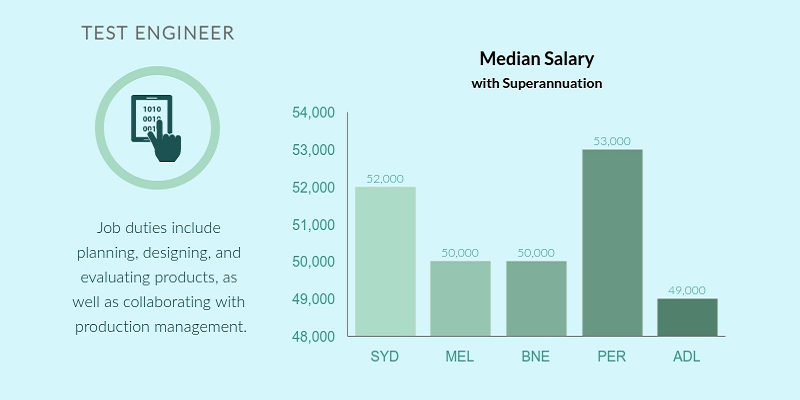
Test Engineer is a highly specialised position which leads to several prospective career paths within IT. It is to be noted that majority of the graduates who are fresh on board in this profession have Bachelor degree. Yes, that is a bit of good news for the under-graduates! Moving on to the statistics of comparing the median salary for Test Engineers across various cities in Australia, Perth has the highest paid test engineer jobs for the graduates. However, there is not much difference in the salary across the cities. In this case, you might want to consider comparing the living expense to make your call.
Software Engineer
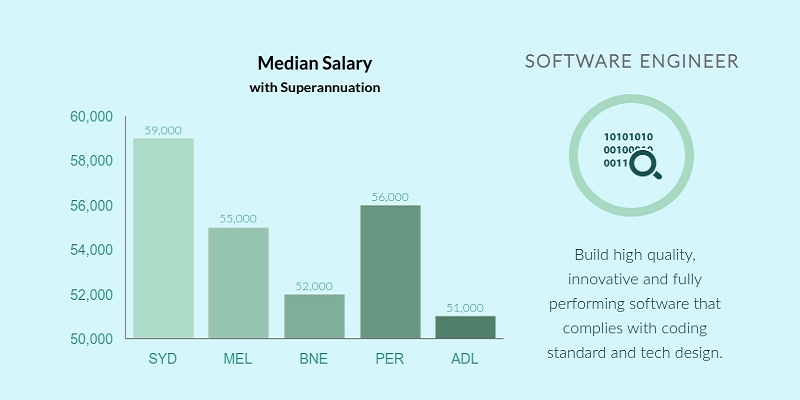
If dealing with networks, operating systems, databases or applications is your key, then Software Engineering is the profession you should be hunting for. If you start your career as a Software Engineer, there are high possibilities for you to reach the top of your career as Development Manager. Sydney job market is the winner this time with the highest median pay for graduates without work experience. In fact, this is the highest paid graduate job across Australia.
App Developer
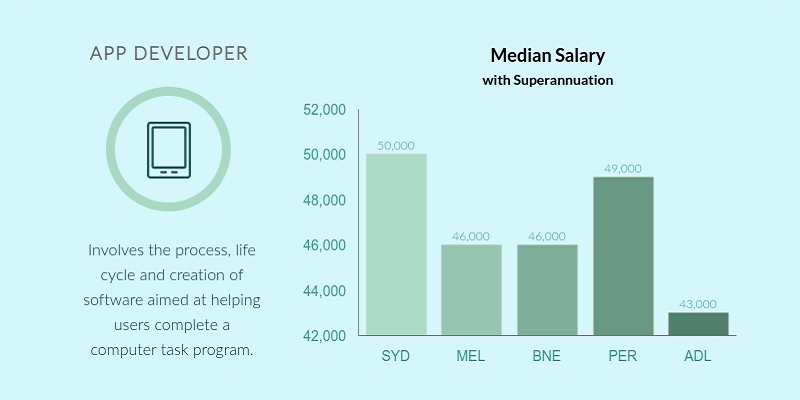
If you are bit by the code bug, then App Developer job role would be your piece of cake. This position involves designing prototypes, developing application and coding. Once again, Sydney’s median is high. However, you might want to consider Perth as there is just a minor variance in terms of salary, but the living expense would be comparatively less.
Support Analyst
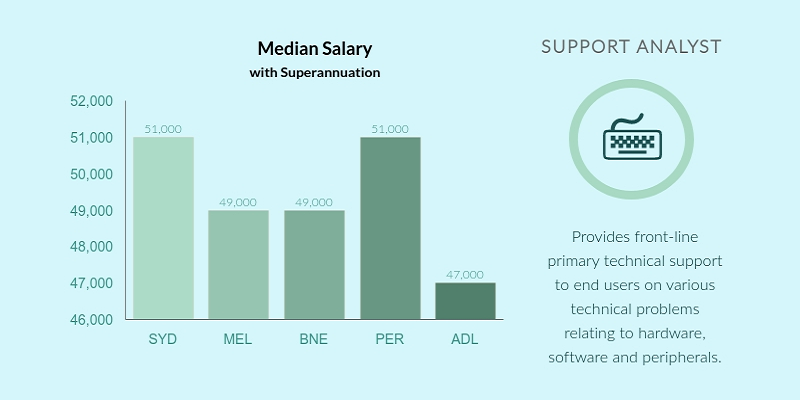
Support Analyst is a job role with high number of openings for graduates without work experience. In this job role, you would be a part of back end team providing technical support. For this role, though the median salary is highest at Sydney and Perth, the difference is minor amongst all the cities. So, you can sit back and prioritise other aspects than salary to make your decision.
Thus, now you know what kind of jobs you must hunt for in the Australian market, the ones that are going to pave a better career pathway for you. However, you must note that these are just the median salaries and they can vary depending upon the software languages and tools you equip yourself with.
If you are anticipating which career to choose and want to know about your study or PR prospects in Australia, you can consult with our counsellors at any of our nearest branches. Having helped numerous aspirants realise their dreams and goals to Study in Australia, our counsellors are well-versed & experienced to give you the most suitable advice regarding career choices and of course the right kind of Australia visa. Just get in touch with any of our branches or request someone from our team to connect to you by simply filling out the inquiry form.
Want to study or settle abroad but have lots of doubts? Get answers to your queries on our Immigration Expert Forum
If you are a potential aspirant looking to migrate to Australia, you would probably be familiar with the term Skilled Occupation List (SOL).
It is a standard list of occupations currently acknowledged for immigration to Australia. The list comprises of different categories including professionals, managers, traders, etc and is applicable to following visas:
- Subclass 186 Employer Nomination Scheme
- Subclass 187 Regional Sponsored Migration Scheme
- Subclass 189 Skilled Independent visa
- Subclass 190 Skilled Nominated visa
- Subclass 485 Temporary Graduate visa
- Subclass 489 Skilled Regional Sponsored visa
The Department of Home Affairs updates the SOL on a regular basis to demonstrate or echo changes in the Australian Labor Market and current demand for occupations in the country.
Following is the summary of proposed changes made on 17 January 2018 to the list of eligible skilled occupations.
Occupations added to the list & the caveats applicable
| Occupation | ANZSCO Code | Caveat Applicable (From January 2018) |
|---|---|---|
| Property Manager*** | 612112 | Only below positions are exempted from caveats: – Nominated base salary of less than AUD$65000 – Business with less than five employees – Business with annual turnover of less than AUD$1 Million – The location is not in regional Australia |
| Psychotherapist | 272314 | Nil |
| Real Estate Representative*** | 612115 | Only below positions are exempted from caveats: – Nominated base salary of less than AUD$65000 – Business with less than five employees – Business with annual turnover of less than AUD$1 Million – The location is not in regional Australia |
Note: You can find the list of eligible postcodes in Regional Australia here: ?
Occupations Removed from the List
| Occupation | ANZSCO Code |
|---|---|
| Horse Breeder*** | 121316 |
| Management Consultant | 2274711 |
Occupations Moved from STSOL to MLTSSL
| Occupation | ANZSCO Code | Caveat Applicable (From January 2018) |
|---|---|---|
| Horse Breeder*** | 121316 | Positions Exempted: – Predominantly involve low skilled tasks (for instance: fruit picking or packing, feeding of livestock or animals) OR – The location is not in regional Australia Note: This caveat has not changed |
| Management Consultant | 2274711 | Positions Exempted: – Hold Annual Turnover of less than AUD$1 Million – Operate business with less than five employees – Have Nominated base salary of less than AUD$90,000 Note: Base Salary Requirement has been raised to $90,000 |
Source: Department of Home Affairs
The above changes will be applicable to the applications lodged on or after 17 January 2018 and will not affect the applications lodged prior to this date.
Need further assistance to apply for the visa or want to know the caveats on occupations in detail? Get in touch with our experts today!
As a recent international graduate in Australia, you constantly find yourself tangled in the thoughts of your next move, whether to extend and find work in the country or pursue further studies.
Aren’t you?
Well, regardless of the preference, one option that offers you the privileges of both is applying for Temporary Graduate Visa (Subclass 485).
Specifically designed for international graduates from Australian educational institution, 485 visa comprises of two streams:
- Graduate Work Stream (valid for 18 months)
- Post-Study Work Stream (valid from 2 to 4 years)
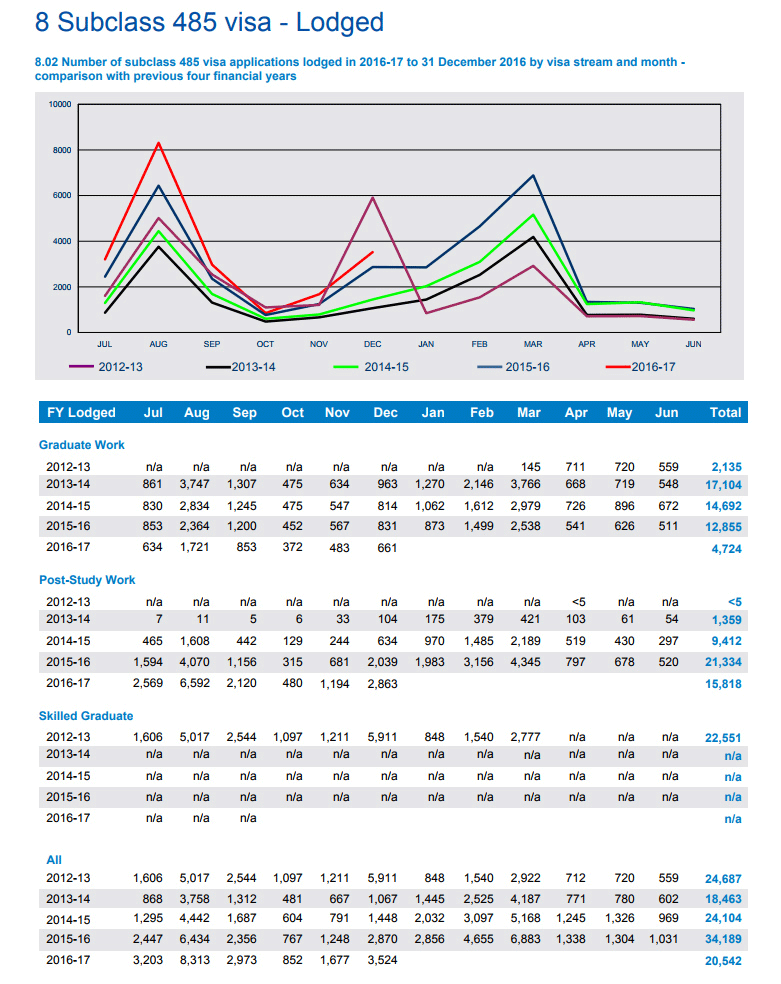
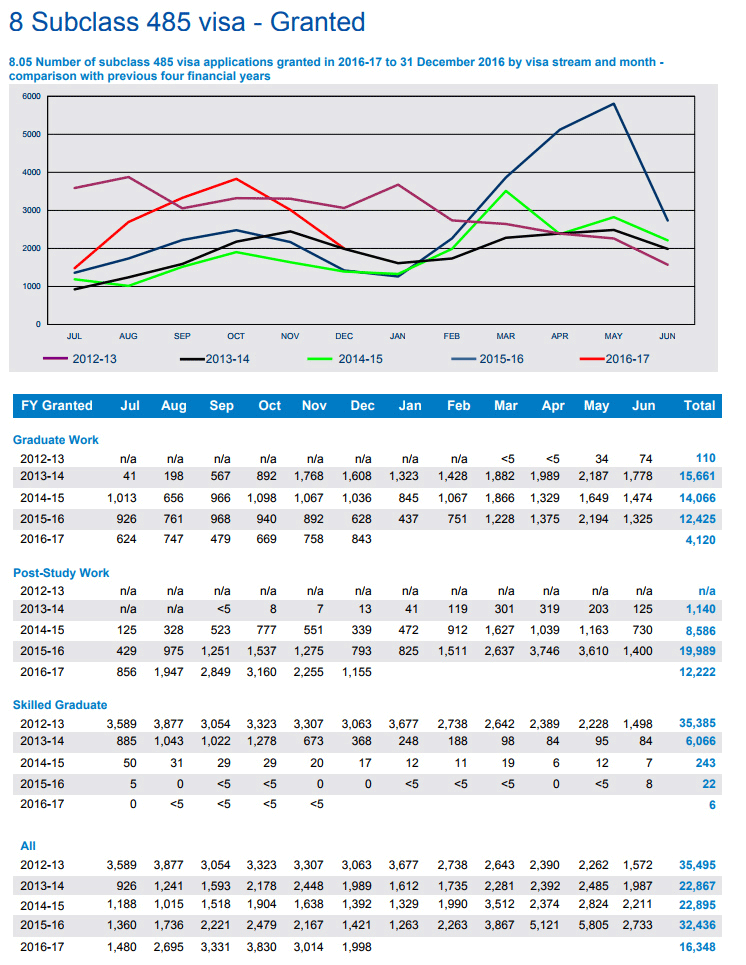
Over the past few years, there has been an exponential growth in the number of applicants applying for temporary graduate visa as it imposes no restrictions to undertake an employment and also increase the likelihood of acquiring a permanent residency in Australia.
The statistics given below clearly demonstrate the same. Take a look!
Source: https://www.homeaffairs.gov.au/
Are you also willing to apply for 485 visa?
Before you start prepping for its visa application, we have highlighted few points below that you must know to avoid common pitfalls.
1. English Language Requirement: All the applicants of 485 visa are required to provide evidence of English language proficiency. It can be proved by either of the following tests.
| Test | Listening | Reading | Writing | Speaking | Required Overall score |
| IELTS | 5 | 5 | 5 | 5 | 6 |
| PTE Academic | 36 | 36 | 36 | 36 | 50 |
| TOEFL iBT | 4 | 4 | 14 | 14 | 64 |
| OET | B | B | B | B | – |
| Cambridge (CAE) | 154 | 154 | 154 | 154 | 169 |
2. Overseas Visitor Health Cover (OVHC): 485 visa has the condition attached as a part of eligibility criteria named 8501 condition wherein the applicant needs to have health cover for the duration of stay in Australia.
This requirement can only be met by getting appropriate level of Overseas Visitor Health Cover. Getting a 485 visa health insurance cover an applicant for number of things including ambulance transport, a portion of doctor’s fees, pharmacy costs, hospital admissions, dental or physiotherapy services, etc.
3. Choosing the right stream: Since 485 visa is divided into two categories, you need to know carefully which category you are falling under i.e. graduate or post graduate.
The Graduate Work Stream is eligible for international students who have been graduated with the skills or qualification that is relevant to the occupation listed on Skilled Occupation List.
The Post-Study Work Stream is eligible for international students graduated with a bachelor, masters or doctoral degree from an Australian education provider irrespective of their field of study.
Evidence you need to meet academic qualification requirement for both streams:
- Course must have been registered with CRICOS (Commonwealth Register of Institutions and Courses for Overseas Students)
- Held eligible student visa within 6 months of applying for visa and it must be free of a No Further condition
- Full transcripts with all the mark sheets
- Transcripts in case of credit exemptions taken in the last period of study
- Details of all the completed qualifications (Australia or overseas)
- Completion letter mentioning the completion date
4. Dependent family members: Temporary graduate visa applicants can only include their partner, child/step child or their partner child/step child in their application. All the dependent members of the family unit are required to meet health and character requirement (Form 80) and appropriate level of health cover.
Other Important things to consider to get eligible for 485 visa
- You must have age less than 50
- You must have completed 16 calendar months of studying in Australia
- You must lodge your application within 6 months of course completion
- You must have your skill assessment done from a relevant authority (if applying under graduate work stream)
- You must have applied for Australian Federal Police Check before applying for the visa
Epilogue
If you are willing to extend your stay in Australia on 485 visa then make sure you lodge your application between the completion of your course and expiry of your student visa.
As you need to meet a lot of criteria in the nick of time, chances are high of making errors in the application and facing a refusal or denial of visa. This is why, it is often recommended to embark upon the process with the best assistance or support available.
We, at Aussizz Group, being registered with MARA (Migration Agents Registration Authority), are completely familiar with the current laws, requirements and changes in the Australian immigration. Our assistance in gathering the required documents and lodging a well-prepared application always save our clients from big headaches and get a positive outcome.
Don’t believe us? Why not get in touch with one of our experts today.
A good education is imperative for a successful career. The international education positively impacts your career as well as personal growth. The experiences you gain while studying and living in the globally diverse environment are manifold. Social Worker is one such field where a global exposure matters a lot. And the best places to get valuable and quality Social Worker Education is Australia.
Here we have highlighted various key points related to this field. You will be able to discover ample of opportunities if you are opting to gain Social Worker qualifications from Australia. Below are the pressing questions and their answers that you must be concerned about in case you are very serious about taking up this career.
- What is Social Work?
- Who are Social Workers and what do they do?
- Where do Social Workers work?
- What is the annual earning of a Social Worker?
- Which are the Social Worker Degree Courses in Australia?
- What is the demand of Social Workers in Australia? What are the possibilities pertaining to migration and job roles?
- Are there possibilities for permanent residency after graduating from the related course?
- What is the basic course entry prerequisite for this course?
- Are you interested to start a new career? Where can you study and when can you start?
1. What is Social Work?
Social Work is an exciting career area which is very greatly related to psychology. It is work carried out with well trained professionals with the aim to reduce pain and suffering of those who are suffering from social deprivation. It is an academic and professional discipline that looks into the welfare of individuals and communities.
2. Who are Social Workers and what do they do?
The trained professionals who utilize social theories to understand human issues and help them improve their lives further improving the society as a whole are known as Social Workers. Social Workers usually specialize in helping women, children and aiding to life- threatening problems.
Social Workers:
- Behave as advocates for their clients
- Teach clients new skills
- Get their clients to link to essential resources within the community
- Protect vulnerable clients and make sure that their best interests are observed
- Counsel clients who need support and assistance
- Research social problems to look for remedies
3. Where do Social Workers work?
Most Social Workers are employed either in the social assistance sector or the healthcare sector which include psychiatric clinics, NGOs, hospitals etc.
They are also employed in government agencies at the state and local level. Their positions would include child welfare assessments, help any individual in need of public assistance and also work with individuals who come in contact with the criminal justice system.
4. What is the annual earning of a Social Worker?
An average social worker salary depends on many factors such as the speciality area, educational background etc. However, an average earning of a social worker ranges from approximately AUD 50 K to AUD 80 K per annum (the salary depends on the years of significant experience) an applicant possesses and the demand of the position in each state within Australia.
5. Which are the Social Worker Degree Courses in Australia?
Courses in the field of social work range into 2 types: –
- The undergraduate degree (Bachelor of Social Work) with no prior study. This study can take up to four years to complete.
- The postgraduate degree [Master of Social work / Master of Social Work (qualifying)]. This degree is offered for two years. Recently these courses are also offered to graduates with specialisations such as psychology, law and social science.
Due to diverse areas the specialisations are offered, social workers are able to choose to take up jobs pertaining to family or child welfare services, psychiatric services, healthcare sectors, age care sectors and the criminal law and justice sector.
AASW (Australian Association of Social Workers) is the skill assessment authority for social worker looking to apply for Australia migration visa. Therefore, students studying this course must make sure that it is accredited by AASW for their skill assessment outcome to be positive. to ensure a positive skill assessment for migration purposes.
6. What is the demand of Social Workers in Australia? What are the possibilities pertaining to migration and job roles?
Social Worker is a large occupation and has grown to a considerable extent in the last 5 years. Based on the data provided in the Occupation Ceiling, Social Workers was allocated 1562 places out of which only 72 places have been occupied. Based on this information, statistics say that approximately only 4.6% of the places were taken this year which significantly portrays the skill shortage faced. This trend would continue until more graduates take up this field to study. This field of study is not very popular among students and this information must be made aware greatly so that the skill shortage reduces considerable.
Key Salary Info:-
| Starting Salary | Approx. $50,000 to $55,000 pa |
| Senior level position | Approx. $75,000 to $98,000 pa |
The state of Darwin and Western Australia have the highest demands for Social Worker.
7. Are there possibilities for permanent residency after graduating from the related course?
Certainly, as this occupation falls under the MTSSL list, studying an accredited course from a reputed university will make the student eligible to successfully get a positive Skill assessment from AASW. They can directly apply for the Permanent Residency (189) without having any Australian state or regional area sponsoring them. One needs a minimum of 60 points.
8. What is the basic course entry prerequisite for this course?
To study a Bachelor Degree, the student needs to hold a relevant high school degree with good percentage. To study Master Degree, a Bachelor degree in the following discipline (social welfare, community work, sociology, psychology, nursing, education, criminal justice, international studies, and indigenous studies) is essential. It has been seen that admission criteria can change from case to case basis. The minimum IELTS requirement for entry into the course is overall 6.5 with no less than 6.0 each or PTE equivalent. English Requirement is also subject to change based on the Universities chosen to study this course.
9. Are you interested to start a new career? Where can you study and when can you start?
Social Work courses are offered by many Australian Universities. The earliest intake is in March 2018.
In today’s world, Social Work is definitely one of the occupation rising its way through. For someone who is passionate about the working for the society, Social Worker Career is one best option. Also there are many pathways towards Australia PR.
This is the chance to pursue a noble profession. With our Education counsellors, you can get detailed information and complete guidance on selecting the suitable course. They are not only experts but experienced to provide various solutions depending upon the individual’s requirements and situations. Not just that, they will guide you with your Australia Student Visa application, too. So, just visit our office or fill out the inquiry form to get the process started. We guarantee optimum service.
You can seek guidance from our expert on our International Student Forum too.
International Education can enhance an individual’s career exponentially. While there are many different fields to opt, there is one career that is on the rise in Australia which is that of the Quantity Surveyor and it is related to the field of construction.
Australia offers top quality education with industry oriented practical exposure as a part of course curriculum. Based on such valuable learning that it offers, it attracts large number of international students. This profession, however, is not so well-known amongst the folks hailing from outside the land down under. But, there are Quantity Surveyor Courses offered by reputed Australian educational institutes that one can opt.
This blog answers all the questions that uncover the occupation of Quantity Surveyor in detail.
- Who is a quantity surveyor?
- How much are quantity surveyors earning?
- What qualification will I need to become a quantity surveyor?
- What is the scenario regarding the demand for this field in Australia? What are the possible migration outcome and job outcomes?
- Is there a possible PR option after studying this course?
- Can I study this course at a Masters level without holding relevant Bachelors in this field?
- I am interested in this new career and eager to start? Where can I study and when is the next intake?
1. Who is a quantity surveyor?
A Quantity Surveyor is a qualified professional who specialises in managing complete costs (from start to final calculations) related to the building and civil engineering projects measurement and estimating the value of construction costs. A qualified professional will be working for the lucrative construction industry providing key inputs on Building Cost evaluation and management process.
2. How much are quantity surveyors earning?
They earn an average salary of AU$74,648 per year. As professionals build their project management skills, wages rise to up to AU $110,000 per year
3. What qualification will I need to become a quantity surveyor?
A Bachelors or Masters level qualification in an appropriate field of construction management is needed. Some of the examples of qualifying degrees are as below
- Bachelor of Construction Management
- Bachelor of Construction Management and Economics
- Master of Construction Practice (Professional)
For any student, looking to apply for Permanent Residency Visa for Australia, it is advised to opt for courses accredited by AIQS (Australian Institute of Quantity Surveyors) to ensure a positive skill assessment.
4. What is the scenario regarding the demand for this field in Australia? What are the possible migration outcome and job prospects?
There is obviously an enormous demand in Australia and a skill shortage with not enough students taking up this field. This also reflects in the occupation ceiling. A total of 1000 occupation ceilings have been allocated for applicants for migration programme year 2017 and so far only 18 have been filled. This trend is expected to continue until we see more graduates taking up this field of study. So far, awareness around this field of study is less among the international students.
Key information:
| Initial salary | $63,500 P/A |
| Senior salary | $110,000 P/A |
| Average salary | $75000 P/A |
The top three regions for employment as a Quantity Surveyor include:
| Queensland (QLD) | 27.1% |
| New South Wales (NSW) | 27.0% |
| Victoria (VIC) | 23.8% |
5. Is there a possible PR option after studying this course?
Yes. Students can secure a positive skill assessment from AIQS upon completion of one of their accredited courses. Since the occupation is on the Skilled Occupation list i.e MLTSSL, one can meet the requirements for Permanent residency (189) with 60 points. You need not be sponsored by any state or regional area.
6. Can I study this course at a Masters level without holding relevant Bachelors in this field?
Students can certainly opt for this course at a Masters level too. The non-graduate entry allows students from any discipline to become a Quantity Surveyor after completing a Masters level course. You will require an IELTS score of overall 6.5 with no bands less than 6.0 or even PTE equivalent is accepted for entry into the course.
7. I am interested in this new career and eager to start? Where can I study and when is the next intake?
Many universities offer Construction management courses at a Bachelors level and Masters Level Australia wide. The earliest intake for this course is in Jan 2018. So what are you waiting for!!! For more info on quantity surveyor Courses and to make an application.
Quantity Surveying in the public sector has high importance. Due to which the pay is lucrative. Quantity Surveyors are regarded as construction industry professionals. If you are looking to make your career in that industry, then going for a specialised course is sure to yield fruitful results. As the occupation is in the MLTSSL, there are good chances for the international students to get Permanent Residency in Australia post completion of the suitable academic course.
At Aussizz Group, our education counsellor work diligently to provide all round solution for every aspiring student. They have developed expertise and supported numerous students choose the right course, suitable institute and even assisted entirely with the Student Visa for Australia. You, too, can get in touch with our counsellors at any of our branches to know more about the Quantity Surveyor occupation and pathway courses to it. If you prefer that we contact you, then fill your details in the inquiry form and one of our education consultant will get back to you.
Want to ask another question? Ask the overseas education professionals on the Study Abroad Forum.
Over few years, Australia has emerged as one of the top destinations to offer supreme quality education. This has resulted in talents from across the globe flocking in to study in Australia. The chance to unfurl awesome career opportunities has further resulted in willingness amongst students to explore the Permanent Residency prospects.
If you are a student who is dying to grasp an awesome career opportunity in Australia, then you must consider getting complete info about the Career in Laboratory Science.
Here are some important insights on Careers in Lab Medicine, more commonly known as Medical Laboratory Scientists!
- Who are Medical Laboratory Scientists?
- How much does a Medical Laboratory Scientist earn?
- What is the qualification one must acquire in order to become a Medical Laboratory Scientist?
- What are some of the other related careers associated with this field of study?
- What is the demand for this career in Australia? What are the migration possibilities and job outcomes?
- Are there PR possibilities after completion of this course?
- What is the entry requirement for this course?
- I am ready for a new career and raring to start? Where can I study and when can I start?
1. Who are Medical Laboratory Scientists?
Medical Laboratory Scientists are qualified healthcare professionals who perform chemical, microscopic and bacteriological diagnosis, and analysis of blood, tissue and other fluids. They play a vital role in examining and providing information by generating accurate laboratory data which would assist physicians in diagnosing patients and determining appropriate treatment methods.
2. How much does a Medical Laboratory Scientist earn?
The average salary of a Medical Laboratory Scientist is approximately AUD 58,000 per year, however, wages could rise up to approximately AUD 100,000 per annum depending on the years of experience a candidate possesses.
3. What is the qualification one must acquire in order to become a Medical Laboratory Scientist?
A Bachelor or Master qualification in the relevant field of Medical Science is needed.
The Course options are
- Bachelor of Medical Science (Pathology)
- Bachelor of Science (Laboratory Medicine)
- Bachelor of Medical Laboratory Science
- Bachelor of Biomedical Science (Laboratory Medicine)
- Bachelor of Laboratory Medicine
- Master of Laboratory Medicine
- Master of Laboratory Medicine (Professional Experience Sequence)
It is advised that students take up courses from Universities accredited by AIMS (Australian Institute of Medical Scientist) to ensure a positive skill assessment for migration purposes.
4. What are some of the other related careers associated with this field of study?
Medical laboratory scientist can also gain employment as Biomedical Scientist, Medical Scientific Officer, Pathologist in a hospital or research setting.
5. What is the demand for this career in Australia? What are the migration possibilities and job outcomes?
There is definitely a huge demand when it comes to this field as very few opt to study this particular field. Looking at the Occupation Ceiling, Medical Laboratory Scientists was allocated 1487 places for the current migration programme year but, so far, only 35 places have been filled. Statistics show that only 2.5% of the places were taken this year indicating apparent skill shortage.
Key Statistics: –
- Starting Salary currently range from approximately $55,000 to $60,000 per annum.
- Senior level position wages range from approximately $85,000 to $100,000 per annum
- Highest demand for a Medical Laboratory Scientist is in the state of Queensland (QLD) and New South Wales (NSW). However, there is a demand for this occupation all over Australia.
6. Are there PR possibilities after completion of this course?
Yes, Student would get a positive Skill Assessment from AIMS if they complete one of the courses from the Universities accredited by AIMS. This occupation is listed on the MLTSSL (Medium and Long Term Strategic Skills List) and one can qualify for Permanent Residency Visa specifically under the Visa Subclass 189 without any state or regional area sponsoring the applicant with 60 points.
7. What is the entry requirement for this course?
For a bachelor level qualification, the student must have completed an appropriate high school qualification with majors in the field of Science. For a master level qualification, student must have completed a bachelor qualification in the cognate discipline (Laboratory Medicine, Biomedical or Biological Sciences, health science or Medicine) with a minimum GPA of 2.0 (out of 4.0) or a minimum of 5 years of work experience in the relevant field. An IELTS score of overall 6.5 with no bands less than 6.0 or PTE equivalent is needed as minimum requirement for entry into the course.
8. I am ready for a new career and raring to start? Where can I study and when can I start?
Laboratory Medicine courses at a Bachelor level and Master Level is offered at various universities Australia-wide. The nearest intake for this course is in February 2018.
It is indeed a high-paying and bright career choice. There are many good universities offering this Medical Laboratory Medicine Courses and you can certainly get more information about the course, admissions, tuition, Student Visa application process from our education consultant. They will guide you with the suitable pathway, make university as well as visa application and more.
Quick Decision will be in your favour as the intake is in February 2018. Get rid of all the dilemmas. Just talk to our education consultant regarding career opportunity in Australia, give us a call or visit our branch near you.
You can also simply fill out the inquiry form and one of our consultants will get back to you within 24 hours.
Have another question? Ask the education experts and registered migration agents on International Student Forum