Psychology Courses in Australia for International Students
Degrees, Pathways, Accreditation, Costs & Career Outcomes Explained
Introduction
If you’re planning to study psychology in Australia, you’re definitely not alone. It’s one of the most popular courses among international students due to its strong career prospects and global recognition.
However, there’s something important that many students don’t realise at the beginning — not every psychology degree leads to becoming a registered psychologist.
Australia follows a structured and regulated pathway for psychology and choosing the wrong course can result in limited career opportunities or additional years of study.
That’s why understanding the right pathway from the start is critical. At Aussizz Group, we guide students in selecting the right courses, aligning their academic plans with visa requirements, and ensuring long-term career success.
Understanding Psychology Accreditation in Australia
In Australia, psychology is a regulated profession governed by the Australian Health Practitioner Regulation Agency (AHPRA) and the Psychology Board of Australia (PBA).
To become a registered psychologist, students must complete programs accredited by the Australian Psychology Accreditation Council (APAC).
Important: A 3-year bachelor’s degree in psychology alone does NOT qualify you for registration.
To verify whether a course is approved, students should always check:
👉 This simple step can decide your entire career pathway.
The Psychology Pathway in Australia
Before choosing a psychology course in Australia, it’s important to understand that it is not a single-degree pathway. Instead, it is a structured journey that takes several years to complete.
Many students assume that a bachelor’s degree is enough to become a psychologist. However, in Australia, that is only the first step. To become a registered psychologist, you must complete a minimum of 5–6 years of approved study and training, followed by further qualification or supervised practice.
Psychology Pathway Overview
Stage
Duration
What You Study
Outcome
Bachelor’s degree
3 years
Core psychology subjects and research fundamentals
Foundation only (no registration)
Honours / 4th Year
1 year
Advanced study and research
Eligible for postgraduate pathway
Postgraduate / Internship
1–2 years
Specialisation or supervised training
Eligible for registration
Total Duration
5–6 years
Full pathway
Registered Psychologist
Each stage plays an important role, and students must complete all steps to move forward. The fourth year is especially critical, as it determines eligibility for postgraduate study, which is often competitive.
Most students choose a Master’s pathway, as it offers better career opportunities and a clearer route to registration.
At Aussizz Group, we help students plan their complete psychology pathway—from selecting the right course to preparing for visa requirements—so they can move forward with confidence.
Important Points to Remember
A 3-year bachelor’s degree alone does NOT qualify you for registration.
Entry Requirements for Psychology Courses in Australia
Before applying, it’s important to have a clear idea of whether your academic background matches the requirements for psychology in Australia.
For most students, the requirements are straightforward at the beginning but become more competitive as you move further along the pathway—especially for postgraduate programs.
As you progress, universities place more emphasis on academic performance and overall profile. For master’s programs, a strong GPA (around 5.5–6.5 on a 7-point scale or equivalent) is usually expected, and admission can be competitive.
Meeting the minimum criteria does not always guarantee admission, especially for specialised programs like clinical psychology.
At Aussizz Group, our education consultants help students evaluate their academic profile, understand eligibility requirements, and identify the most suitable pathway—whether it’s direct entry or an alternative route.
Alternative Pathways: Foundation and Diploma Options
Not every student meets the direct entry requirements for a psychology degree—and that’s completely okay.
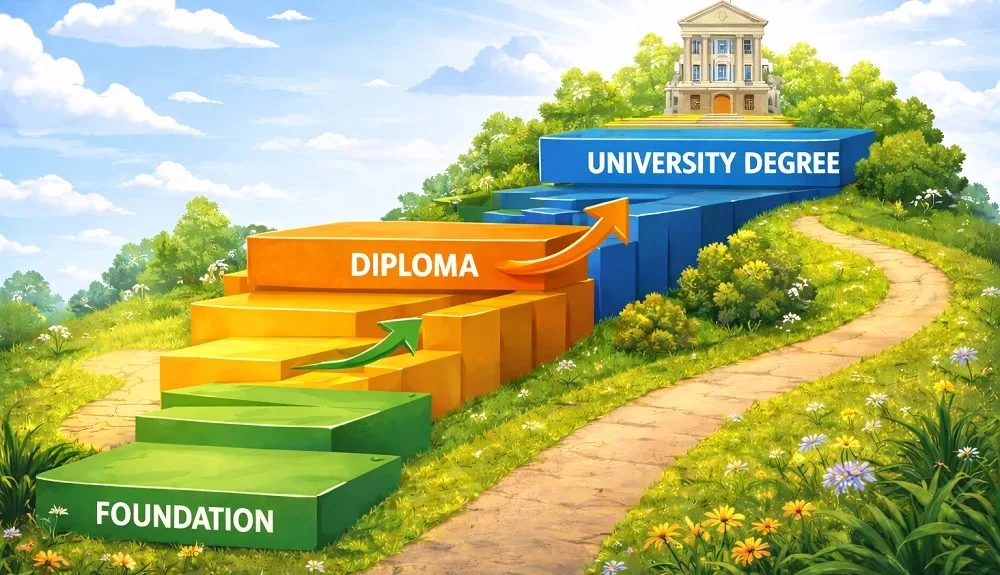
Australian universities offer alternative pathways that allow students to gradually progress into a bachelor’s program instead of starting directly.
Foundation programs are usually suitable for students who have completed Year 11 or whose academic results are slightly below the required level. These programs help build the academic and English skills needed to enter the first year of a bachelor’s degree.
Diploma programs, on the other hand, are equivalent to the first year of a university degree. This means that after completing a diploma, students can often enter directly into the second year of a bachelor’s program, depending on the university and course structure.
Pathway Options Overview
Pathway
Entry Level
Duration
Outcome
Foundation Program
Year 11 or lower scores
6–12 months
Entry into Year 1 of bachelor’s degree
Diploma Program
Year 12 (below required score)
8–12 months
Entry into Year 2 of bachelor’s degree
Important to understand: Foundation and diploma programs do not lead directly to a psychology qualification. They are designed to prepare you for entry into an APAC-accredited bachelor’s degree, after which the standard psychology pathway continues.
These pathways are a great option for students who need additional preparation, but it’s important to ensure that the final degree you progress into is APAC-accredited, especially if your goal is to become a psychologist.
At Aussizz Group, we regularly guide students on whether a pathway option is suitable for their profile and help them choose the right progression route to avoid delays in their academic journey.
Cost of Studying Psychology in Australia for International Students
The total expense includes tuition fees, living costs, and other essentials such as Overseas Student Health Cover (OSHC). While the exact amount varies depending on the university and city, the following estimates can give you a general idea.
It is important to note that psychology is not a short-term course. Since the full pathway can take 5–6 years, students should plan their finances for the entire duration of study, not just the first year.
This is also a key requirement for the Australian Student Visa (Subclass 500), where applicants must demonstrate sufficient financial capacity to support their stay in Australia.
At Aussizz Group, we assist students in understanding the overall cost, preparing financial documentation, and selecting the right OSHC plan—ensuring their visa application is well-prepared and compliant.
Scholarships for Psychology Students in Australia
Many international students explore scholarship options to reduce their overall study costs. While scholarships are available in Australia, it is important to understand that they are usually limited and competitive.
In most cases, scholarships provide partial fee reductions rather than full funding, particularly at the undergraduate level.
Students should plan their finances independently and consider scholarships as an added benefit rather than relying on them completely.
At Aussizz Group, we help students identify suitable scholarship opportunities based on their academic profile and guide them through the application process.
Career Outcomes After Studying Psychology in Australia
One of the most important questions students have is, “What can I do after studying psychology?”
The answer depends largely on how far you go in your studies.
If you complete only a bachelor’s degree, your career options will be limited to entry-level roles. These may include positions in human resources, community support, or research assistance. While these roles provide valuable experience, they do not allow you to work as a psychologist.
To become a registered psychologist, you must complete the full pathway, including postgraduate study or supervised training. Once you achieve registration, your career opportunities expand significantly. You can work across a variety of sectors, including healthcare, education, corporate organisations, and private practice.
Career Progression Overview
Qualification Level
Career Opportunities
Bachelor’s degree
HR Assistant, Support Worker, Research Assistant
Honours / 4th Year
Entry-level roles + pathway eligibility
Registered Psychologist
Clinical, community, education, private practice roles
Specialised Psychologist
Clinical psychologist, organisational psychologist, mental health specialist
In Australia, registered psychologists are in demand, particularly in mental health and community services. With experience, professionals in this field can earn between AUD 70,000 to 100,000 or more, depending on their area of specialisation.
Students should also understand that career outcomes depend not only on the qualification but also on factors such as experience, performance, and ongoing professional development.
At Aussizz Group, we guide students in choosing courses that align with their long-term career goals, ensuring they follow the right pathway from the beginning.
How to Become a Registered Psychologist in Australia?
Becoming a registered psychologist in Australia involves completing an approved and structured pathway rather than a single course.
To be eligible for registration, students must:
Complete an APAC-accredited sequence of study (minimum 4 years)
Undertake postgraduate study or supervised training (such as a master’s degree or internship pathway)
Meet English language requirements set for professional registration
Satisfy the registration standards set by the Psychology Board of Australia under the Australian Health Practitioner Regulation Agency (AHPRA)
Once all requirements are met, students can apply for general registration as a psychologist in Australia.
It is important to understand that registration is based on completing the correct accredited pathway. Choosing the right course from the beginning plays a critical role in ensuring you are eligible to apply later.
Student Visa and Genuine Student (GS) Considerations
While the application process may seem straightforward, one of the most important parts of the visa assessment is the Genuine Student (GS) requirement.
In simple terms, this means you need to clearly explain:
Why you have chosen this course
How it connects to your previous studies or experience
How it will help you in your future career
For psychology students, this becomes even more important because the pathway is long and structured. Visa officers often assess whether you understand the full journey—from your bachelor’s degree to postgraduate study—and whether your plan is realistic.
Another key requirement is financial capacity. You must demonstrate that you have sufficient funds to cover your tuition fees, living expenses, and other costs for your stay in Australia.
It is also important that your course choice makes sense for your profile. A well-aligned academic plan strengthens your visa application, while unclear or inconsistent choices can raise concerns.
At Aussizz Group, we assist students in preparing strong GS statements, organising financial documents, and ensuring that their entire application is clear, consistent, and aligned with visa requirements.
Final Advice: Plan Smart, Choose Right
Studying psychology in Australia can lead to a rewarding and respected career, but success in this field depends on making the right decisions from the beginning.
Understanding the pathway, choosing an accredited course, and planning your long-term journey are all essential steps. A small mistake at the start—such as selecting the wrong course—can lead to delays, additional costs, or limited career options later.
This is why it’s important to approach your study plans with clarity and proper guidance. With the right support, the process becomes much simpler and more structured.
At Aussizz Group, we work closely with international students to help them make informed decisions at every stage—from selecting the right course and university to preparing student visa applications and planning future pathways.
👉 If you’re considering studying psychology in Australia, connect with Aussizz Group today for personalised guidance and take the first step toward building your future with confidence.
Frequently Asked Questions (FAQs)
1. Can I become a psychologist in Australia with a 3-year degree?
No, a 3-year bachelor’s degree alone is not enough to become a registered psychologist in Australia. You must complete a minimum of 5–6 years of approved study, including a fourth year and postgraduate qualification or supervised training.
2. What is APAC accreditation and why is it important?
APAC (Australian Psychology Accreditation Council) accredits psychology programs in Australia. Only APAC-accredited courses are recognised for progressing toward psychologist registration. Choosing a non-accredited course can limit your career options.
3. How long does it take to become a psychologist in Australia?
On average, it takes 5 to 6 years to become a registered psychologist. This includes a bachelor’s degree, honours year, and postgraduate study or supervised training.
4. Can international students register as psychologists in Australia?
Yes, international students can become registered psychologists if they complete an APAC-accredited study pathway and meet all registration requirements set by the Psychology Board of Australia.
5. Is a Master of Counselling the same as a psychology degree?
No, a Master of Counselling is different and does not usually lead to psychologist registration. Students must follow an APAC-accredited psychology pathway to become a registered psychologist.
6. What IELTS score is required for psychology courses in Australia?
For undergraduate courses, IELTS is usually around 6.0–6.5. For postgraduate courses, it is typically 6.5–7.0, depending on the university.
7. Can I study psychology if I don’t meet direct entry requirements?
Yes, students can choose alternative pathways such as foundation or diploma programs. These help you progress into a bachelor’s degree, after which the standard psychology pathway continues.
8. Are scholarships available for psychology students in Australia?
Yes, scholarships such as Australia Awards, Destination Australia, and university merit scholarships are available. However, they are competitive and usually provide partial fee support.
9. Is psychology in demand in Australia?
Yes, there is growing demand for mental health professionals in Australia. However, career opportunities depend on completing the full pathway and obtaining registration.
10. Does studying psychology lead to PR in Australia?
Psychology-related occupations may appear on Australia’s skilled occupation lists, but PR outcomes depend on multiple factors such as qualification level, experience, and migration policies. Students should focus on the right study pathway first.

 AUS
Australia
AUS
Australia
 IND
India
IND
India
 UAE
UAE
UAE
UAE
 CA
Canada
CA
Canada
 SL
Srilanka
SL
Srilanka