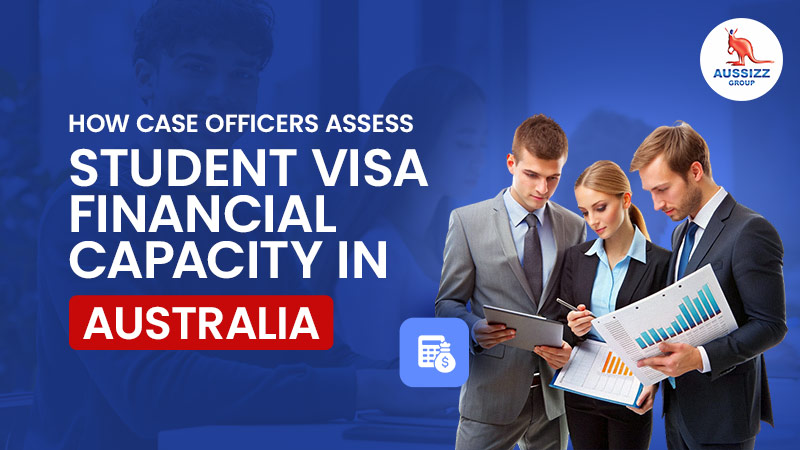
How Case Officers Assess Student Visa Financial Capacity in Australia?
Financial capacity is one of the most important parts of an Australian Student visa application. It is not only about showing a bank balance. A case officer may look at whether the money is enough, whether it is genuinely available, where it came from, whether the sponsor can realistically support the student, and whether the documents match the student’s study plan.
Many Student visa applicants think financial evidence is a simple upload task. They arrange a bank statement, attach it to ImmiAccount and assume the requirement is complete. In reality, the Department may look deeper. A strong application should not only show funds; it should explain the source, access and financial logic behind those funds.
The Department of Home Affairs states that if the document checklist requires financial capacity evidence, it must be attached with the visa application. If required evidence is not provided, the application may be refused without asking for more information. Even if the checklist does not ask for financial evidence at lodgement, the Department may still request it during processing.
Aussizz Group has helped 200,000+ applicants to their Australian Dreams, and for Student visa applicants, the key message is simple: do not treat financial capacity as just a bank balance. Treat it as a complete evidence story.
Case Officers First Check Whether the Required Amount is Covered
The first layer of assessment is whether the applicant has enough money for the visa. Home Affairs states that, at a minimum, Student visa applicants must have enough money for travel, up to 12 months of course fees, 12 months of living costs for themselves and accompanying family members, and school fees for any school-age children who accompany them.
Cost area
What the case officer may check
Travel costs
Whether the student and family members can travel to Australia
Course fees
First 12 months of fees, minus any amount already paid
Living costs
Minimum living amount for the student and family
School fees
Required where school-age children accompany the student
Whether the overall plan looks financially realistic
Already paid amounts
Receipts for tuition or deposits already paid
Under the current financial capacity instrument, the primary Student visa applicant’s annual living cost amount is AUD 29,710. For accompanying family members, the annual living cost amount is AUD 10,394 for a spouse or de facto partner and AUD 4,449 for a dependent child. Annual school costs for a school-age dependant are listed as AUD 13,502, unless a specific waiver situation applies.
These figures are minimum visa amounts. Home Affairs also warns that actual living costs vary across Australia and may be higher than the visa minimum. Students should research the cost of living in the area where they intend to study.
Financial Capacity is About Access, Not Just Ownership
A case officer may accept that money exists in a bank account but still question whether the student can actually use it for study and living costs in Australia. This is called genuine access to funds.
Home Affairs states that if an applicant is asked to give evidence of financial capacity, they must also prove they have access to the money. If someone else is providing funds, the applicant should provide evidence of the relationship, the person’s identity documents and evidence of any financial support previously given to the student or another Student visa holder.
This is where many applications become weak. A large balance in a relative’s account may not be enough if the relationship is unclear, the source is unexplained or there is no evidence that the student can genuinely access the money.
Sudden Large Deposits Need a Clear Source
Case officers often look at the history of funds, not only the closing balance. A one-day bank balance certificate may show that money was present on a specific date, but it does not explain how the funds were built.
Home Affairs specifically states that if applicants provide evidence of deposits of money, they should explain the source to show how the funds were accumulated. Supporting evidence can include recent bank transaction statements showing fund history and regular payments or growth patterns, such as salary income. Home Affairs also notes that a bank balance certificate across a single day does not show how the funds increased.
Fund pattern
How it may be viewed
Regular salary savings
Usually easier to explain
Fixed deposit from long-term savings
Strong if supported by source documents
Sudden large cash deposit
Needs clear source evidence
Money transferred from relative
Needs relationship and transfer explanation
Business income
Needs business operation and income proof
Sale of property or asset
Needs sale deed, receipt and bank trail
A sudden deposit is not automatically a refusal reason. The problem happens when the applicant cannot explain where the money came from and why it is genuinely available for study.
Annual Income Can be Used Instead of Showing Funds
Some applicants may rely on annual income evidence instead of showing the full funds amount. Home Affairs states that, as an alternative, applicants can provide evidence that their parents or partner had personal annual income of at least AUD 87,856 in the 12 months before applying. If family members are included, the required annual income is at least AUD 102,500.
This is important for students whose parents or partner have strong taxable income. However, Home Affairs states that income evidence should be official government documentation, such as tax assessments less than 12 months old, and that bank statements or direct evidence from an employer are not accepted for this annual income option.
Loans Must Look Real and Usable
Education loans can support a Student visa application, but the loan evidence should be clear. The loan should come from a financial institution or government source, and the terms should show that the money is available for tuition and living costs.
Home Affairs lists loans from a financial institution and government loans as acceptable forms of financial capacity evidence. It also states that the best evidence of genuine access to funds when relying on a loan is evidence of disbursement.
A loan approval letter may not always be enough if it is conditional, unclear or not yet accessible. The case officer may want to see that the loan can genuinely be used for the student’s study and stay in Australia.
Sponsor Credibility Matters in Student Visa Financial Assessment
Many Indian and South Asian students rely on parents, spouses or close family members for financial support. That can be acceptable, but the sponsor’s profile must be credible.
A sponsor with strong income, clear tax records and a close relationship is easier to understand than a distant relative with unexplained funds. The case officer may ask whether it is realistic for that person to pay tuition and living costs for the student.
Financial Capacity and Genuine Student Requirement Work Together
Financial capacity is separate from the Genuine Student requirement, but the two can connect. Home Affairs states that Student visa applicants must be genuine students and must show an understanding that studying in Australia is the primary reason for applying for the visa.
Financial concern
GS concern it may create
Unclear source of funds
May raise questions about the real study plan
Course cost does not match family income
May make study choice look unrealistic
Heavy dependence on work in Australia
May suggest study is not the primary purpose
Sponsor relationship is weak
May question whether support is genuine
Course change with weak finances
May raise overall credibility concerns
Home Affairs also states that students should not rely on work to support themselves or their family while in Australia. This is very important. Even though Student visa holders may usually work limited hours while their course is in session, expected part-time income should not be used as the main plan to pay tuition and living expenses.
Dependants Increase the Financial Requirement
If a student includes a spouse, de facto partner or child, the financial requirement increases. This is because the case officer must be satisfied that the whole family can live in Australia, not just the primary student.
Home Affairs states that all subsequent entrants, meaning family members who apply after the Student visa has been granted, must attach financial capacity evidence with their visa application. If they do not provide it, the application may be refused without asking for more information.
This is why couples and families should plan finances from the beginning. Adding family later does not remove the financial requirement.
Packaged Courses Can Affect the Financial Evidence Required
Many students apply for packaged courses, such as ELICOS plus diploma plus bachelor, or diploma plus master’s degree. Home Affairs states that for packaged courses, students must provide a CoE for each course, and the last course in the package is treated as the main course of study. The main course is used to work out what financial and English evidence must be provided.
Package example
Financial planning point
ELICOS + Diploma
Check main course and total cost sequence
Diploma + Bachelor
Main course may affect evidence level
Graduate Certificate + Master
Total fee planning should be realistic
Long package
Upfront and future tuition costs should be clear
Course gap
Gap rules and living cost planning matter
A case officer may look at whether the student can realistically complete the whole study plan, not only pay the first deposit.
Common Financial Capacity Mistakes That Can Create Refusal Risk
Many financial-capacity problems are avoidable. The issue is often not that the student has no money, but that the evidence does not explain the money properly.
Common mistake
Better approach
Uploading only a balance certificate
Provide transaction history and source of funds
Showing sudden deposits without explanation
Attach sale, income, loan or transfer evidence
Using a distant sponsor without proof
Provide relationship and support evidence
Relying on future part-time work
Show funds available before visa grant
Ignoring family costs
Include spouse, child and school costs
Providing income letters only
Use official government income documents where relying on annual income
Using unclear business funds
Provide business registration, tax and operation evidence
Waiting for a Department request
Upload required evidence at lodgement if checklist asks
The safest financial file should answer three questions clearly: Is there enough money? Is it genuinely available? Does the source make sense?
Final Advice Before Lodging Financial Documents
Student visa financial capacity is not just about meeting a number. Case officers may assess the amount, source, access, sponsor credibility, fund history, family costs and connection with the Genuine Student requirement.
Applicants should prepare evidence that shows the full story. If the money is from savings, show how it was saved. If it is from a parent, prove the relationship and income source. If it is from a loan, show the loan is approved and accessible. If it is from a business, show that the business is operating and the funds are genuine.
The minimum financial amounts are important, but applicants should also remember that real living costs in Australia can be higher than the visa minimum. A realistic budget can make the application stronger and help students avoid stress after arrival.
Aussizz Group can help students review financial capacity evidence, sponsor documents, course cost planning, Genuine Student responses and Student visa application strategy.
Aussizz Group has helped 200,000+ applicants to their Australian Dreams, and the right document planning can help students avoid financial-capacity mistakes that may delay or damage their visa application.
FAQs
Q1. How much money do I need for an Australian Student visa?
At a minimum, you need enough funds for travel, up to 12 months of course fees, 12 months of living costs for yourself and accompanying family members, and school fees for any school-age children. The primary student annual living cost amount is currently AUD 29,710.
Q2. What is genuine access to funds for a Student visa?
Genuine access means you can actually use the money for your study and stay in Australia. If someone else provides the funds, you should show your relationship, their identity, financial evidence and proof that the support is real.
Q3. Is a bank balance certificate enough for an Australian Student visa?
A one-day bank balance certificate may not be enough because it does not show how the funds were accumulated. Transaction history and source-of-funds evidence are usually stronger.
Q4. Can my parents sponsor my Student visa?
Yes. Parents can support a Student visa application, but you should provide relationship proof, identity documents and evidence of their income, savings or financial capacity.
Q5. Can I use an education loan for my Student visa?
Yes. A government loan or loan from a financial institution can be used as evidence. Strong evidence may include approval, terms and disbursement details.
Q6. Can I rely on part-time work in Australia to show financial capacity?
No. Home Affairs states that students should not rely on work to support themselves or their family while in Australia.
Q7. What is the annual income option for Student visa financial capacity?
Instead of showing funds, applicants may provide official government evidence that their parents or partner had personal annual income of at least AUD 87,856 in the 12 months before applying. If family members are included, the amount is AUD 102,500.
Q8. Do subsequent entrants need financial evidence?
Yes. Family members who apply later as subsequent entrants must attach evidence of financial capacity with their visa application.
Q9. Why do sudden deposits create issues in Student visa applications?
Sudden deposits can raise questions if the source is unclear. You should explain where the money came from and provide evidence such as salary savings, sale documents, loan records or transfer proof.
Q10. Can Aussizz Group help with Student visa financial documents?
Yes. Aussizz Group can help review financial capacity evidence, sponsor documents, source-of-funds explanation, course cost planning and Student visa application strategy.

 AUS
Australia
AUS
Australia
 IND
India
IND
India
 UAE
UAE
UAE
UAE
 CA
Canada
CA
Canada
 SL
Srilanka
SL
Srilanka
 HK
Hong Kong
HK
Hong Kong