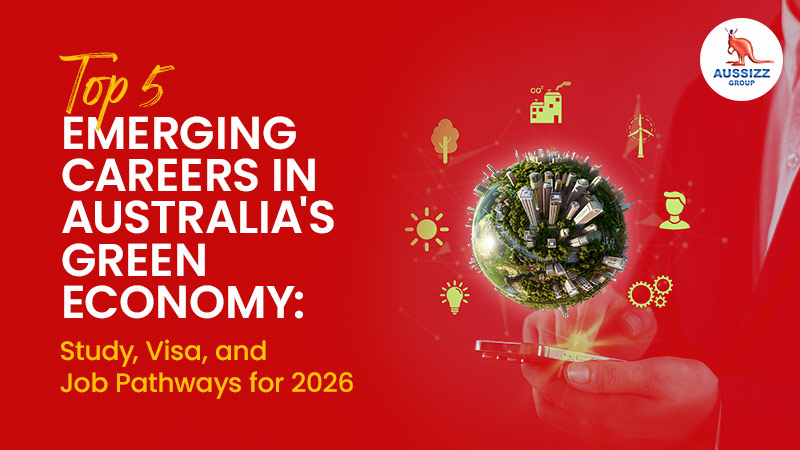
Top 5 Emerging Careers in Australia’s Green Economy: Study, Visa, and Job Pathways for 2026
As Australia accelerates toward its net-zero emissions target by 2050, the green economy is booming, creating thousands of new roles in renewable energy, sustainability, and environmental management.
With renewable energy generation already at nearly 40% of the national grid and investments pouring into hydrogen, battery storage, and biodiversity projects, 2026 promises even more opportunities. The sector could add up to 28,000 jobs by 2030 alone, driven by federal incentives and state-level initiatives like the Nature Repair Market.
For international students and skilled migrants, this means accessible study programs, streamlined visa pathways via the Core Skills Occupation List (CSOL), and strong PR routes-especially in regional areas where many green jobs are concentrated.
This guide spotlights the top five emerging careers, selected for their projected growth, alignment with Australia’s 2025-2026 migration priorities, and inclusion on the CSOL (which covers 456 in-demand occupations, emphasizing green tech and engineering).
Each includes the relevant ANZSCO code
(Australia’s standard occupation classification, transitioning to OSCA in late 2025 but still key for assessments), top study courses, job prospects, and migration strategies. Salaries are averages from recent data, varying by experience and location.
1. Renewable Energy Engineer
ANZSCO Code: 233312 – Designs, develops, and oversees renewable energy systems like solar farms, wind turbines, and hydrogen plants. Skill Level 1 (Bachelor’s degree required).
Study Pathways for 2026: Enroll in engineering-focused programs emphasizing renewables. Top options include:
Master of Renewable and Future Energy at University of Western Australia (UWA): Covers microgrids, smart tech, and storage; 1-2 years full-time, fees ~AUD 45,000/year. Industry placements with partners like Clean Energy Council.
Bachelor of Engineering (Renewable Energy) at RMIT University: Hands-on solar/wind projects; 4 years, ~AUD 40,000/year, with PR-aligned accreditation from Engineers Australia. Intakes: February/July 2026; scholarships for international students via Destination Australia for regional study.
Job Prospects: High demand in Queensland and Western Australia’s hydrogen hubs; roles at firms like Worley or Gentari. Entry-level: AUD 85,000–100,000; mid-career: AUD 120,000+. Projected 15% growth by 2026, with 5,000+ openings in solar/wind projects.
Visa and Migration Pathways: On CSOL for Skills in Demand (SID) visa (Subclass 482)-up to 4 years, pathway to Employer Nomination Scheme (ENS, Subclass 186) PR after 2-3 years. Post-study: Temporary Graduate Visa (Subclass 485) for 2-4 years work rights. Regional focus? Add 15 points for Subclass 491 (provisional, leads to PR). Skills assessment via Engineers Australia; English via IELTS/PTE.
2. Sustainability Manager
ANZSCO Code: 139999 – Manages organizational sustainability strategies, including carbon auditing and ESG reporting. Skill Level 1.
Study Pathways for 2026: Interdisciplinary courses blending business and environment. Highlights:
Graduate Diploma in Sustainable Energy at University of Queensland (UQ): Focuses on policy, tech, and supply chains; 1 year, ~AUD 48,000, with flexible online options.
Bachelor of Environmental Science (Sustainability) at Curtin University: Includes carbon literacy modules; 3 years, ~AUD 38,000/year, with Planet Positive certification for green skills. Intakes: February/November 2026; free Green Skills Passport micro-credential for upskilling.
Job Prospects: Fastest-growing green role, up 24% since 2016; positions at consultancies like PwC or Cleanaway. Average salary: AUD 110,000–140,000, with bonuses for project leads in net-zero transitions. Over 1,000 openings on LinkedIn/SEEK in 2025, expanding to urban/regional firms.
Visa and Migration Pathways: CSOL-eligible for SID visa; transition to Subclass 190 (state-nominated PR) with 5-15 extra points for green priorities in states like NSW/VIC. Post-grad: Subclass 485 for networking; skills assessment via VETASSESS. Target regional nominations for faster processing (under 6 months).
3. Environmental Engineer
ANZSCO Code: 233915 – Develops solutions for pollution control, waste management, and climate adaptation. Skill Level 1.
Study Pathways for 2026: Engineering with environmental focus. Recommended:
Master of Engineering (Environmental) at UNSW: Covers renewables and risk assessment; 2 years, ~AUD 50,000/year, with industry projects.
Bachelor of Science (Environmental Engineering) at University of Melbourne: Integrates circular economy; 3 years, ~AUD 42,000/year.Intakes: March/August 2026; scholarships for sustainability-focused research.
Job Prospects: Key for Australia’s green transition; roles in government agencies and consultancies. Salary: AUD 90,000–130,000; 10% annual growth in demand for biodiversity projects. 500+ jobs listed on EnvironmentalJobs.com.au in 2025.
Visa and Migration Pathways: On CSOL; SID visa for entry, pathway to Subclass 189 (points-tested independent PR, 65+ points needed). Subclass 485 post-study; Engineers Australia assessment. Regional incentives via Subclass 491 add 15 points and faster invites.
4. Solar PV Installer/Technician
ANZSCO Code: 342411 – Installs and maintains solar photovoltaic systems; requires Clean Energy Council accreditation. Skill Level 3 (Diploma/Certificate III).
Study Pathways for 2026: Vocational training for hands-on roles. Top picks:
Certificate III in Electrotechnology (Solar Installation) at TAFE NSW: 1 year, ~AUD 15,000, with CEC certification pathway.
Diploma of Renewable Energy Engineering at Holmesglen Institute: Covers PV and battery systems; 1-2 years, ~AUD 18,000/year.Intakes: Multiple in 2026; apprenticeships available for work-study combo.
Job Prospects: Booming with solar boom; entry roles at RESINC or local installers. Salary: AUD 70,000–95,000 (plus overtime); 20% growth projected. Regional focus (e.g., NT/SA) for family-friendly setups.
Visa and Migration Pathways: CSOL for SID visa (short-term stream); pathway to Subclass 494 (regional employer-sponsored, PR after 3 years). Subclass 485 for graduates; TRA skills assessment. Employer sponsorship common due to shortages.
5. Biodiversity Project Manager
ANZSCO Code: 234399 – Manages conservation projects under Nature Repair Market, including credit verification. Skill Level 1.
Study Pathways for 2026: Ecology and policy blend. Essentials:
Bachelor of Environmental Science (Conservation) at University of Tasmania: Fieldwork in biodiversity hotspots; 3 years, ~AUD 35,000/year.
Master of Biodiversity Conservation at Australian National University (ANU): Policy and market focus; 2 years, ~AUD 47,000/year.Intakes: February 2026; SIT Study Abroad for immersive sustainability terms.
Job Prospects: Emerging with 2025 Nature Repair Act; roles at Bush Heritage or consultancies. Salary: AUD 95,000–125,000; 25% growth in conservation finance. 300+ listings on NRMjobs in 2025.
Visa and Migration Pathways: CSOL-eligible; Subclass 482 to Subclass 186 PR. Subclass 485 post-study; VETASSESS assessment. State nominations (e.g., TAS/NT) for Subclass 190/491.
Career
ANZSCO
Avg. Salary (AUD)
Key Visa Pathway
Top Study Duration/Cost
Renewable Energy Engineer
233312
85k–120k
SID to ENS (186)
1-2 yrs / 40k–50k
Sustainability Manager
139999
110k–140k
SID to 190
1 yr / 38k–48k
Environmental Engineer
233915
90k–130k
485 to 189
2-3 yrs / 42k–50k
Solar PV Installer
342411
70k–95k
SID to 494
1 yr / 15k–18k
Biodiversity Project Manager
234399
95k–125k
482 to 186
2-3 yrs / 35k–47k
Frequently Asked Questions (FAQs)
Q1. Are all these green jobs really on the current Core Skills Occupation List (CSOL)?
Yes – as of the latest CSOL released in December 2024 and effective throughout 2026:
Renewable Energy Engineer (233312) → Confirmed on CSOL
Environmental Engineer (233915) → Confirmed on CSOL
Sustainability Specialists (139999 or 139912 in some cases) → Confirmed on CSOL
Electricians with solar specialisation & Solar PV Installers (via 342111/342411 pathways) → Covered under CSOL trades stream
Environmental Scientists & Biodiversity roles (234312/234399) → Confirmed on CSOL This means they qualify for the Skills in Demand (SID) visa (Subclass 482) and fast-tracked employer sponsorship pathways.
Q2. I only have a diploma/certificate – can I still get PR in the green sector?
Absolutely. Trades like Solar PV Installer/Electrician (ANZSCO 342411/341111) and Battery Storage Technicians are Skill Level 3 and sit on CSOL. You can enter via:
Subclass 482 (SID visa) → Subclass 494 (regional) → Subclass 191 PR after 3 years, or
Direct Subclass 190/491 state nomination if the state (e.g., SA, TAS, NT) is sponsoring green trades in 2026.
Q3. Which Australian states give extra points or priority for green jobs in 2026?
South Australia: +15 points for renewable energy & hydrogen roles
Western Australia: Fast-track for Pilbara & Kwinana hydrogen hub jobs
Tasmania: Priority processing for all environmental & conservation roles
Northern Territory: Almost automatic nomination for solar & sustainability roles under the Territory’s “Green List”
NSW & Victoria: Extra points for roles linked to their 2035 net-zero plans
Q4. Can I study a short course and still get the 485 Post-Study Work visa?
A Master by coursework (even 1 year) in renewable energy/environmental fields Examples: Master of Renewable Energy (UWA), Graduate Diploma in Sustainable Energy (UQ), or packaged Bachelor + Master programs.
Q5. Is English requirement lower for green jobs?
No change – still IELTS 6.0–7.0 (or equivalent) depending on visa stream. However, many regional states waive the “superior English” requirement and give extra points if you study/work regionally.
Ready to go green Down Under? These careers align with Australia’s 2025-2026 migration cap of 185,000 places, prioritizing skills shortages. Start with a skills assessment and EOI in SkillSelect.

 AUS
Australia
AUS
Australia
 IND
India
IND
India
 UAE
UAE
UAE
UAE
 CA
Canada
CA
Canada
 SL
Srilanka
SL
Srilanka
 HK
Hong Kong
HK
Hong Kong